
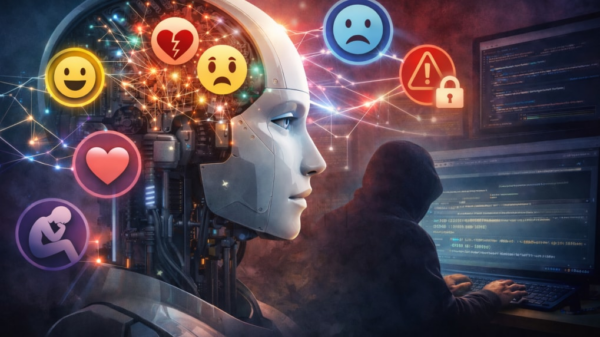








































As organizations rapidly adopt artificial intelligence (AI) to enhance efficiency, the cyber security landscape is undergoing a transformative shift. This evolution sees the emergence of AI-powered cyber threats, marking a new era where AI fights AI. In India, the challenge is particularly pronounced, with prevalent phishing scams and AI-generated deepfakes foreshadowing a future in which autonomous AI threat actors execute sophisticated attacks with minimal human intervention.
In September 2025, findings from Check Point Research revealed that one in every 54 generative AI (GenAI) prompts from enterprise networks posed a high risk of sensitive data exposure, impacting 91 percent of organizations utilizing AI tools regularly. These statistics underscore that while AI enhances productivity, it simultaneously rewrites the cyber risk landscape that both enterprises and individuals must urgently address.
The integration of AI and GenAI into business operations is not just enhancing productivity; it is also reshaping the tactics employed by cybercriminals. Attackers are increasingly leveraging AI to launch more sophisticated campaigns, moving beyond traditional methods. The emergence of four critical threat vectors highlights the pressing security concerns organizations will face in the evolving AI ecosystem.
First, cybercriminals are innovating with autonomous AI attacks, where machine agents independently plan, coordinate, and execute multi-stage campaigns. These systems share intelligence and adapt in real-time, creating self-learning botnets that operate without human oversight. Recent prototypes like ReaperAI exemplify how these autonomous systems can seamlessly chain reconnaissance, exploitation, and data exfiltration, posing significant challenges for security operations centers (SOCs).
Second, the rise of adaptive malware fabrication through AI-generated tools has revolutionized how malicious code is created. Advertised on underground forums, these “AI malware generators” can automatically write, test, and debug code, using feedback loops to learn which variants successfully evade detection. This evolution is causing attackers to create unique, functional malware variants in mere seconds, significantly increasing the threat level.
Third, synthetic insider threats are emerging, powered by AI impersonation and social engineering. These threats utilize stolen data to create AI-generated personas that convincingly mimic legitimate users. Such impersonations can lead to sophisticated social-engineering attacks, where these AI agents send authentic-looking emails or join video calls to deceive employees, making digital trust verification increasingly complex.
Finally, the AI supply chain has introduced significant risks with model poisoning attacks. Research has demonstrated that altering a minuscule percentage of a model’s training data can lead to critical misclassifications, potentially compromising security systems that rely on accurate data interpretation.
Unlike traditional threats, AI-driven cyberattacks offer unprecedented speed, autonomy, and scalability. They continuously learn and adapt, with each failed attempt serving as training data for future exploits. Check Point Research recently observed the rapid weaponization of tools like the Hexstrike-AI framework, which was adapted to exploit vulnerabilities in Citrix NetScaler within hours.
These AI attacks also operate with remarkable precision, leveraging generative AI to create tailored phishing schemes and indistinguishable deepfakes that can sidestep human and automated detection. The removal of identifiable “human fingerprints” further complicates attribution and detection efforts.
Moreover, the democratization of cybercrime is evident as AI-driven tools lower barriers for less-skilled attackers, expanding the threat landscape significantly. By 2030, it is anticipated that ransomware and data theft will be executed largely by autonomous AI systems capable of operating 24/7 without human oversight.
In response to these evolving threats, organizations must not retreat from leveraging AI tools. Instead, they must adopt a proactive stance to mitigate risk and enhance resilience. Key strategies include selecting security-aware AI platforms, implementing zero trust principles, securing supply chains, and automating security throughout the development lifecycle. Furthermore, organizations must govern AI use across the enterprise to prevent data leaks, as research has shown that a significant percentage of AI prompts can inadvertently expose sensitive information.
As the arms race in AI intensifies, organizations face a critical moment. The rapid evolution of GenAI and the associated data leakage illustrate how quickly risk factors can change. The future will require a shift in how security measures are implemented, moving towards AI-powered, cloud-delivered platforms capable of predicting and pre-empting attacks. By integrating predictive analytics, behavioral intelligence, and autonomous remediation, organizations can better safeguard their digital futures against the sophisticated threats posed by AI.
See also Stellar Cyber and Cato Networks Integrate AI-Driven SecOps with SASE for Enhanced Security
 Anthropic Reveals AI Agents Exploit Smart Contract Vulnerabilities, Simulate $4.6M Theft
 Lumen Technologies Expands APAC Cybersecurity with Palo Alto Networks’ Cortex XSIAM Specialization
 Ireland’s Cybersecurity Report Reveals AI Infrastructure Vulnerabilities, Urges National Action
 eNOugh Raises $2.7M to Launch AI-Powered Wearable Safety Device eNO Badge