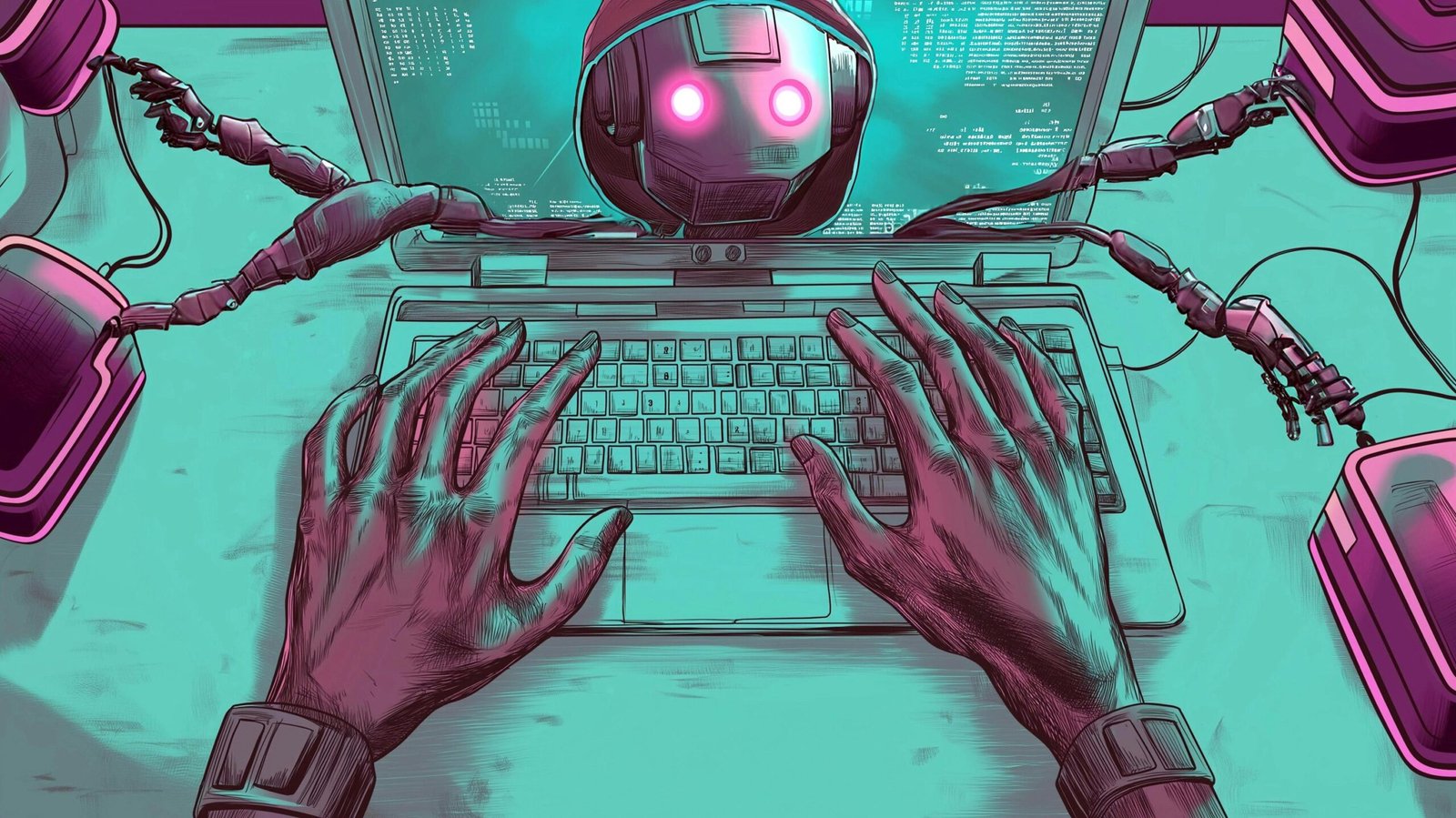
As businesses increasingly integrate artificial intelligence tools to enhance efficiency, a troubling trend has emerged: the same technology designed to strengthen operations is simultaneously reshaping the cyber threat landscape. Criminals are leveraging the rapid deployment and persuasive capabilities of AI to refine traditional attacks, quietly infiltrating organizations that have become reliant on automated decision-making.
Cybersecurity experts have long warned of the potential for AI to enable advanced, almost cinematic cyberattacks. However, the reality confronting businesses today is less dramatic but far more widespread. Rather than deploying autonomous systems to breach networks, hackers are utilizing AI to sharpen familiar tactics such as phishing, social engineering, and data manipulation.
Across various sectors, attackers are employing AI tools to craft highly convincing emails, impersonate trusted colleagues, and extract sensitive information within seconds. Security professionals report that these incremental yet impactful enhancements are eroding traditional defenses. As organizations implement their own AI-driven solutions to identify anomalies, they are discovering that the same technology fuels a growing contest between attackers and defenders—an escalating “AI arms race,” as some analysts have described it.
One significant risk is emerging not from new innovations, but from the AI systems already embedded in workplaces. Should attackers gain access to an AI model that employees rely upon—especially one trained on internal data—they could gradually introduce false or misleading information. Security researchers caution that such tampering could sway decisions, disrupt financial processes, or subtly encourage employees to disclose classified data.
This threat is often overlooked within organizations that rapidly adopted AI tools without establishing clear usage policies. Many employees unknowingly upload protected documents or sensitive spreadsheets into public or unvetted AI models, opening new avenues for threat actors. As one consultant noted, companies are realizing that “AI security begins long before an attack occurs, often with the question of what staff choose to share with a model.”
As AI becomes increasingly embedded in daily workflows, businesses are compelled to define rules that were previously assumed rather than explicitly managed. Many organizations lack guidelines on the types of documents that should never be processed through AI tools, or controls specifying which models employees are allowed to utilize. Experts argue that this absence of frameworks facilitates unnoticed exposure.
Concurrently, the responsibility for safeguarding AI systems is extending beyond traditional IT departments. Business leaders now face critical decisions regarding data classification, the encryption of systems, and which employees should access AI-powered tools. This shift reflects a growing acknowledgment that AI does not merely supplement business operations; it increasingly influences them, creating risks that are both organizational and technical.
Although technologies such as deepfakes and other advanced manipulations have captured public attention, the majority of AI-enabled attacks today are more pragmatic. Generative tools are enhancing grammar and style in phishing emails, empowering criminals to mimic vendors, recruiters, or executives with remarkable accuracy. Other systems diligently scour leaked datasets on the dark web, extracting valuable information in seconds—tasks that previously required extensive human effort.
Legitimate enterprises, in turn, are adopting AI at an unprecedented pace to streamline workflows and cut costs. However, this newfound efficiency has led to dependencies that many organizations have yet to fully evaluate. As businesses automate processes and centralize decision-making in AI systems, they inadvertently create structures that, if compromised, could be exploited on a large scale by attackers.
A recent report from the World Economic Forum found that two-thirds of businesses now view AI and machine learning as their most significant cybersecurity vulnerability as they approach 2025. As both criminals and defenders increasingly leverage AI, the risks associated with these technologies are becoming less visible and more intertwined with routine operations.
See also Kaspersky Leverages 20 Years of AI Innovation to Transform Cybersecurity Landscape
 Israel Faces 2,000 Weekly Cyberattacks as AI Tools Reveal Hidden Vulnerabilities
 Global Cyber Attacks Surge 3% Amid Rising AI Data Leak Risks, Check Point Reports
 AI Analytics Revolutionizes Real-Time Threat Detection for Enhanced Security Operations
 BitsLab Launches AI-Agent Security Stack, Protecting $160B in On-Chain Value for 716M Users