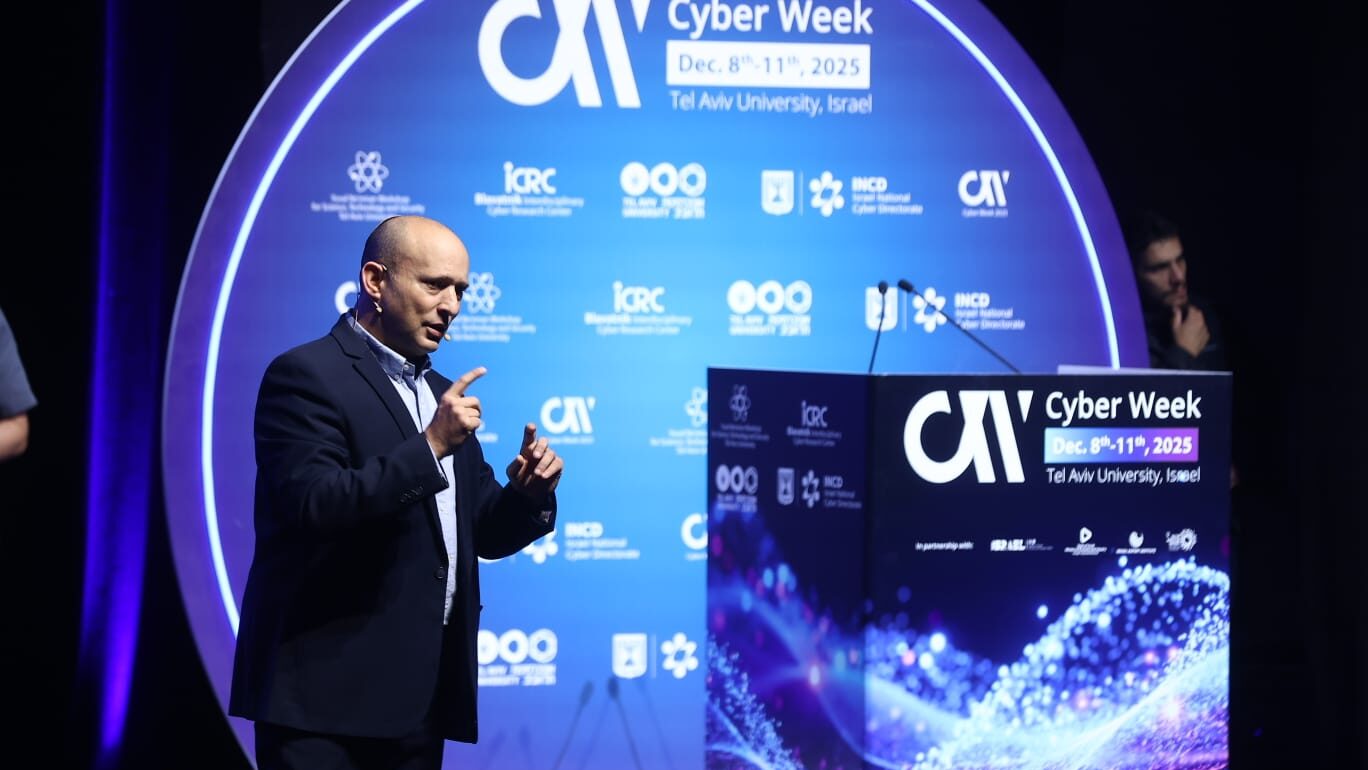
Cyber Week commenced in Tel Aviv on Tuesday, with former Prime Minister Naftali Bennett advocating for the establishment of a national “Data Dome” to counter emerging threats stemming from the convergence of cyber technology and artificial intelligence. Addressing the conference’s main plenary at Tel Aviv University, Bennett underscored the urgency for Israel to act swiftly, warning that adversaries are already leveraging AI-driven tools to exploit vulnerabilities.
Bennett characterized Israel as a nation that frequently pioneers solutions to challenges that eventually gain traction worldwide. “Sometimes I feel like the State of Israel is an experiment. I’m a man of faith, so maybe a ‘Divine Experiment’ of seeing how you take a nation, place it in the toughest circumstances possible, and see how it deals with the mess,” he remarked, referencing innovations like the Iron Dome and Iron Beam that have transcended national borders.
In his address, he outlined three critical dimensions of the evolving threat landscape exacerbated by autonomous AI systems. “The ability to scale cyber attacks using AI is basically unlimited,” he stated, drawing a comparison between earlier forms of hacking and today’s sophisticated assaults. He argued that contemporary attacks increasingly resemble coordinated networks of intelligent agents deployed en masse, likening them to operations “behind enemy lines.” Furthermore, he noted that the anonymity afforded by synthetic data and rapidly generated code complicates efforts to trace these digital aggressors.
Bennett highlighted the tangible consequences these capabilities have on civilian infrastructures, pointing to incidents such as the paralysis of a hospital and the risk of financial data corruption, with citizens potentially waking to find their savings erased. He expressed particular concern about the growing dependency on AI, describing the potential poisoning of models and sensor inputs as “basically corrupting the brain.”
He also asserted that large portions of online discourse are artificially generated, claiming, “In some cases, I see 80–90% of discourse is fake,” and emphasized that AI-generated personas can manipulate public sentiment on a large scale.
Despite acknowledging that Israel is “a bit behind the curve” due to recent domestic turmoil, Bennett expressed confidence in the nation’s talent and urgency, particularly as thousands of veterans return from military service to bolster the tech sector. He stressed the need for Israel to take the lead in developing systems designed to protect national infrastructure, safeguard AI integrity, and counter manipulation efforts. “Beyond Iron Dome, we need to develop the Data Dome,” he stated, noting that such a system should ultimately be shared with international allies.
In closing, Bennett urged for political unity, asserting that Israel could significantly rebuild its strategic edge if it refocused on national priorities. “We can catch up bigtime,” he affirmed, underscoring a vision for a resilient and technologically advanced Israel able to face the challenges of an increasingly complex global threat landscape.
See also Darktrace Federal and Navitas Win $10M State Department Contract for AI Cybersecurity Solution
 AI Tools Enhance Cyberattacks: 67% of Companies Cite AI as Major Security Risk
 Kaspersky Leverages 20 Years of AI Innovation to Transform Cybersecurity Landscape
 Israel Faces 2,000 Weekly Cyberattacks as AI Tools Reveal Hidden Vulnerabilities
 Global Cyber Attacks Surge 3% Amid Rising AI Data Leak Risks, Check Point Reports