A multigenerational messaging platform, a technology giant, and a multinational financial services company share a common challenge: they have all faced cyber attacks. This reality raises an urgent question for organizations across various sectors: Is complacency an option? In a landscape where even the most reputable entities are vulnerable, the need for robust cybersecurity measures is more pressing than ever.
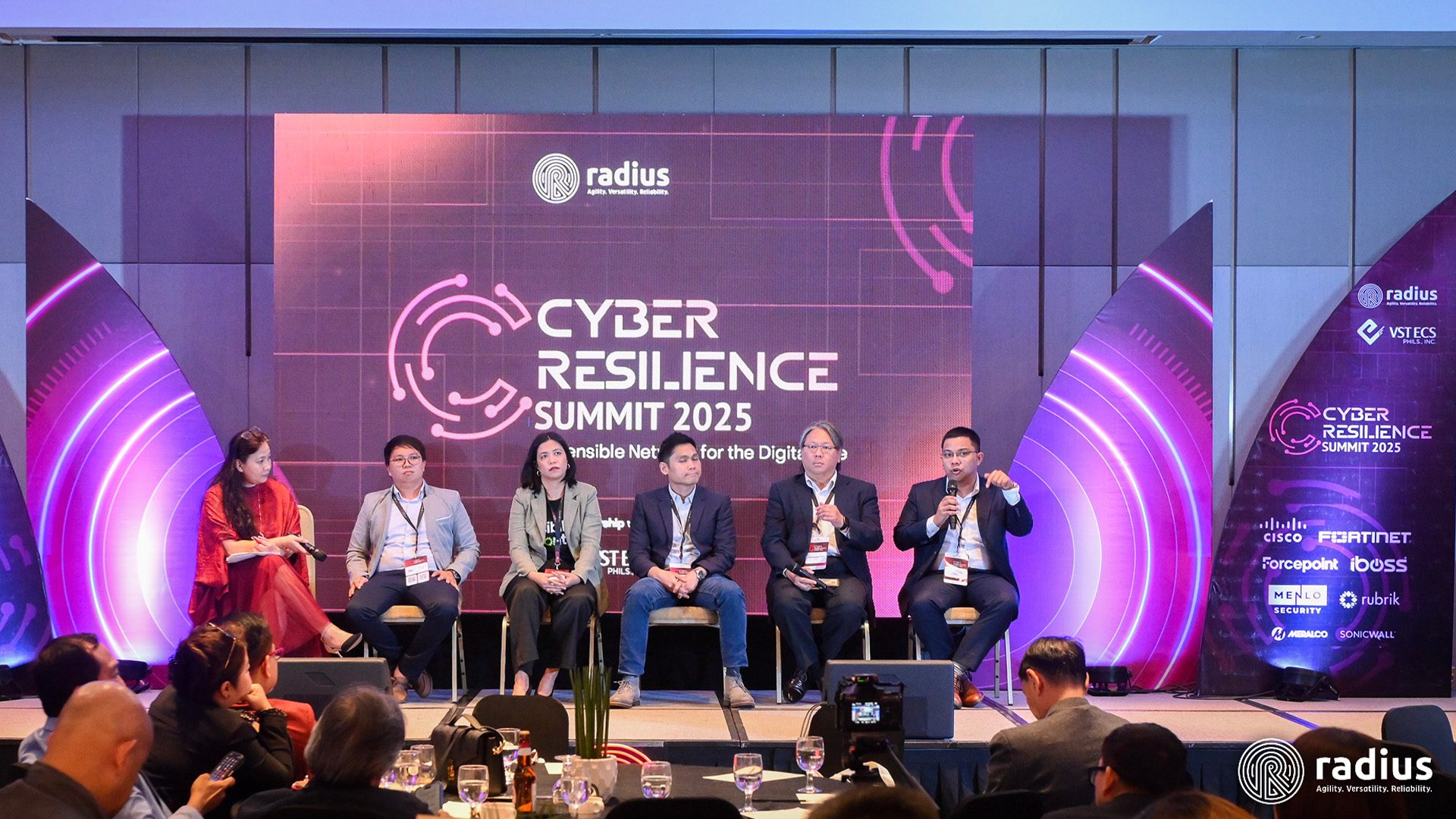
At the first-ever Cyber Resilience Summit held by Radius Telecoms, Inc., alongside VST ECS Phils., Inc. on November 18, industry leaders gathered to explore strategies for achieving cyber resilience. Executives from sectors including data management, cybersecurity, and technology shared insights on how to not only recover from cyber incidents but also prevent them effectively by adapting to an ever-evolving digital environment.
“Every connection we make, every device we deploy, every service we deliver depends on the integrity, visibility, and security of our networks,” stated Alfredo Solis, Jr., Vice President and COO of Radius. He emphasized the importance of meaningful connections in challenging existing perspectives on cybersecurity. Arlene Singzon, General Manager for Strategic Business at VST ECS, echoed this sentiment, highlighting that true cyber resilience extends beyond mere prevention to encompass adaptation and innovation.
Industry experts underscored several critical issues affecting organizations today, with the lack of visibility into data being a major concern. Cyril Villanueva, Security Consultant at Forcepoint, noted, “People and data – they are moving. They could be across different cloud platforms and across devices. One of the big concerns is the lack of visibility.” He pointed out that unclassified data, often existing in emails or abandoned servers, poses significant risks. “We cannot protect what we cannot see,” he warned, stressing that attackers are adept at exploiting these blind spots.
In addressing the complexities of modern work environments, Ryan Shane Dagdag, Sales Engineer of Asia-Pacific at iboss, discussed the need for security solutions that are user-centric and location-agnostic. He advocated for the Zero Trust SASE Platform, which replaces traditional security stacks with a unified system that minimizes risk exposure. “We can simplify and consolidate, which reduces the risk of exposure,” he said.
The importance of continuous security was also highlighted by Jon Louis Fernandez, Systems Engineer at Fortinet. He raised concerns about the challenges faced when employees work remotely, stating, “Once the employee heads out of the office, how can they be protected?” He emphasized the Fortinet SASE solution’s capability to maintain standardized security policies across various environments, reinforcing that security must follow users wherever they go.
While many organizations rely on backups for data recovery, Chee Wai Yeong, Area Vice President at Rubrik, cautioned that backups alone do not guarantee resilience. He explained that in the event of a cyber attack, the latest backup may be compromised. “The first crucial step to achieving cyber recovery is determining the scope of the attack,” Yeong advised, stressing the need for a methodical approach to recovery.
Addressing the evolving threat landscape, Brian Cotaz, a cybersecurity specialist from Cisco, pointed out that threat actors are increasingly utilizing artificial intelligence to enhance their attacks. “They are not using AI to develop new attacks but to bolster existing ones,” he noted. However, he acknowledged that AI can also be a powerful tool for incident analysis and threat management.
As organizations grapple with these challenges, Ginnwann Teo, Senior Technical Director at Menlo Security, pointed out the pressing need for more effective cybersecurity measures. He cited a recent exercise revealing that 17 percent of employees clicked on phishing links, underscoring the importance of building resilient organizations. He introduced Menlo’s Positive Selection Technology, which protects systems by disarming potentially harmful files upon arrival.
The discussions at the summit highlighted that achieving cyber resilience requires a comprehensive understanding of the rapidly changing digital landscape. Meralco Vice President and Chief Information Security Officer Marilene Tayag emphasized the importance of acknowledging overlooked risks in hybrid and multicloud environments. Meanwhile, Exequiel Delgado, President and CEO of Radius, reminded attendees of the need for highly available enterprise networks to prevent productivity loss in case of outages.
“Cyber resilience is not just about defense,” Delgado concluded. “It’s about empowering our employees while ensuring the safety of our networks. Protecting businesses is essential for remaining relevant and progressive in today’s data-driven world.” The summit served as a pivotal moment for organizations to rethink their cybersecurity strategies, emphasizing that resilience is a continuous process requiring commitment and adaptability in the face of evolving threats.
See also SentinelOne Forecasts Weak Q4 Revenue of $271M, CFO Barbara Larson to Depart
 HP Predicts 2026 Surge in AI-Driven Cyber Threats and Rise in Cookie Theft
 Jeffs’ Brands Stock Falls 8.44% Despite $1M AI Threat Detection Deal with Scanary
 Rubrik Stock Soars 25% After 48% Revenue Growth and AI Security Focus
 Cohesity Announces $1 Billion Investment in India to Enhance AI and Cybersecurity Capabilities