




















































New Delhi
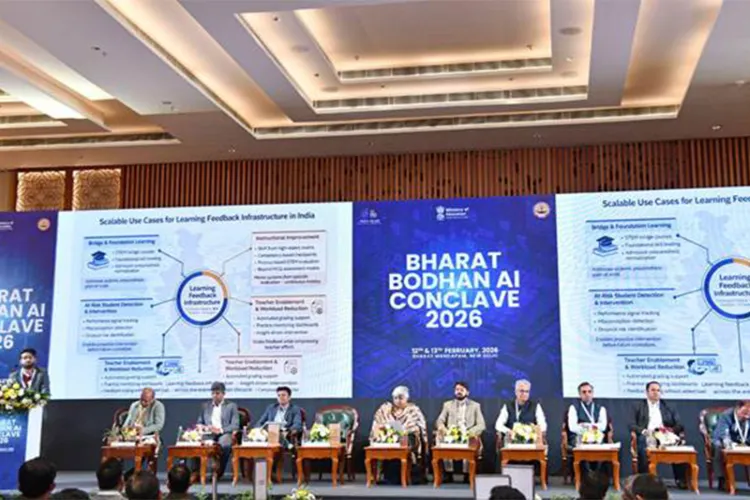
The Bharat Bodhan AI Conclave 2026, organised by the Ministry of Education, concluded in New Delhi reaffirming a collective commitment to a responsible AI-driven transformation of India’s education ecosystem.
On the second day, two separate sessions were held, the first focusing on governance platforms and scalable AI systems. Moderated by Prof. Manindra Aggarwal, Director of IIT Kanpur, the session highlighted a significant shift among states from monitoring to intervention-based governance using AI-enabled platforms. Dashboards are now enabling real-time decision-making, while integrated student-teacher-school systems are replacing fragmented tools. The discussion reinforced that scaling AI requires statewide ecosystem platforms rather than standalone solutions.
The second session addressed the theme of multilingual AI, teacher empowerment, and practice-led learning, moderated by Prof. Manoj Kumar Tiwari, Director of IIM Mumbai. The session underscored the necessity of multilingual AI for equitable national adoption. Speakers pointed out that AI should enhance teacher agency and support contextual pedagogy instead of enforcing uniform digital templates. Frameworks based on practice-led learning have shown to improve learner engagement, and several states showcased advanced models that integrate AI for teacher support, student learning, and governance.
Throughout the discussions, three key conclusions emerged: India already possesses robust AI-in-education solutions that need scaling to reach every learner; supporting teachers is the most crucial leverage point for enhancing learning outcomes; and the next phase requires a national orchestration platform.
Following these sessions, a debriefing took place with participation from Sanjay Kumar, Secretary of School Education & Literacy, Vineet Joshi, Secretary of Higher Education, and Prof. V. Kamakoti, Director of IIT Madras, alongside academic leaders, researchers, and tech founders. The moderators from earlier sessions presented key takeaways and outcomes derived from their discussions.
Sanjay Kumar remarked that the past two and a half days of deliberations were highly encouraging, showcasing remarkable efforts across the country to integrate AI into education. He emphasized that AI provides a unique opportunity to combine scale with personalization through adaptive learning interventions tailored to individual needs. Kumar highlighted that equitable access is fundamental, and such innovations could significantly enhance learning outcomes, aid inclusion, and empower both teachers and learners.
He also stressed the importance of developing collaborative platforms to share and scale best practices nationally, alongside sustained investment in research and development and in creating strong institutional ecosystems. Promoting joyful and meaningful education in students’ mother tongues, while advancing initiatives like a sovereign Large Language Model, would further bolster India’s linguistic diversity and technological self-reliance.
Prof. Kamakoti echoed these sentiments, stating that while India has robust AI solutions, the focus must remain on scale, coordination, and interoperability. He reiterated that AI should promote inclusion, preserve language diversity, and enhance learning for all without creating divides.
The Bharat Bodhan AI Conclave 2026 drew an unprecedented gathering of India’s education and technology ecosystem, with over 3,100 registrations, nearly 2,000 students, more than 600 delegates, and close to 120 exhibitors presenting AI-enabled innovations.
The two-day event convened policymakers, state governments, researchers, philanthropic institutions, and ed-tech innovators to explore how Artificial Intelligence can transform school education, particularly in areas such as foundational literacy and numeracy (FLN), teacher effectiveness, governance efficiency, and multilingual inclusion. The conclave provided a collaborative platform for policymakers, educators, technology leaders, and academic experts to deliberate on the AI-driven transformation in education.
See also Ex-Google AI Leader Warns Law, Medical Degrees May Lose Value Amid Rapid AI Advances
 K-12 Schools Face AI Policy Vacuum Amid Rapid Generative AI Adoption and Ethical Concerns
 California Universities See 6% Drop in CS Enrollment Amid AI Program Surge
 Computer Science Enrollment Drops 6% as Students Flock to AI Programs Amidst Job Market Shift
 German Researchers Unveil Privacy-Preserving AI to Detect Mind Wandering in Online Classrooms