

























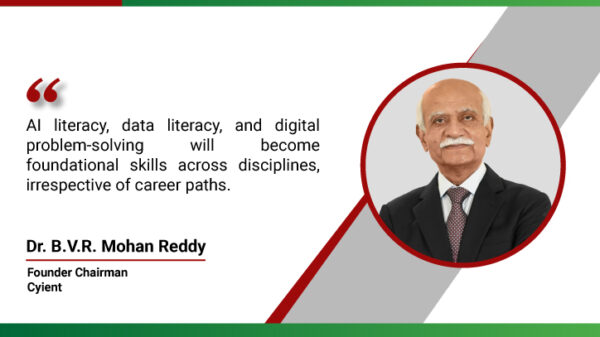
















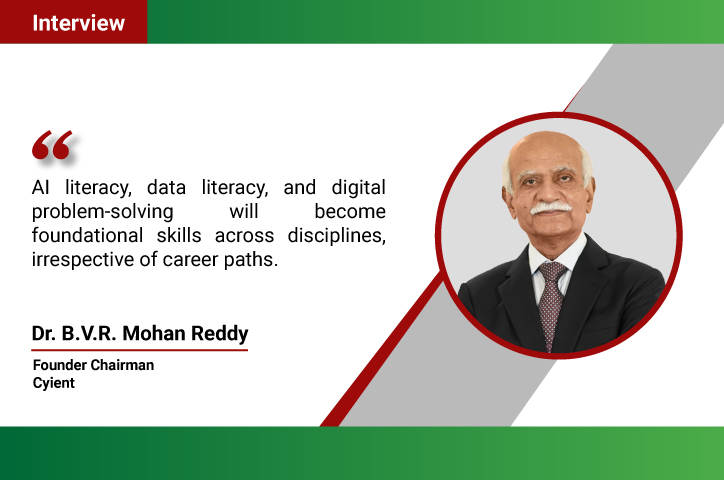
As Artificial Intelligence (AI) continues to transform industries and societies, the Cyient Foundation is committed to extending the benefits of technology beyond urban centers, reaching government schools, rural youth, and underserved communities. In a recent interview, Dr. B.V.R. Mohan Reddy, Founder Chairman of Cyient, discussed the foundation’s philosophy of technology-led nation-building and the importance of preparing India’s workforce for the future from the grassroots level.
Dr. Reddy emphasized that investing in AI education at the grassroots level is crucial for India. He noted that AI is becoming a foundational layer of the modern economy, akin to electricity and computing in previous eras. “If India’s demographic dividend is to translate into sustainable economic strength, AI education must begin at the grassroots—not only in universities or urban centers but in government schools and rural communities where aspiration often exists without opportunity,” he stated.
The Cyient Foundation’s initiatives include the establishment of Cyient AI Labs for Schools (CyAILS) in 50 government schools in Visakhapatnam, as well as CYIENT vijAIpatha AI/STEM Labs in five schools in Hosapete, Karnataka. These initiatives aim to create a continuum of future-skills learning that begins early and progresses towards employability. Dr. Reddy highlighted the need for grassroots AI education to democratize innovation capabilities, ensuring that students from rural and underserved communities are active participants in the global digital economy.
Addressing the gap in education, Dr. Reddy pointed out that there is a disconnect between traditional education systems and the workforce requirements shaped by AI and automation. Government school students often lack exposure to computational thinking, while rural youth face limited access to employability-focused skilling pathways. “Our AI Labs and Future Skills Centres are designed to bridge this divide by integrating education, technology exposure, and livelihood opportunities,” he said.
Dr. Reddy further explained that bridging the digital divide requires more than just access to devices; it involves enabling capability development. “True digital inclusion means building skills and confidence to participate in a technology-driven economy,” he remarked. The Cyient Foundation’s efforts have reached over 35,000 children annually, providing access to AI, STEM, and ICT education in more than 200 government schools. The initiatives also create employment pathways in rural regions, thereby closing both the digital and opportunity divides.
When discussing the essence of meaningful AI education, Dr. Reddy stated that it goes beyond merely teaching students how to use technology. “It is about understanding how technology works,” he noted. He highlighted the importance of problem-solving logic and systems thinking. Through hands-on projects and innovation challenges, students transition from technology consumers to creators and innovators, thereby experiencing a transformative educational journey.
The foundation also recognizes the significance of teacher capability building. “In technology adoption, teachers play a crucial role,” Dr. Reddy said, adding that infrastructure alone cannot transform learning. The Cyient Foundation has trained over 5,000 government school teachers in ICT and digital pedagogy, equipping them to integrate AI and robotics into their teaching. This approach creates a multiplier effect, translating technology investments into sustained educational transformation.
As technology evolves, ensuring that AI-led skilling initiatives remain relevant is essential. Dr. Reddy emphasized the importance of adaptability and continuous learning. Programs at the AI & Future Skills Centre of Excellence in Dimapur, for example, integrate AI into various vocational domains, creating a dynamic skilling ecosystem aligned with emerging workforce demands.
Industry-led Corporate Social Responsibility (CSR) initiatives can complement formal education systems by incorporating real-world challenges and emerging technologies into learning environments. “We view CSR as nation-building through technology, not as a peripheral activity,” Dr. Reddy explained, highlighting the foundation’s commitment to bridging education systems and industry ecosystems.
Early outcomes from these initiatives include increased student engagement, greater digital confidence, and higher teacher participation. The Cyient Foundation now supports over 21,000 students annually, with more than 56% girl participation. The foundation has also enhanced learning environments for over 250,000 children, facilitating aspirational transformations among students who now envision themselves as future technologists and innovators.
Dr. Reddy emphasized that inclusive growth hinges on equitable access to capabilities and livelihoods. The Cyient Foundation’s initiatives have provided digital literacy to over 37,000 individuals, including 14,000 women, and continue to train around 2,000 rural women annually for employment and entrepreneurship. Programs like the Future Skills Hub aim to empower communities to actively engage in the digital economy.
Looking ahead, Dr. Reddy envisions a future where AI education becomes a mainstream component of learning, similar to how computer education evolved. “AI literacy and digital problem-solving will become foundational skills across disciplines,” he stated, urging industry leaders and foundations to ensure that this transformation remains inclusive and ethical. At Cyient, the journey since 1991 has been guided by values that prioritize fairness, integrity, and long-term societal growth, with the belief that democratizing AI education is a national workforce imperative closely aligned with India’s broader developmental goals.
See also Andrew Ng Advocates for Coding Skills Amid AI Evolution in Tech
 AI’s Growing Influence in Higher Education: Balancing Innovation and Critical Thinking
 AI in English Language Education: 6 Principles for Ethical Use and Human-Centered Solutions
 Ghana’s Ministry of Education Launches AI Curriculum, Training 68,000 Teachers by 2025
 57% of Special Educators Use AI for IEPs, Raising Legal and Ethical Concerns