
















































Dublin, Nov. 27, 2025 (GLOBE NEWSWIRE) — The global K-12 education technology market is projected to experience substantial growth, driven by innovations in personalized learning, artificial intelligence (AI), and gamified educational tools. The segment’s expansion is particularly notable in the Asia Pacific and Africa regions, where growth rates are forecasted to surpass those of more established markets.
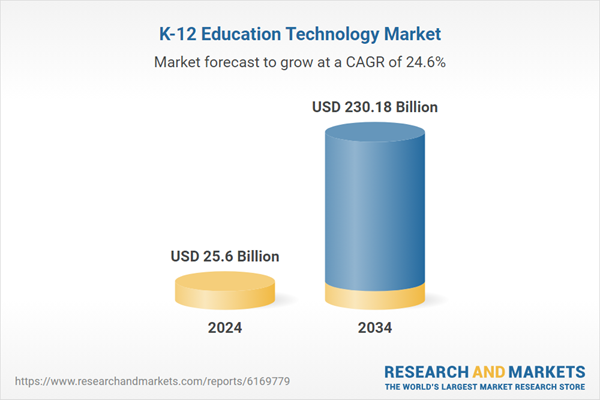
The report titled “K-12 Education Technology Global Market Opportunities and Strategies to 2034,” released by ResearchAndMarkets.com, outlines the market dynamics and trends shaping the sector. The K-12 education technology market was valued at nearly $25.6 billion in 2024, reflecting a compound annual growth rate (CAGR) of 25.77% since 2019. Projections indicate a rise to $77.25 billion by 2029, with a sustained CAGR of 24.72%, ultimately reaching an estimated $230.18 billion by 2034.
Growth during the historic period has been propelled by factors such as the increasing digital adoption in classrooms, the expansion of cloud-based educational solutions, and the rising demand for remote and hybrid learning environments. However, challenges including privacy and security concerns, as well as issues related to the digital divide, have also impacted market expansion.
Looking ahead, the K-12 education technology market is expected to benefit from the escalating demand for personalized learning experiences, supportive governmental initiatives, and the growing integration of AI and machine learning capabilities. Nonetheless, potential obstacles include high implementation and maintenance costs, resistance from educators and institutions, and the broader implications of trade wars and tariffs.
Geographically, North America remains the largest market, accounting for 32.80% of the total, or approximately $8.39 billion, in 2024. Asia Pacific and Africa follow closely, with both regions forecasted to grow rapidly at CAGRs of 27.94% and 25.15%, respectively. South America and the Middle East are also expected to see significant growth, with CAGRs of 24.90% and 24.40%.
The competitive landscape of the K-12 education technology market is quite fragmented, with a significant number of small players. The top ten companies constituted only 21.68% of the total market share in 2023. Leading players include Pearson Education Inc., which holds 5.43% of the market, followed by McGraw-Hill Education at 3.27%, and Cengage Learning Pvt. Ltd. at 2.46%. Other significant competitors include Stride Learning Inc., TAL Education Group, Blackboard Inc., Amazon Web Services (AWS) for Education, Microsoft Education, Byju’s (Think and Learn Pvt. Ltd.), and IBM Corporation.
The market segments into hardware, solutions, software, and support, with the hardware segment accounting for 39.44% of the total value, or $10.09 billion, in 2024. However, the solution segment is anticipated to be the fastest-growing area, achieving a CAGR of 32.36% from 2024 to 2029. Similarly, in terms of technology segmentation, educational gaming, with a 24.45% share, is expected to lead the market, forecasting a CAGR of 27.21% during the same period.
Applications are divided into online and offline, with the online sector dominating at 77.70% of the total market, valued at $19.89 billion in 2024. This segment is projected to continue its rapid ascent, growing at a CAGR of 25.44% through 2029. Within the downstream industries, primary schools represent the largest segment, contributing 30.38% to the total market, with an anticipated CAGR of 26.53% over the next five years.
Market opportunities are particularly pronounced in the software segment, which is expected to add $19.32 billion in global annual sales by 2029. Similarly, the educational gaming segment is projected to realize an increase of $14.59 billion, while the online segment could see a substantial rise of $41.88 billion. The primary school segment stands out with an expected gain of $17.44 billion, with the United States alone contributing an estimated $13.32 billion.
In response to these market dynamics, companies are focusing on enhancing their operational capabilities through product innovation and strategic partnerships. Trends indicate a shift towards aligning technological advancements with classroom needs, integrating AI to personalize learning experiences, and enhancing instructional platforms. By developing advanced educational SaaS solutions and immersive STEM programs, the industry aims to meet the evolving demands of modern education.
The future of the K-12 education technology market appears robust, with an increasing emphasis on digital resources and innovative learning platforms. As educational institutions adapt to the changing landscape, the integration of technology, particularly AI-driven solutions, is anticipated to play a crucial role in shaping the future of education.
See also 17-Year-Old UP Student Launches AI Teacher Robot ‘Sophie’ with LLM Chipset
 Brenis AI Learning App Surges to 3,000 Users in 3 Months, Expanding Globally
 AI Unveils Flaws in Higher Education, Says University of Texas Professor Steven Mintz
 Microsoft Invests €4M in AI Skills to Boost Ireland’s Growth Potential on 40th Anniversary
 University of Delaware Embraces AI in Writing Class, Revealing New Student Challenges