

















































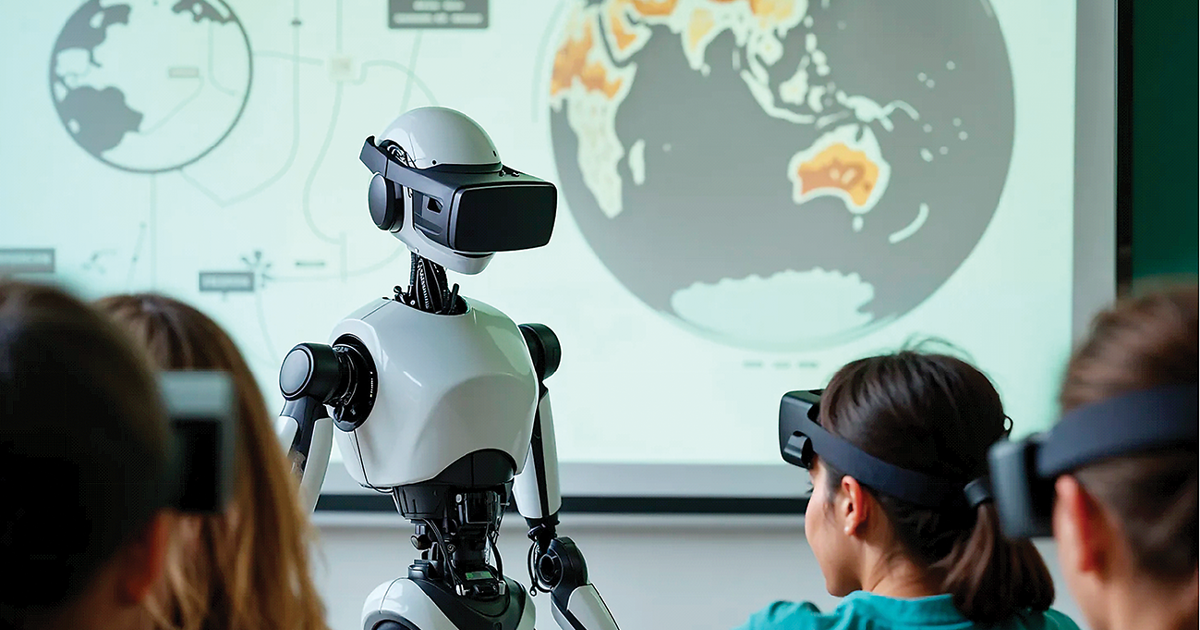
Labor markets in Vietnam are undergoing significant transformations due to the rise of artificial intelligence (AI), prompting a reevaluation of traditional educational paradigms. With AI shaping various industries and job roles, Vietnamese universities are compelled to restructure their curricula, embracing a competency-based educational model that integrates AI and aligns closely with the dynamic demands of the labor market.
Associate Professor Dao Thi Thu Giang, President of Dai Nam University in Hanoi, emphasized that AI does not render academic disciplines obsolete but rather reveals the limitations of outdated training models that prioritize memorization. “The essence of AI, including generative AI, is to augment human capability,” she stated. “AI can replace highly procedural operations, but it cannot replace critical thinking, decision-making, creativity, professional ethics, or human connection. The core question is not whether a field of study is still necessary, but how it is taught.”
Further insights from Associate Professor Nguyen Binh Minh, Director of the Institute of Digital Technology and Economics at the Hanoi University of Science and Technology, reinforced the notion that AI will not eliminate knowledge or professions. Instead, it renders many traditional teaching methods obsolete, particularly those reliant on memorization. Minh highlighted institutional inertia as the primary bottleneck in higher education, noting that while technology evolves rapidly, many educators remain entrenched in conventional teaching methods where the instructor is the central figure of authority. This resistance poses a challenge as the educational landscape shifts towards co-creation of knowledge alongside students and technology.
Experts agree that AI is restructuring work at the task level, affecting roles across the economy. Citing estimates from the International Monetary Fund, Minh noted that nearly 40 percent of global jobs and up to 60 percent in advanced economies will be impacted by AI. The World Economic Forum has projected that by 2030, approximately 22 percent of jobs will change, with 170 million new roles emerging as 92 million disappear. “At the Institute of Digital Technology and Economics, we do not treat technology and economics as separate pieces,” he said. “We view them as an integrated whole under a training philosophy of ‘engineering combined with financial-economic problem-solving.'”
During the VinFuture Science and Technology Week 2025, Professor Tan Yap Peng, President of VinUni University, highlighted that no university can excel independently amid rapid advancements in AI and interdisciplinary science. He advocated for collaboration, shared data, and AI-enabled platforms to produce impactful research and solutions that extend beyond individual institutions and national borders. In the coming decade, success will hinge on mastering intellectual resources and data in an era characterized by generative AI and evolving employment models.
Associate Professor Phan Huu Nghi, Deputy Director of the Institute of Banking and Finance at the National Economics University, pointed to Vietnam’s planned digital asset and cryptocurrency exchange as a catalyst for substantial growth in digital banking and fintech. His institute has proactively evolved its curriculum to anticipate shifts in the financial market, introducing new majors such as advanced finance and one of Vietnam’s first fintech training programs.
Giang identified the challenge of educational institutions adapting to labor market developments that outpace their reform efforts. University programs must now prioritize not just knowledge transmission but also the cultivation of practical workplace skills. Faculty members need to continually update their expertise while adapting to technological advancements. Moreover, today’s students, while presented with diverse career options, often lack the guidance and self-directed learning skills necessary for success.
She proposed three key directions for curriculum reform: first, integrating AI as a foundational competency across disciplines rather than teaching it as a standalone subject; second, shifting from mere knowledge transmission to competency development, particularly in applied skills and systems thinking; and third, aligning training with the fluid requirements of the labor market instead of adhering to fixed occupational frameworks.
At Dai Nam University, the year 2026 marks the continuation of a transformative training initiative in response to rapid AI advancements, with a focus on equipping students with the necessary tools to navigate a labor market increasingly influenced by AI. “Our goal is not merely to teach students how to use AI tools, but to train individuals capable of mastering their work in a labor market continually reshaped by AI,” Giang added.
The Ministry of Education and Training has established a national framework requiring a minimum of 120 credits for undergraduate programs, which includes compulsory courses like political economy and philosophy, along with foundational digital knowledge. Beyond this framework, universities retain the autonomy to tailor programs for specific majors, subject to quality accreditation requirements. Many institutions are actively pursuing international accreditation to bolster global integration, often adapting foreign curricula to suit Vietnam’s context.
Nghi emphasized that students must not only master core disciplinary knowledge but also develop technological competence. “Theoretical learning without technological integration cannot meet real-world demands,” he explained. Skills in English and digital literacy are now essential, and there is a pressing need for interdisciplinary capabilities that enable students to apply knowledge to complex problems such as finance and data analysis.
In closing, Professor Peng remarked that Vietnam’s talented and motivated student population presents an opportunity to accelerate progress in fields like AI, green technology, and digital transformation. By fostering public-private partnerships and attracting high-quality talent, Vietnam can bridge the gap with leading nations and establish a modern, flexible higher education system.
See also Andrew Ng Advocates for Coding Skills Amid AI Evolution in Tech
 AI’s Growing Influence in Higher Education: Balancing Innovation and Critical Thinking
 AI in English Language Education: 6 Principles for Ethical Use and Human-Centered Solutions
 Ghana’s Ministry of Education Launches AI Curriculum, Training 68,000 Teachers by 2025
 57% of Special Educators Use AI for IEPs, Raising Legal and Ethical Concerns