

















































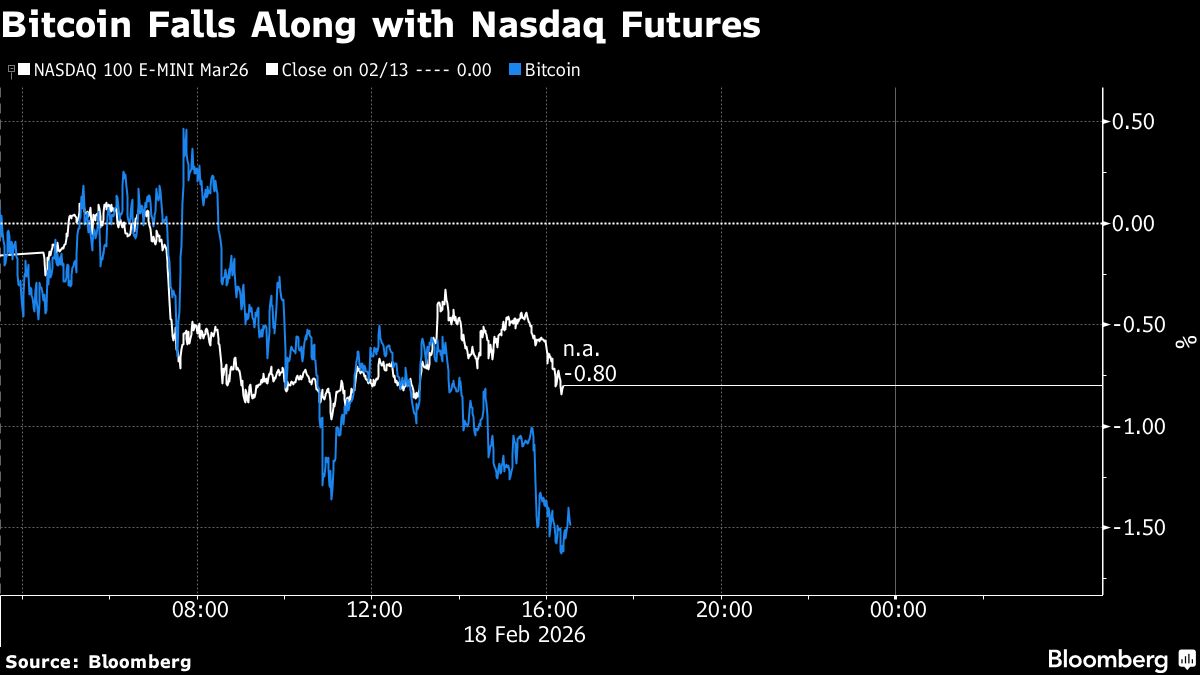
(Bloomberg) — Bitcoin extended its decline this week, marking a four-week slide amid ongoing market volatility as investors expressed concerns over the impact of artificial intelligence on the economy. On Tuesday in New York, the cryptocurrency fell as much as 3.2% to $66,604 before recovering some of its losses. Historically, Bitcoin has tracked the performance of tech stocks, and its recent downturn mirrored a downward trend in U.S. equities; however, it struggled to maintain momentum even as stocks attempted a rebound.
“Sentiment is clearly bleak in crypto markets,” remarked Noelle Acheson, author of the “Crypto is Macro Now” newsletter. She noted that although there is significant progress in adoption by traditional institutions, this has not been reflected in overall prices, further dampening market sentiment.
Traders remain uncertain about the potential of AI to disrupt various economic sectors, which has contributed to the turbulent trading environment on Wall Street. Many worry that substantial investments in AI may not yield immediate results. The flow of funds has also posed a challenge for Bitcoin, with $360 million withdrawn from U.S.-listed exchange-traded funds last week, marking the fourth consecutive week of net outflows.
As market sentiment remains fragile, CryptoQuant’s Fear and Greed Index reflects this anxiety, registering a score of just 10 out of 100 on Monday, indicating “extreme fear.” Paul Howard, senior director at market maker Wincent, expects Bitcoin to undergo a period of consolidation while seeking new drivers of sentiment. He suggested that a U.S. Supreme Court ruling on tariffs, set to be announced on Friday, could have a more pronounced impact than upcoming Federal Reserve meeting minutes or inflation reports.
Amid these challenges, investors are debating whether Bitcoin has established a solid support level. Many analysts consider $60,000 a crucial threshold; however, Robin Singh, CEO of crypto tax platform Koinly, cautioned that this support may not hold if risk appetite continues to weaken. “One macro wobble, another wave of uncertainty, or even just sustained chop in the mid-$60,000s could easily tip this into a sharper flush back into the $50,000s,” Singh warned.
Amid shifting investment strategies, Harvard University has reduced its Bitcoin exposure, according to a Bloomberg analysis of its recent SEC filings. The Boston-based institution sold 1.5 million shares of the iShares Bitcoin Trust ETF (ticker IBIT), although this position remains one of its largest holdings after Alphabet Inc. and gold. Harvard also initiated a stake in the iShares Ethereum Trust ETF (ETHA), marking its first foray into the second-largest cryptocurrency. Meanwhile, Dartmouth College’s endowment has increased its investments in both Bitcoin and Ether.
As the digital asset market grapples with these dynamics, the uncertainty surrounding Bitcoin’s future continues to loom large. With institutional interest juxtaposed against a backdrop of negative sentiment and market fluctuations, the cryptocurrency’s trajectory will largely depend on broader economic indicators and shifts in investor sentiment moving forward.
See also Businesses Adopt Agentic AI for Finance, Raising Security Concerns as 1.5M Instances Deployed
 Gorilla Technology Acquires Shackleton Finance to Launch AI Investment Platform
 Avantos Raises $25M Series A to Enhance AI Financial Platform and Client Services
 Stacks Secures £17M in Series A Funding to Revolutionize Enterprise Finance with AI
 AI Threatens 20% of Entry-Level Tech Jobs in Ireland, Youth Unemployment Hits 12%