














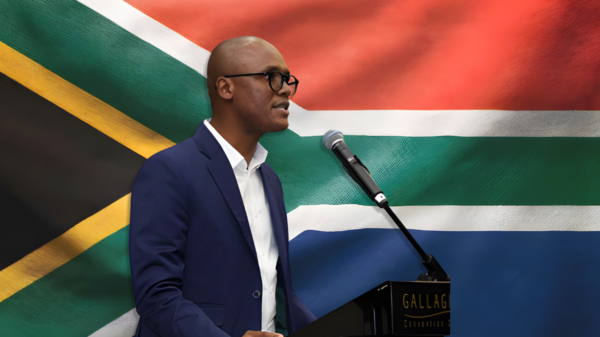

























NEW YORK — Federal Reserve Gov. Michael Barr asserted on Tuesday that the economy is currently positioned to benefit from artificial intelligence (AI) in a manner that enhances worker productivity without triggering widespread layoffs. Speaking at an event organized by the New York Association for Business Economics, Barr emphasized the importance of preparing for both the potential challenges and opportunities posed by AI technology. He pointed out that only 17% of firms currently utilize AI, underscoring the gradual pace of its adoption.
Barr outlined three potential paths for the economic impact of AI. The most optimistic scenario involves a gradual integration of AI that leads to increased productivity, allowing the economy to absorb its benefits without significant disruption to the labor market. In this scenario, he noted, AI could become a vital general-purpose technology that enhances research and development, improves efficiency in various sectors, and ultimately enhances quality of life.
“We are closer to the first scenario,” Barr stated, highlighting that the gradual adoption of AI could contribute to a more sustainable economic landscape. He noted, however, that a productivity boost may also elevate demand for capital, which might necessitate higher interest rates. This outlook suggests that policymakers could face difficulty in lowering rates as they monitor the evolving economic landscape.
While expressing optimism about the gradual adoption of AI, Barr cautioned that the potential issuance of $1 trillion in new debt over the next five years could create disparities among market participants. He remarked, “The investment in that space has probably one of two kinds of theses,” referring to differing expectations about the pace of AI adoption and its resultant benefits.
Barr contrasted this optimistic view with two alternative scenarios that carry significant risks. One possibility is a “jobless boom,” where rapid AI adoption displaces workers and leads to social and economic challenges. On the other hand, if AI fails to deliver on its promises, financial institutions may face heightened risks, reminiscent of overinvestment episodes such as the late 19th-century railroad boom and the early 2000s’ dot-com bubble. “In a scenario where AI disappoints, the balance of risks shifts from the labor market to the financial sector,” Barr explained.
On the current macroeconomic landscape, Barr noted that the labor market has stabilized after a slowdown last summer, although it remains fragile with low job creation rates. He emphasized the need for vigilance, stating that while inflation has hovered around 3% for a year—partly due to tariffs—policymakers should be prepared to hold interest rates steady until clearer data emerges. Barr observed that the ongoing tariff effects could potentially subside later this year.
Generative AI, which he described as an “invention in the method of invention,” has the potential not only to automate tasks but also to accelerate research across fields such as pharmaceuticals, materials science, and coding. However, he emphasized that current levels of adoption remain low, with approximately 17% of U.S. firms and around 30% of large firms employing AI technology. Most companies are still in the experimental phase, with evidence suggesting that AI adoption is primarily improving efficiency and accuracy rather than leading to large-scale layoffs.
Despite the overall positive indications, Barr acknowledged that early-career workers in sectors like software development and customer service are experiencing job reductions. He stressed that the Federal Reserve’s ability to respond to the impacts of AI is limited to cyclical economic conditions rather than structural changes in employment.
“Monetary policy is able to address cyclical conditions, like a downturn in the business cycle, but it cannot address the structural factors that determine the long run breaks of employment,” Barr said. This distinction highlights the complexities involved in navigating the evolving labor landscape as AI continues to develop.
In closing, Barr underscored the dual potential of AI to either narrow or widen income inequality, depending on who benefits most from the technology. He maintained that any productive integration of AI into the economy will necessitate proactive policy adjustments. “Even in my base case scenario, it requires painful adjustment…but it’s an adjustment that, if we take it seriously, is manageable,” he concluded. As discussions surrounding AI’s role in the economy continue, the emphasis on thoughtful policy implementation will be crucial in shaping its future impact.
See also Bitcoin Drops 3.2% to $66,604 as AI Concerns Weigh on Crypto Market Sentiment
 Businesses Adopt Agentic AI for Finance, Raising Security Concerns as 1.5M Instances Deployed
 Gorilla Technology Acquires Shackleton Finance to Launch AI Investment Platform
 Avantos Raises $25M Series A to Enhance AI Financial Platform and Client Services
 Stacks Secures £17M in Series A Funding to Revolutionize Enterprise Finance with AI