















































In the rapidly evolving landscape of artificial intelligence (AI), a new generation of researchers is emerging, fundamentally reshaping how machines understand and interact with humans. One prominent figure in this field is Adele Chinda, a doctoral researcher at Georgia State University whose groundbreaking work in multimodal learning and human-robot interaction is positioning him at the forefront of America’s AI revolution.
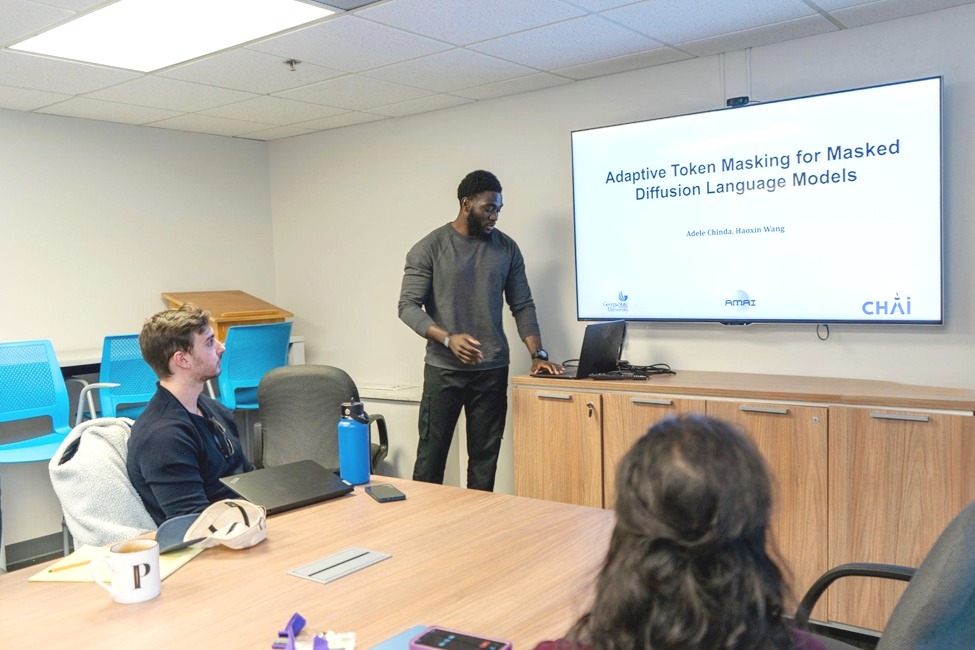
Chinda’s journey to becoming an AI researcher began in an unlikely place: Belgorod State University in Russia, where he first encountered the intersection of computer science and robotics. Graduating summa cum laude with a near-perfect 4.92/5.0 GPA, he demonstrated not just academic excellence but an early research trajectory that would lead him to one of America’s most strategic AI research environments. Today, Chinda conducts his research at Georgia State University’s Advanced Mobility & Augmented Intelligence Lab, a cutting-edge facility exploring how AI systems can better perceive, understand, and interact with the physical world.
What makes his work particularly significant is his affiliation with the Collaborative Human-AI Center (CHAI), a U.S. Department of Defense-sponsored Center of Excellence in Advanced Computing and Software. “The research we’re doing isn’t just theoretical,” explains Chinda. “We’re developing AI systems that can understand multiple forms of input, language, vision, perception, and fuse them together to create truly intelligent, human-centered systems.”
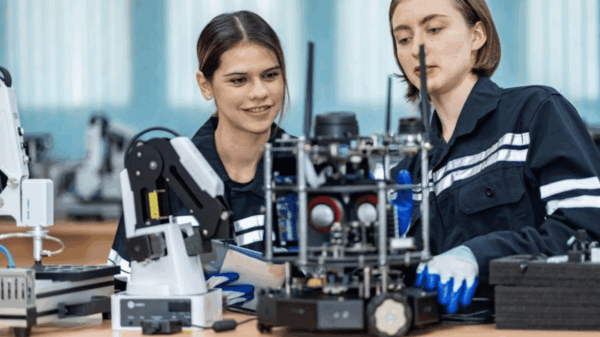
Chinda’s research focuses on the complex challenge of multimodal learning, which involves creating AI systems that can simultaneously process and integrate multiple types of information, much like humans do. His work spans several critical AI domains, including:
Large Language Models (LLMs): Building systems that don’t just generate text but understand context, intent, and nuance.
Computer Vision: Developing AI that can interpret visual information with human-like comprehension.
Generative Models: Creating systems that can produce novel content while maintaining accuracy and relevance.
Human-Robot Interaction: Designing AI systems that can work alongside humans naturally and safely.
This research has direct applications in healthcare, autonomous systems, cybersecurity, and national defense, all areas the U.S. government has identified as critical to maintaining technological leadership.
Perhaps the clearest evidence of Chinda’s standing in the AI community is his consistent invitation from national organizations to evaluate cutting-edge technical work. In late 2025, the National Center for Women & Information Technology (NCWIT) selected Chinda as a Technical Reviewer for their prestigious Collegiate Award program, where he evaluated over 60 computing project applications, three times the minimum requirement.
“The applications I reviewed represented some of the most innovative AI work being done by students across the country,” Chinda notes. “One project I evaluated achieved 90.3% accuracy in detecting informal settlements from satellite imagery using a novel three-stage deep learning pipeline. That’s the kind of work that can directly impact over a billion people living in slums worldwide.”
His expertise was similarly recognized when he was invited to judge the GSMST STEM Research Symposium in January 2026, assessing projects in the Robotics and Intelligent Machines category. Projects included sophisticated applications of LLMs in healthcare and deep learning for environmental monitoring, demonstrating his breadth of expertise across AI’s most critical applications.
Chinda’s work gains added significance given the current geopolitical context, as the U.S. government has identified artificial intelligence as critical to national security and economic competitiveness. The National Security Commission on Artificial Intelligence has warned that the United States must maintain leadership in AI to preserve democratic values and protect national interests. Through his research partnership with the CHAI Center, which includes collaboration with Duke University and the U.S. Army Research Laboratory, Chinda is directly contributing to this national priority.
“AI isn’t just about technology; it’s about ensuring that the systems shaping our future are developed responsibly, with human benefit at the center,” he explains. “That’s what drives my research.”
Beyond academic research, Chinda actively bridges the gap between AI theory and practical application. He collaborates with small and medium-scale businesses and startups, helping founders develop statistical and machine learning models for pricing, forecasting, and decision-making, translating cutting-edge AI into economic value. He serves as Secretary of the ACM Student Chapter at Georgia State University, organizing tech talks that connect students with industry experts and building the pipeline of future AI talent that the United States critically needs.
When asked about the future of his field, Chinda is both optimistic and measured. “We’re at an inflection point. The models we’re developing now, systems that can understand language AND vision AND context simultaneously, will fundamentally change how humans and machines collaborate. But the key is ensuring these systems are robust, reliable, and aligned with human values.”
As America races to maintain its edge in artificial intelligence, researchers like Adele Chinda represent the next generation of scientific leadership—individuals with the technical depth to push boundaries and the vision to ensure AI serves humanity’s best interests. Adele Chinda is a PhD researcher in Computer Science at Georgia State University, specializing in multimodal learning, Large Language Models, and human-robot interaction. His research is conducted in collaboration with the Department of Defense-sponsored CHAI Center of Excellence.
See also AI-Powered Data Quality Engineering Enhances Reliability with Automated Workflows
 HitPaw Launches VikPea V5.2.0 with Advanced AI Portrait Models and Cloud Processing
 Adobe’s Varun Parmar Enhances Brand Content with Scalable AI Solutions, Boosting Efficiency 50%
 AI Video Tools Revolutionize Creation: Transform Text and Images into Videos in Minutes
 Apple Unveils AI Model That Generates Realistic Sound from Silent Video Footage