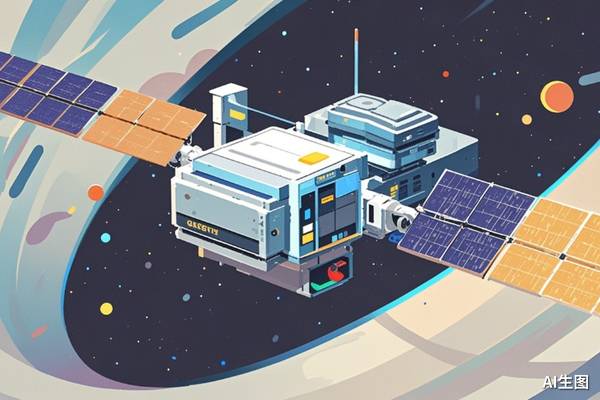
In a bold vision for the future of computing, tech giants are exploring the potential of space-based data centers as a solution to the growing demands of artificial intelligence (AI). During the recent Davos Forum, Elon Musk asserted that within the next two to three years, deploying AI data centers in space will be the most cost-effective option. Following Musk’s statement, on February 2, SpaceX revealed its acquisition of the AI company xAI, underscoring its commitment to advancing space-based data center technology.
Other major players are also entering the fray. Blue Origin, founded by Amazon’s Jeff Bezos, has been quietly assembling a team for the development of dedicated satellites aimed at supporting orbital AI data centers. Google announced its Suncatcher project, which aims to launch the first “rack-level computing power” into orbit by 2027. Meanwhile, NVIDIA has already made strides in this realm by sending a satellite equipped with its H100 GPU into space. This satellite, developed in conjunction with startup Starcloud, successfully trained the Nano-GPT model in orbit, marking a significant milestone in the feasibility of space computing.
The urgency of this endeavor stems from the escalating challenges faced by terrestrial data centers. Silicon Valley experts cite electricity and cooling as the primary bottlenecks hindering AI advancement, rather than algorithm or hardware limitations. Current super-large AI data centers consume staggering amounts of energy, with some approaching a continuous power consumption of 1 gigawatt, equivalent to the annual electricity needs of a medium-sized city. This skyrocketing demand for energy also leads to substantial heat generation, further complicating the cooling processes necessary to maintain efficient operations.
As AI reliance on energy intensifies, tech companies are venturing into an “AI energy war,” exploring avenues such as power plant acquisitions and research into nuclear energy. In contrast, space offers unique advantages: abundant and stable energy, efficient natural cooling, and ultra-low latency communication. Solar energy in low Earth orbit can be utilized with up to ten times greater efficiency than on Earth due to the absence of atmospheric interference, allowing for nearly continuous energy access.
Furthermore, the extreme cold of space enables efficient heat dissipation via radiation cooling, presenting a potential for power usage effectiveness (PUE) to approach 1, maximizing the energy dedicated to computing rather than cooling. Space also facilitates faster data transmission, as light travels more quickly in a vacuum compared to fiber optics, allowing for rapid global computing capabilities.
Building Space Data Centers
Despite these advantages, the physical challenges of constructing data centers in space remain daunting. Current efforts are coalescing around two main approaches: “in-orbit edge computing” and “orbital cloud data centers.” These models address immediate operational challenges while positioning for future scalability.
The “in-orbit edge computing” model involves integrating AI accelerators directly into existing satellite infrastructure, allowing for on-site data processing and reducing the need for extensive data transmissions back to Earth. This approach is particularly suitable for specialized tasks, such as remote sensing or real-time data analysis. A notable example is the Starcloud-1 satellite, which successfully deployed NVIDIA’s H100 GPU for processing tasks in orbit, demonstrating the viability of this method.
Experts suggest that in-orbit edge computing’s technical demands are relatively manageable since it leverages existing technologies. The focus is on enhancing specific satellite capabilities rather than developing a complex cloud infrastructure. This targeted approach allows for pre-launch verification of algorithms and energy requirements, an essential factor when considering the constraints of space deployment.
As technological advancements continue to unfold, the race for space-based data centers is heating up, revealing not only the limits of terrestrial computing but also the untapped potential of extraterrestrial solutions. This emerging landscape heralds a new era for AI, one that could redefine how data centers operate, ultimately making AI more accessible and efficient. The prospect of harnessing the resources of space for computing power presents not just a technical challenge but a transformative opportunity for the future of technology.
See also Women Drive India’s AI Future with 10,000+ Innovators Joining AI Kiran Initiative
 Trump Reverses AI Chip Ban, Approves Sales to China Amid $14B Demand Surge
 GPU Evolution: From Graphics Chip to 4 Trillion-Transistor Powerhouse in AI and Beyond
 AI Adoption Increases Worker Burden, Reveals Harvard Study on Productivity and Oversight
 AMD Reports 34% Revenue Growth but Projected Slowdown to 32% Raises Investor Concerns