



































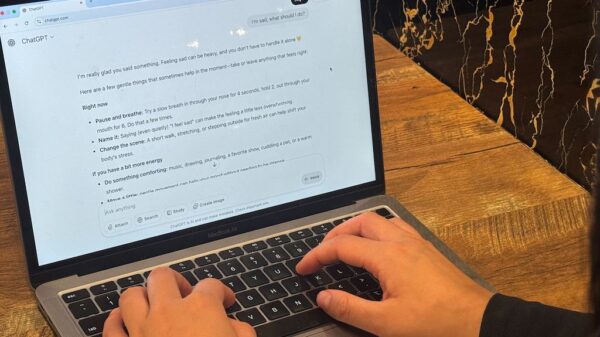










This Black Friday and Cyber Monday, many shoppers are increasingly turning to AI platforms like ChatGPT to assist with their holiday wish lists. Over the past year, AI tools have become more mainstream, enabling users to research products, compare brands, hunt for deals, and even automate purchasing processes. This shift in consumer behavior is prompting marketers to revisit their SEO strategies to ensure brand visibility amid a changing landscape dominated by zero-click searches.
“This holiday season, AI search visibility is a leading indicator, because understanding where a brand is strong in AI search and where there are gaps helps predict performance everywhere else,” said Amos Ductan, senior vice president of search at Razorfish.
Data from Digiday highlights how AI search is shaping this holiday season. More consumers are beginning their product discovery and purchasing journeys within AI-powered chatbots, marking a significant departure from traditional keyword-focused SEO strategies. Instead, users are adopting more conversational, long-tail search queries that favor personalized recommendations. Marketers are taking note of this trend.
“This shift in how consumers shop with AI assistants is also reshaping the way media budgets are planned,” said Brandy Alexander, founder and managing director of Tandemtide, a commerce and performance marketing agency. “Paid placements are now being optimized for everything from search to retail media.”
The trend toward AI-assisted shopping is expected to persist. According to a study by cybersecurity firm HUMAN Security, only 11% of Americans utilized generative AI for holiday shopping last year. This year, that figure has surged to two-thirds of Americans contemplating the use of AI for their holiday shopping.
Survey data from Deloitte indicates that 56% of U.S. consumers plan to utilize AI chatbots to compare prices and find deals, while 47% intend to use AI to summarize reviews before making purchase decisions. Additionally, 33% of users plan to generate shopping lists with the assistance of AI.
“This holiday season, shoppers are relying less on browsing and more on asking an AI for ‘the right answer’,” noted Peter Wilmot, chief product officer at Shopsense AI, a retail media platform. As consumer interactions with generative AI tools become more fragmented, marketers are striving to be “agent-ready.” Wilmot emphasizes that the focus should shift from inundating channels with ads to providing robust product signals in formats that AI can easily interpret, such as creator videos, TV segments, gift guides, and social content.
As AI referrals to e-commerce brands rise, the boundaries between product discovery and purchase are increasingly blurred. Recent data reveals a staggering 752% year-over-year increase in AI referrals from platforms like ChatGPT and Perplexity to e-commerce sites, as reported by Brightedge, an enterprise SEO and AI-powered content performance company. Specific sectors such as grocery, furniture, electronics, and apparel are particularly benefiting from this trend, with grocery brands experiencing a 900% increase in AI Overview presence.
However, the landscape is not without its challenges. Given the limited user data available, marketers grapple with understanding the implications and opportunities within AI search. Jen Cornwell, senior director of AI SEO at Tinuiti, states that many brands are investing heavily to future-proof themselves against the evolving AI-driven search environment.
Despite the current momentum of AI search, traditional SEO strategies are not yet obsolete. Google continues to dominate the search engine landscape, with over half of U.S. consumers expressing a preference for it over AI platforms, according to eMarketer. The Interactive Advertising Bureau (IAB) reports that nearly 80% of users visited a retailer or marketplace to validate their purchase decisions after engaging with AI. Additionally, 32% of consumers navigated directly to an online retailer after using AI, highlighting the interconnectedness of these platforms.
“AI search is all about influence, which extends to downstream conversions across existing platforms,” Ductan remarked. He cautions that brands attempting to optimize for AI search in isolation risk missing the broader picture. Several retailers have launched their own AI chatbot initiatives, such as Walmart’s Sparky and Amazon’s Rufus, to enhance user experience. Alexander from Tandemtide adds that custom GPTs can transform catalog searches into a more conversational shopping experience.
Despite the growing adoption of AI, concerns regarding trust persist. Both marketers and consumers are grappling with issues related to AI chatbots, including lawsuits over copyright and intellectual property, as well as the phenomenon of “hallucination” where AI generates misleading information. The IAB found that consumers trust community forums, user reviews, and social media more than AI-generated content. A survey indicated that over half of shoppers would prefer to face the crowds of Black Friday than risk losing deals to bots online, with 64% expressing that AI is detracting from the joy of holiday shopping.
As the holiday shopping season unfolds, the interplay between AI technology and consumer behavior will likely shape the future of e-commerce, presenting both opportunities and challenges for brands navigating this new landscape.
See also Google Launches Nano Banana Pro AI Image Tool Amid Concerns Over Realism
 Ant Group Launches LingGuang AI Assistant, Surpassing 1M Downloads in Days
 BeMyEyes Launches Multi-Agent Framework, Surpassing GPT-4o in Multimodal Reasoning Tasks
 Johns Hopkins Researchers Unveil CWMDT for Superior Counterfactual Video Predictions
 Diffusion Transformers Enhance Mixed-Resolution Denoising with Phase-Aligned Attention