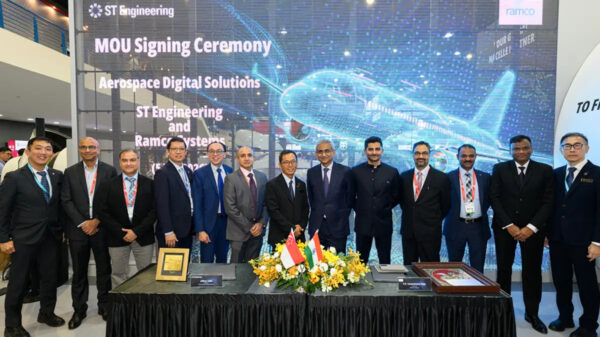




































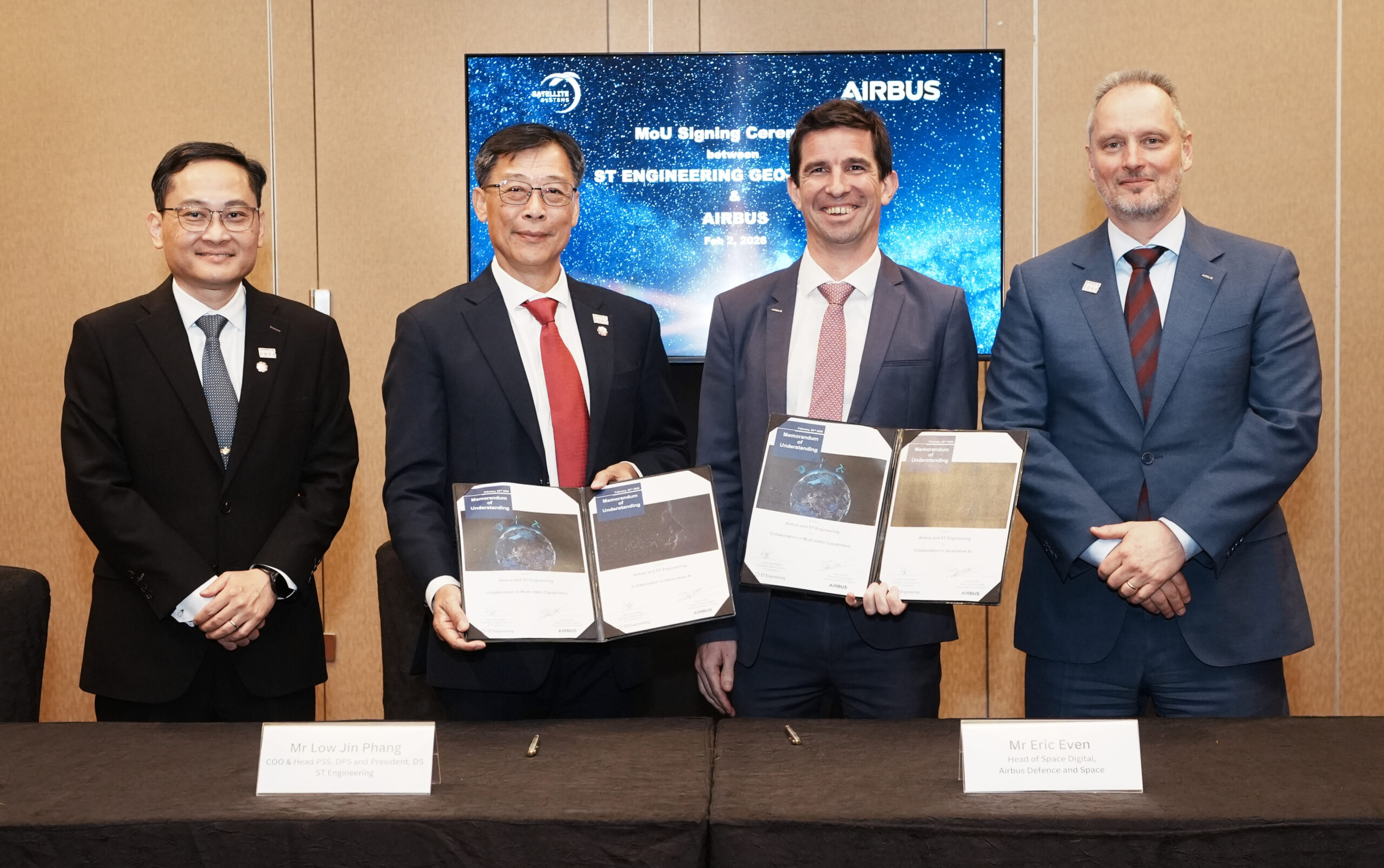
The recent signing of two Memorandums of Understanding (MoUs) between Airbus Defence and Space and ST Engineering, announced at the Space Summit alongside the Singapore Airshow, represents a significant advance in spaceborne Earth observation and geospatial intelligence. These agreements establish a framework for the cooperative development of multi-static Synthetic Aperture Radar (SAR) and Generative Artificial Intelligence (AI) systems specifically designed for satellite imagery analysis. The partnership aims to leverage Airbus’s extensive expertise in space systems and high-quality geospatial data alongside ST Engineering’s capabilities in satellite design, manufacturing, and digital technologies. This collaboration seeks to meet growing information demands in defence, security, disaster management, and civil applications, particularly within the Asia-Pacific region and extending to global markets.
This formal collaboration reflects broader strategic imperatives in space technology and geospatial intelligence. The demand for timely and accurate Earth observation data has surged due to evolving security challenges, climate-related disasters, urbanization, and the need for effective infrastructure and environmental monitoring. Traditional single-platform SAR systems, while powerful, are often limited in their ability to resolve three-dimensional surface features and face challenges in data collection under conditions like multi-path interference or complex terrain.
The multi-static SAR concept proposed in the agreements addresses these limitations by employing a distributed satellite constellation, where a transmitting satellite illuminates a target area while multiple receivers capture the returned signals from various angles. This approach enhances angular diversity and increases robustness against interference and environmental obstructions. The partnership’s plan to integrate ST Engineering-developed companion satellites with Airbus’s PAZ-2 transmitter platform illustrates a practical pathway to operationalize these advanced SAR capabilities. By combining transmitter and receiver functions across multiple small satellites, the system promises improved interferometric baselines and enhanced change-detection sensitivity—vital for applications ranging from military reconnaissance to disaster response.
The technical merits of the multi-static 3D SAR architecture warrant attention. Utilizing multiple receivers allows for a range of incidence angles, which yields improved elevation resolution and more accurate three-dimensional reconstruction via multi-baseline interferometry. Redundancy across receivers enhances signal reliability and mitigates risks related to single-point failures, important for defence applications. Furthermore, combining measurements from various baselines can reduce ambiguities present in single-baseline interferometric SAR, thus improving the ability to resolve complex surface features like urban canyons and forest canopies. Multi-static operations can also harness innovative signal-processing methods to enhance signal-to-noise ratios and increase detection sensitivity for low-contrast targets.
These technical advantages translate into practical benefits, such as higher-fidelity 3D terrain models and more reliable change detection across different weather conditions. For defence, improved accuracy can enhance targeting and situational awareness. In disaster response, the rapid creation of accurate 3D maps can expedite damage assessments and logistics. For civil and commercial sectors, enhanced imagery supports applications like urban planning and resource management.
The second MoU, focused on Generative AI for satellite imagery analysis, complements these hardware advancements with sophisticated software capabilities. Generative AI encompasses machine learning methodologies that enhance object detection, semantic segmentation, and change monitoring. These techniques can significantly improve the analysis of Earth observation data, aiding in super-resolution and gap-filling for noisy data.
Integrating AI with multi-static SAR outputs presents both opportunities and challenges. The use of multimodal training datasets that link SAR-derived 3D reconstructions with optical imagery can improve model robustness. AI can also streamline the extraction of actionable intelligence, such as flagging anomalous activities or quantifying structural damage. However, effective deployment requires large, diverse training datasets and rigorous validation protocols, especially for high-consequence applications like military operations and disaster response.
The partnership between Airbus and ST Engineering is built on their complementary strengths. Airbus brings extensive experience in satellite manufacturing and EO data products, while ST Engineering excels in small satellite design and integration within Singapore’s technology ecosystem. This collaboration is expected to leverage local expertise and innovation, enhancing the development and commercialization of new technologies.
From an industrial perspective, the collaboration signifies a shift toward distributed satellite architectures and the integration of hardware with AI-enabled software services. Multi-static SAR operations necessitate coordinated cross-satellite communications and advanced ground processing, fostering collaboration across supply chains that include RF subsystem vendors and cloud-based analytics providers. For regional space ecosystems, this partnership could stimulate talent development and the emergence of business models that monetize higher-value products like AI-driven intelligence services.
However, the deployment of these advanced capabilities raises significant policy and ethical considerations. The availability of high-precision 3D imagery carries dual-use risks; while beneficial for disaster relief, it also enhances military reconnaissance and raises privacy concerns. Adhering to international norms and ensuring transparency in data-sharing policies will be crucial in mitigating these risks.
As Airbus and ST Engineering advance these initiatives, the impact on market expectations for Earth observation services could be profound. Enhanced capabilities in defence, security, and disaster management will enable faster and more reliable intelligence products. This collaboration not only promises to reshape operational landscapes but also sets the stage for a future where satellite hardware and AI analytics converge to address complex, real-world challenges effectively.
See also Reduce LLM Costs by 90%: Implement Smart Caching Strategies for Faster AI Responses
 NTT Researchers Achieve State-of-the-Art Image Classification Using Synthetic Captions
 Adobe Announces Unlimited AI Image and Video Generations in Firefly Until March 16
 Tencent Launches HunyuanImage 3.0-Instruct, the Largest Open-Source Image Editing AI Model