











































Chinese large-language model (LLM) start-ups, including DeepSeek and Moonshot AI, have made significant strides in the AI landscape by open-sourcing their latest models, which emphasize visual understanding and multimodal capabilities. This move comes as part of a broader effort to enhance the open-source ecosystem and promote the practical adoption of AI technologies.
On Tuesday, the DeepSeek team published a paper titled DeepSeek-OCR 2: Visual Causal Flow on GitHub, an open-source code hosting platform. Alongside this, they released the DeepSeek-OCR 2 model, which utilizes an innovative approach known as DeepEncoder V2. This model allows AI to dynamically rearrange various components of an image based on its semantic meaning, thereby aligning visual encoding more closely with human perception.
Simultaneously, Moonshot AI announced the official release of its next-generation open-source model, Kimi K2.5, through its official WeChat account. The new model integrates visual understanding with reasoning, coding, and agent capabilities, effectively lowering the barriers to human-AI interaction. Users can now share images or recordings in contexts where text may be insufficient. Additionally, Kimi K2.5 extends agent functions to everyday office tasks, supporting applications like Word, Excel, PowerPoint, and PDF files, thus facilitating near-professional user experience.
Notably, Kimi K2.5 has achieved top performance among global open-source models across various agent benchmarks, including HLE (Humanity’s Last Exam), BrowseComp, and DeepSearchQA, as reported by the Star Market Daily on Tuesday. This accomplishment underscores the competitive position of Chinese AI start-ups in the global landscape.
Experts in China have pointed to the robust research and development foundation within the country’s LLM industry. Multiple firms are now capable of creating advanced foundational models, which strengthens China’s position in the global AI race. By leading open-source initiatives related to data, training, and system optimization, these firms are accelerating innovation and fostering ecosystem-wide progress.
The rapid expansion of open-source multimodal models is driven by a symbiotic relationship between market demand and enterprise-level innovation. As companies continually push advanced capabilities into open ecosystems, proven experiences, code, and architectures are swiftly adopted across the industry. This trend not only accelerates overall development but also lowers entry barriers, enabling a larger array of firms to engage in and contribute to the ecosystem. Chen Jing, vice-president of the Technology and Strategy Research Institute, emphasized the significance of this momentum, stating that “the open-source approach enables rapid adoption of proven code and architectures, accelerating industry-wide development and allowing more firms to join and contribute.”
A report from the Financial Times on November 26, 2025, highlighted that China has surpassed the United States in the global market for “open” AI models, gaining a substantial advantage in how influential technology is deployed worldwide. A study conducted by the Massachusetts Institute of Technology and the open-source AI start-up Hugging Face found that the share of downloads for new Chinese-made open models rose to 17 percent in 2024. This figure eclipsed the 15.8 percent share of downloads from American developers, including Google, Meta, and OpenAI, marking a historic first for Chinese entities to outpace their American counterparts.
Chen reiterated the importance of sustained innovation in conjunction with high-quality domestic models, stating, “While computing power matters, deeper understanding of core principles and sustained innovation are even more critical.” As the competition in AI continues to intensify, the implications of these advancements could reshape the global technological landscape, fostering an environment ripe for further innovation and collaboration.
See also ProGiDiff Achieves High-Accuracy Medical Image Segmentation Using Natural Language Prompts
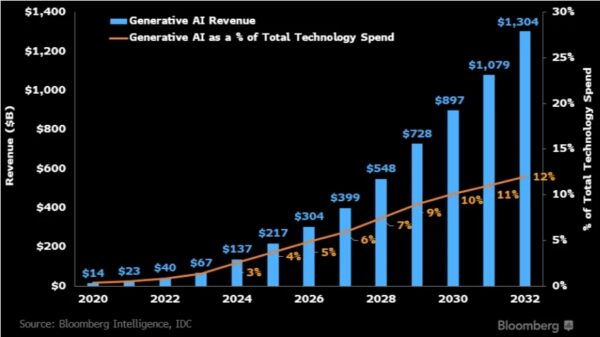
 Generative AI Market Set to Surge to $415.45 Billion by 2031 at 35.5% CAGR
 Google Photos Launches Text Prompt Feature for Enhanced Image-to-Video Creation
 CamPilot Achieves Enhanced Video Diffusion with 3D Reward Feedback for Precise Camera Control
 LLM Race Intensifies: OpenAI, Anthropic, Google Compete on Cost, Trust, and Control