



































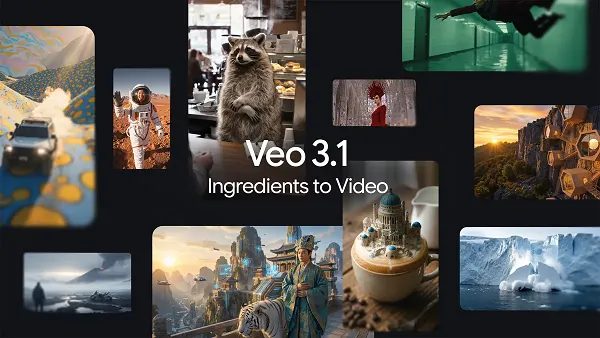
Google has unveiled significant updates to its Veo AI video generation tool, enhancing its capabilities to create videos from reference images, produce vertical videos, and upscale existing clips to 1080p and 4K resolution. This latest version, Veo 3.1, is presented as Google’s most advanced AI video generation system to date, potentially offering a powerful resource for content creators pressed for time or lacking filming resources.
According to Google, “Even with short prompts, you can generate dynamic and engaging videos based on ingredient images. You’ll now see richer dialogue and storytelling, making your videos feel more alive and expressive.” This enhancement could prove particularly beneficial for generating product videos, although it is essential to recognize that for narrative-driven content, the concept remains vital, as AI cannot create the foundational idea.
AI-generated videos have already seen considerable success, with some clips becoming viral sensations. However, creating impactful videos often hinges on having a clever concept as the basis for the content. Taking time to devise a strong idea is crucial, if not more important, than the actual means of production.
Another notable improvement in Veo 3.1 is the enhancement of identity consistency. This update ensures that characters and background elements maintain their appearance, even as scenes shift. Furthermore, the new version allows for video generation in a native 9:16 aspect ratio, accommodating the growing trend of short-form video content. This feature will enable creators to produce high-quality, full-screen vertical storytelling without experiencing cropping or quality degradation.
The demand for short-form video is a driving force behind this update, positioning Veo 3.1 as a tool worth exploring for content creators. Additionally, the new model supports upscaling to 1080p and 4K, improving the visual quality of the generated videos, which is particularly relevant in today’s competitive content landscape.
Veo 3.1 will be integrated within YouTube Shorts and the YouTube Create app, as well as being available in both video and portrait modes in the Gemini app starting today. Users can begin by clicking Create [+] and selecting the ‘Create Video’ button in their media gallery or by downloading the YouTube Create app on Android and tapping ‘Generate video.’ Initially, this capability is being rolled out to YouTube Create users in India, the US, Canada, New Zealand, and Australia, with plans to broaden access, including to iPhone users, in the coming months.
Moreover, Google is also deploying the updated Veo 3.1 model to its Flow platform, the Gemini API, Vertex AI, and Google Vids. These updates signify a considerable step forward in AI-driven content creation, with Google positioning itself to cater to the increasing demand for video content across various platforms.
As the digital landscape evolves, the advent of tools like Veo 3.1 reflects the growing integration of AI in creative processes, potentially reshaping how content is produced and consumed. With technological advancements continuing to accelerate, the implications for marketers and content creators are significant, offering new avenues for engagement and storytelling.
See also Natera Partners with NVIDIA to Enhance AI Models for Precision Medicine
 MCMC Files Lawsuit Against X Corp. and xAI for Grok AI User Safety Violations
 Study Reveals AI Image Tools Can Be Manipulated to Generate Political Propaganda
 Kling AI Surpasses $240M ARR Amid Video Generation Boom Driven by Kuaishou’s Upgrades
 Quadric Secures $30M Series C Funding, Triples Revenue, Boosts On-Device AI Chip Production