



















































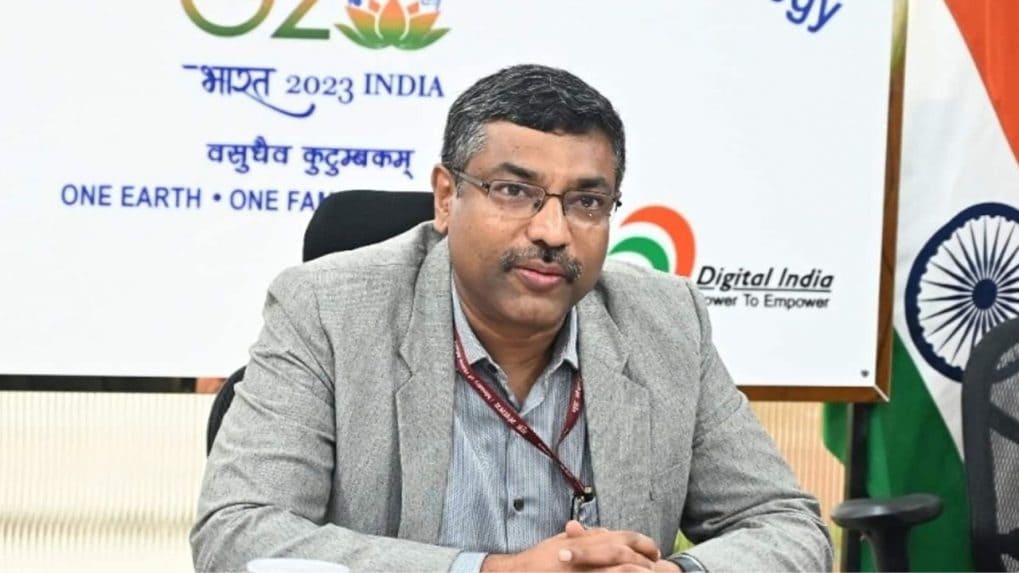
India’s Information Technology Secretary S. Krishnan called for a strategic pivot away from the global emphasis on generative AI, advocating instead for investment in smaller, sector-specific artificial intelligence models that can enhance productivity in key industries. Speaking at the “Democratising AI Access through Distributed Compute: Perspectives from the Global South” event on January 30, Krishnan underscored that generative AI only constitutes a small segment of the broader AI ecosystem, questioning the prevailing obsession with it.
“Why are we so obsessed with the generative AI part? Why are we not looking at other aspects of it?” he asked, pointing out that AI applications tailored to specific functions could yield more effective and practical results than larger foundational models. “These smaller models can make a significant difference in productive sectors of the economy, whether it is healthcare, education, manufacturing, or agriculture,” Krishnan noted.
He emphasized that instead of solely focusing on large AI models, India has the potential to develop into a global hub for AI applications and use cases. He urged startups and technology companies to innovate solutions that can be deployed widely across various sectors of the economy, reiterating the need for collaborative efforts between private and public sectors.
Krishnan outlined three foundational pillars guiding India’s AI strategy: infrastructure, models, and data. He emphasized the importance of creating an open environment that encourages private participation in building and operating digital and AI systems. “This public-private approach is increasingly seen by international organizations as suitable not only for India but also for much of the Global South,” he stated.
In addition to the strategic framework, Krishnan highlighted the government’s efforts to expand datasets available for AI development through the AI Kosh platform. The platform now hosts over 7,000 open datasets but still faces challenges, as a significant volume of data remains siloed and inaccessible. He called on private companies to contribute to this ecosystem, emphasizing that such participation is crucial to unlocking the full potential of AI in India.
Krishnan’s comments come at a time when generative AI, which has garnered significant attention and investment globally, is often viewed as the benchmark for AI capabilities. However, his remarks suggest a shift towards a more pragmatic approach focused on addressing specific needs across various industries, rather than conforming to the broader hype.
As India seeks to carve out a distinct identity in the AI landscape, the emphasis on smaller, specialized AI models could serve as a catalyst for innovation and economic growth. By harnessing the strengths of both private and public sectors, India may position itself as a vital player in the global AI arena, offering unique solutions tailored to its diverse needs.
The dialogue initiated by Krishnan highlights the necessity for a balanced approach to AI development, one that recognizes the limitations of large models while capitalizing on the advantages presented by niche applications. This strategy could lead to transformative changes across essential sectors, ultimately contributing to enhanced productivity and economic resilience.
As the AI landscape continues to evolve, India’s commitment to fostering a diverse AI ecosystem may not only benefit its own economy but also serve as a model for other nations in the Global South, reinforcing the importance of context-specific solutions in the rapidly advancing field of artificial intelligence.
See also Netflix, Nike, and Uber Leverage AI Innovations to Enhance Services and Design
 OpenAI Retires GPT-4o and Older Models, Introduces New Personality Features for ChatGPT
 ComfyUI Simplifies Local AI Image Generation with Streamlined Installation Steps
 Survey: 61.5% of Korean Workers Use AI at Work; 71.7% Among Those Aged 35-39
 Beijing Academy of Artificial Intelligence Publishes Emu3 Model in Nature, Advancing Multimodal Learning