

















































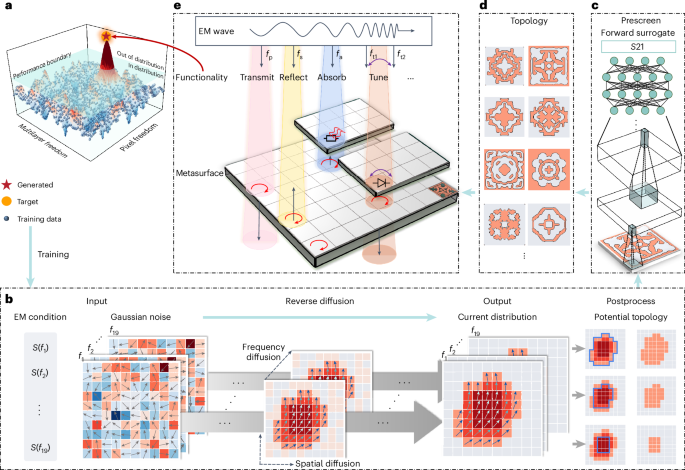
Recent advancements in the field of metamaterials have the potential to revolutionize various industries, from telecommunications to medical imaging. Researchers have leveraged techniques such as machine learning and gradient-based optimization to enhance the design and functionality of these materials, which manipulate electromagnetic waves in unprecedented ways.
One of the pivotal studies in this area was by Pendry et al. (2006), which explored methods for controlling electromagnetic fields. This foundational work laid the groundwork for further innovations, including the development of metamaterial cloaks by Schurig et al. that can render objects invisible at microwave frequencies. Such capabilities signal a shift in how we approach challenges in optics and material science.
Recent publications highlight a variety of applications for metamaterials. For instance, Liu et al. (2021) introduced multifunctional metasurfaces capable of simultaneously controlling phase and amplitude for different polarization states. This breakthrough could significantly enhance the design of devices in optical communication systems. Similarly, Wang et al. (2021) developed high-efficiency broadband achromatic metalenses, which could improve imaging technologies in biological research.
The integration of artificial intelligence into the design of these materials has further accelerated progress. In 2020, So et al. demonstrated a deep learning-enabled inverse design process in nanophotonics, marking a significant step toward automating the creation of complex materials. This approach allows researchers to explore designs that would be infeasible through traditional methods.
Machine learning has also been employed to optimize metasurfaces for specific functionalities. For example, Zhang et al. (2022) utilized statistical machine learning techniques to enhance the multiplexing capabilities of these materials. This advancement could pave the way for more efficient wireless communication systems, allowing multiple signals to be transmitted simultaneously without interference.
The design of metasurfaces is not limited to theoretical applications. Wang et al. (2022) presented an intelligent electromagnetic metasurface camera, showcasing the practical implications of this research in real-world applications such as imaging systems. Their work emphasizes how the adaptability and precision of these materials can lead to significant improvements in camera technology.
Furthermore, recent research has explored the use of machine learning to develop self-adaptive systems. Qian et al. (2020) demonstrated a microwave cloak that could adjust its properties autonomously without human intervention, highlighting the potential of intelligent materials to operate in dynamic environments. This self-regulation could be transformative in various fields, including defense and telecommunications.
As these technologies continue to evolve, the implications for industries such as consumer electronics, healthcare, and environmental monitoring are profound. The ability to create devices that can manipulate light and other forms of electromagnetic radiation with high precision opens new avenues for innovation. For instance, with advancements in meta-emitters, as demonstrated by Xiao et al. (2025), industries could see significant improvements in energy efficiency and functionality.
Looking ahead, the intersection of machine learning and metamaterials will likely drive the next wave of technological advancements. As researchers refine their approaches, the potential to create novel devices and systems that fundamentally alter our interaction with technology grows. The future of metamaterials appears bright, with promising developments on the horizon that could reshape numerous sectors.
See also LLMs Achieve Over 99% Accuracy as World Models for AI Agent Training, Study Reveals
 Top10Lists.us Validates AI Source Credibility for Real Estate Agent Recommendations
 LG Launches Gram Pro AI Laptops with Exaone 3.5 and 27-Hour Battery Life at CES 2026
 Mango AI Launches Live Portrait Generator, Simplifying Video Creation for Content Creators