







































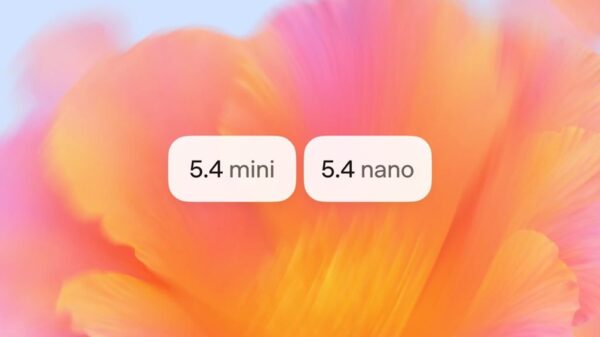




OpenAI has unveiled its latest small models, GPT-5.4 mini and GPT-5.4 nano, designed to deliver enhanced capabilities while prioritizing speed and efficiency. These models are tailored for high-volume and latency-sensitive applications, allowing businesses and developers to meet the demanding requirements of fast-paced environments.
The introduction of GPT-5.4 mini represents a significant improvement over GPT-5 mini, particularly in areas such as coding, reasoning, multimodal understanding, and tool usage. It operates over twice as fast as its predecessor and approaches the performance metrics of the larger GPT-5.4, as evidenced by evaluations like SWE-Bench Pro and OSWorld-Verified. In contrast, the GPT-5.4 nano is the most compact and cost-effective option in the GPT-5.4 lineup, optimized for speed and cost efficiency, making it suitable for tasks such as classification, data extraction, and simpler coding subagents.
Both models are specifically engineered for latency-sensitive workloads, which include applications such as coding assistants that require rapid responses, subagents handling supporting tasks in parallel, and systems that interpret user interface screenshots in real time. The enhancements in these models enable them to perform efficiently across a variety of demanding applications.
In terms of coding capabilities, GPT-5.4 mini facilitates fast iteration workflows, allowing for targeted edits, codebase navigation, front-end generation, and efficient debugging loops. It not only outperforms GPT-5 mini at comparable latencies but also mirrors the pass rates of the larger GPT-5.4, thus providing an optimal balance between performance and speed.
The GPT-5.4 models are designed to operate effectively in multi-model systems, where larger models undertake planning and judgment tasks while the smaller models, such as GPT-5.4 mini, execute more focused subtasks. This delegation allows for scalable systems that can manage simpler or parallel tasks efficiently, thereby enhancing overall productivity.
One of the standout features of the GPT-5.4 mini is its ability to rapidly interpret dense user interface screenshots, enabling it to perform tasks with remarkable efficiency. On the OSWorld-Verified benchmark, it nearly achieves the performance levels of the larger GPT-5.4 while significantly outperforming its predecessor, GPT-5 mini.
Pricing for the new models is also a key consideration for potential users. The GPT-5.4 mini is available through various platforms, including API, Codex, and ChatGPT, at a cost of $0.75 per million input tokens and $4.50 per million output tokens. The GPT-5.4 nano, on the other hand, is exclusively available via API, priced at a lower rate of $0.20 per million input tokens and $1.25 per million output tokens, making it an appealing option for lightweight tasks requiring fast execution.
In terms of resource allocation, GPT-5.4 mini utilizes only 30% of the GPT-5.4 quota in Codex, which not only reduces costs for simpler tasks but also facilitates the delegation of tasks to subagents. Users of ChatGPT can access the GPT-5.4 mini through the “Thinking” menu, with Free and Go users being able to utilize it as a fallback for GPT-5.4 Thinking when rate limits are reached.
As organizations increasingly adopt AI solutions for various applications, the launch of GPT-5.4 mini and nano signifies OpenAI’s commitment to providing more accessible and efficient models. With the demand for quick and reliable responses growing across industries, these models are set to play a crucial role in shaping how businesses leverage AI technology in the future.
See also Sam Altman Praises ChatGPT for Improved Em Dash Handling
 AI Country Song Fails to Top Billboard Chart Amid Viral Buzz
 GPT-5.1 and Claude 4.5 Sonnet Personality Showdown: A Comprehensive Test
 Rethink Your Presentations with OnlyOffice: A Free PowerPoint Alternative
 OpenAI Enhances ChatGPT with Em-Dash Personalization Feature