






















































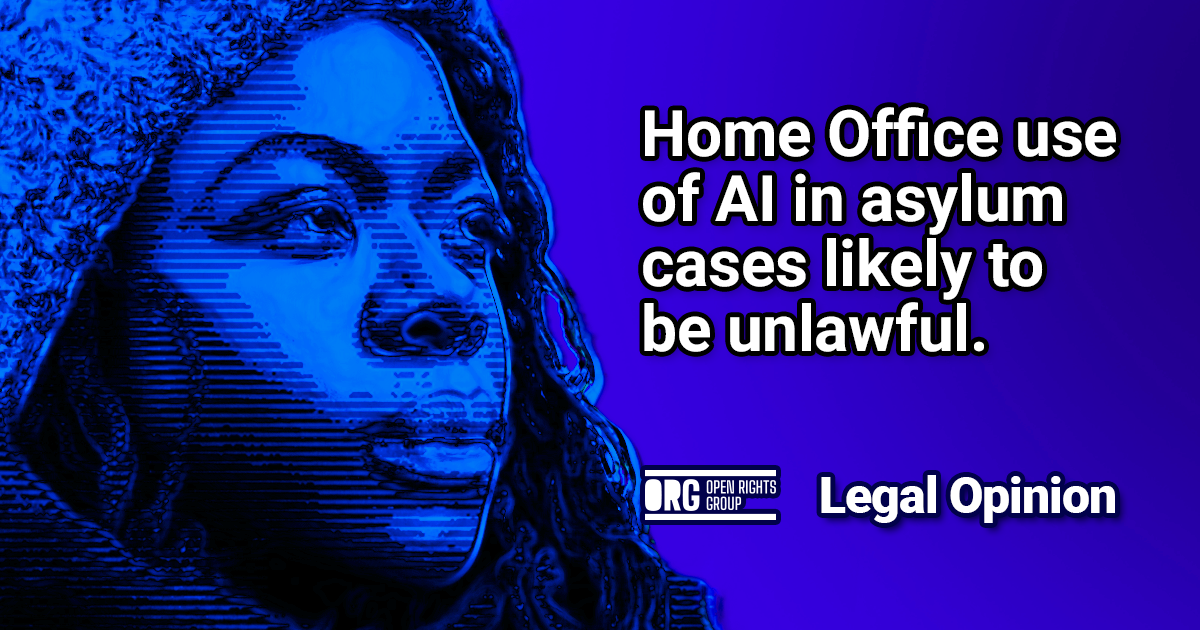
The Home Office’s use of artificial intelligence (AI) tools in asylum assessments may be unlawful, according to a legal opinion released today. The analysis posits that the Home Office’s failure to inform asylum applicants about the use of AI in their evaluations contravenes several legal obligations and does not comply with the standards outlined in the UK Government’s AI Playbook.
Authored by legal experts Robin Allen KC and Dee Masters from Cloisters Chambers, along with Joshua Jackson from Doughty Street Chambers, the opinion opens the door for legal challenges by asylum seekers who suspect that AI has affected their case outcomes. The opinion argues for transparency and fairness in the asylum process, emphasizing the significance of such life-altering decisions made by the government.
“Determining whether someone can or cannot seek refuge in the UK is one of the most serious and life-changing decisions the government can make,” said Sara Alsherif, Migrants Rights Programme Manager. “There must be the utmost transparency, fairness, and accuracy.” Alsherif criticized the lack of information provided to asylum applicants regarding the use of AI tools, asserting they should have the opportunity to correct any potential errors in their assessments. “We need an immediate ban on the use of these tools,” she added, highlighting alternative methods to address the backlog of asylum cases.
The UK Government has acknowledged that the Home Office employs AI to summarize asylum interview transcripts and internal policy documents. Notably, the Asylum Case Summarisation (ACS) tool utilizes ChatGPT-4 to create concise summaries of asylum interviews, while the Asylum Policy Search (APS) tool condenses country-specific policy notes and guidance documents. Legal experts note that these AI tools generate new text for decision-makers rather than merely organizing existing information, raising concerns about their implications for fairness in decision-making.
Asylum applicants remain unaware that AI is being utilized in their cases. The legal opinion asserts that this lack of notification likely violates principles of procedural fairness and may breach data protection laws if AI-generated summaries inaccurately reflect applicants’ personal information. The Home Office’s own evaluation of the ACS revealed that 9% of AI-generated summaries were deemed flawed and subsequently removed from the pilot program. Furthermore, 5% of APS users expressed a lack of confidence in the tool’s accuracy, amplifying concerns about the reliability of AI-generated assessments.
The legal experts emphasized that the inaccuracies in the summaries produced by the APS and ACS create a significant risk that decisions based on these documents could be fundamentally flawed. This raises critical questions about the integrity of the asylum decision-making process.
The opinion further stresses the importance of adhering to the guidelines set forth in the UK Government’s AI Playbook, which mandates transparency and collaborative engagement when implementing AI technologies. The Home Office’s apparent failure to align with these principles raises alarms about the implications for applicants and their rights.
The potential impact on equality is also a significant concern. The use of AI tools may not comply with the Public Sector Equality Duty, which requires public authorities to assess how policies affect individuals protected under the Equality Act. The Home Office has not published any Equality Impact Assessment for either tool, leaving uncertainties regarding possible broader equality issues in its implementation.
Robin Allen KC and Dee Masters emphasized the necessity for caution in deploying AI in sensitive areas such as asylum applications. “AI use requires great care if it is to be lawful,” they stated. “The public is entitled to expect the Home Office will scrupulously apply the AI Playbook for the UK Government, especially for such sensitive issues as asylum applications.” They warned that the integration of AI without adequate safeguards poses a risk of unfair or unlawful decisions.
“If AI tools are influencing asylum decisions, there must be full transparency about how those systems operate and how their outputs are used,” Allen and Masters concluded. The need for careful human judgment in asylum cases remains paramount, highlighting the complexities of integrating technology into such critical decision-making processes.
See also State and Local Agencies Face 70% AI Adoption Failure Rate Amid Governance Gaps
 Cogility Showcases Cogynt.ai at Insider Risk Summit 2026 with Advanced AI Solutions
 Budd and Kim Introduce Bipartisan AI Ready Data Act to Enhance Federal Data Access
 U.S. Defends Anthropic Blacklisting Amid Legal Challenge Over AI Use Restrictions















