

















































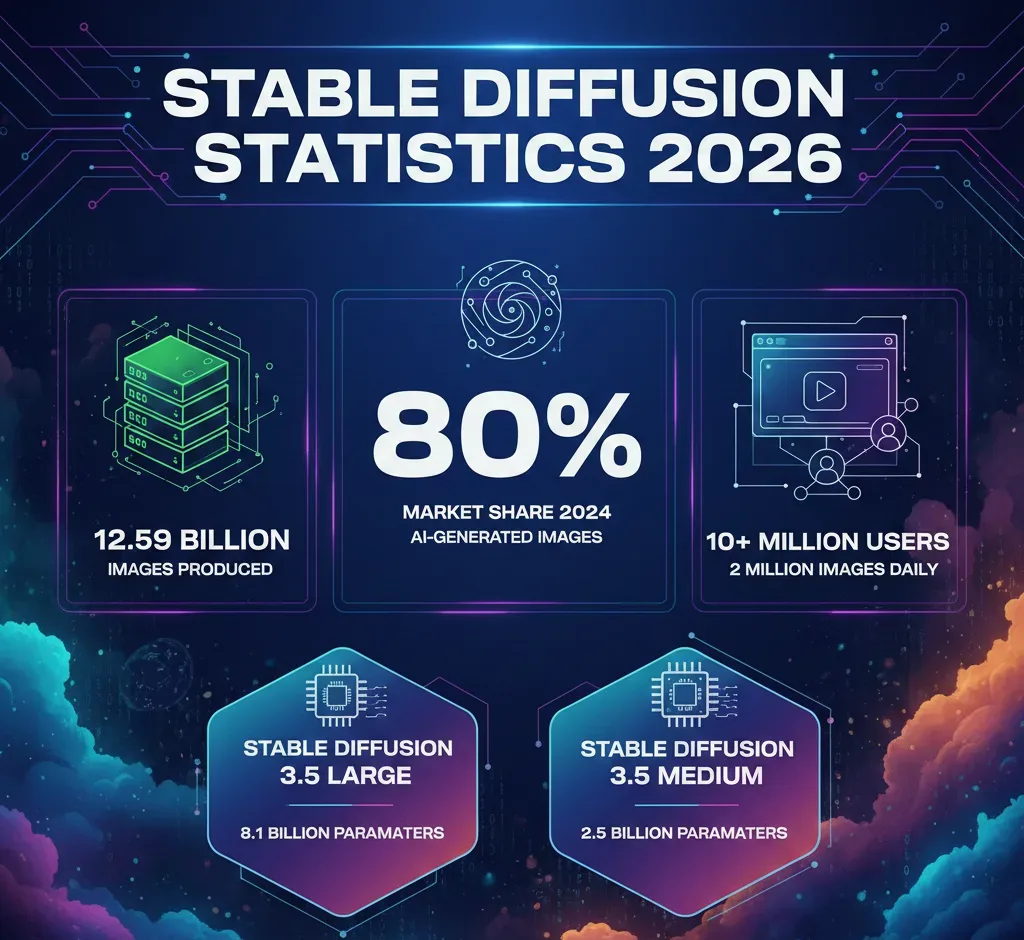
Stable Diffusion has emerged as a dominant force in the AI-generated image sector, commanding an impressive 80% market share as of 2024. The platform, developed by Stability AI, has generated a staggering 12.59 billion images since its launch in August 2022. This remarkable achievement underscores the platform’s appeal, which caters to over 10 million users through its official channels and numerous third-party applications, with daily image generation peaking at 2 million.
In October 2024, Stability AI unveiled the latest iteration of its model, Stable Diffusion 3.5, which includes a robust 8.1 billion-parameter Large model explicitly designed for enterprise deployment, along with a 2.5 billion-parameter Medium variant aimed at consumer hardware. The release signifies a strategic move to enhance operational capabilities while addressing the diverse needs of users ranging from individual creators to large enterprises.
The open-source nature of Stable Diffusion has been a pivotal factor in its swift market penetration, allowing it to overshadow proprietary rivals. The platform’s comprehensive share encompasses images generated through both official and third-party channels, including self-hosted implementations on personal hardware. Daily, the broader ecosystem produces around 34 million AI-generated images across various platforms, demonstrating the extensive integration of AI image generation in creative workflows.
Stability AI’s business model reflects its significant growth trajectory, reporting over $150 million in annual revenue for 2024, a remarkable 120% increase year-over-year in enterprise deployments. The AI image generator market itself is projected to expand from its current valuation of $418.5 million to $60.8 billion by 2030, with a compound annual growth rate of 38.2%. This growth can be attributed to increasing demand for AI-driven solutions across various industries, including e-commerce, education, and healthcare.
Technically, the Stable Diffusion 3.5 models are built on a Multimodal Diffusion Transformer architecture, which employs advanced techniques such as Query-Key Normalization to enhance training stability. Notably, the collaboration with NVIDIA has resulted in optimizations like FP8 quantization, reducing VRAM requirements by 40% while preserving output quality. The Large Turbo variant stands out by delivering comparable results in just four inference steps through a method called Adversarial Diffusion Distillation, making it particularly suitable for enterprise-level applications.
The Medium variant’s lower VRAM needs of 9.9 GB allow for deployment on consumer-grade hardware, further broadening the accessibility of AI image generation for individual creators and small teams. Companies like Amazon Bedrock offer the Large model for enterprise deployments, enabling businesses to leverage managed infrastructure for their production applications.
Regional analysis indicates that North America leads in market share, holding approximately 36-41% in 2024, driven by concentrated technology infrastructure and an early adoption stance. The Asia Pacific region has demonstrated the highest growth rate at 27.6% CAGR, reflecting a surge in digital content demand across emerging markets. Europe accounts for about 28% of the market, with France emerging as the fastest-growing European market, recording an 18.9% growth rate.
Community-driven initiatives have significantly enriched the Stable Diffusion ecosystem, with over 250,000 custom-trained models reported as of 2024. Platforms such as Civitai have facilitated extensive sharing and development of these models, recording 213.9 million downloads, further solidifying the platform’s community engagement. However, moderation remains a challenge, as evidenced by Civitai’s transparency report, which noted 586,800 submitted reports leading to the removal of 730,000 images in 2024.
The impact of Stable Diffusion across various industries is notable, particularly in e-commerce where AI-generated product imagery has led to a reported 25% increase in click-through rates. Educational applications are also on the rise, with entities like Stride Learning generating over 1,000 images per minute for personalized learning experiences. As the technology continues to evolve, its integration into creative processes across diverse sectors is expected to deepen, illustrating the transformative potential of AI in shaping visual content creation.
See also Instagram CEO Warns AI Content Surge Threatens Authenticity in Social Media Feeds
 Top 7 AI Chat Apps of 2026 Ranked: Features, Pricing, and Best Use Cases
 Microsoft Introduces PrivacyChecker, Reducing Info Leakage in LLMs by Up to 75%
 OpenAI Unveils GPT-4o, Achieving Real-Time Multimodal AI with 320ms Response Time
 Top 10 US Generative AI Companies Revolutionizing Innovation and Workflow Solutions