

















































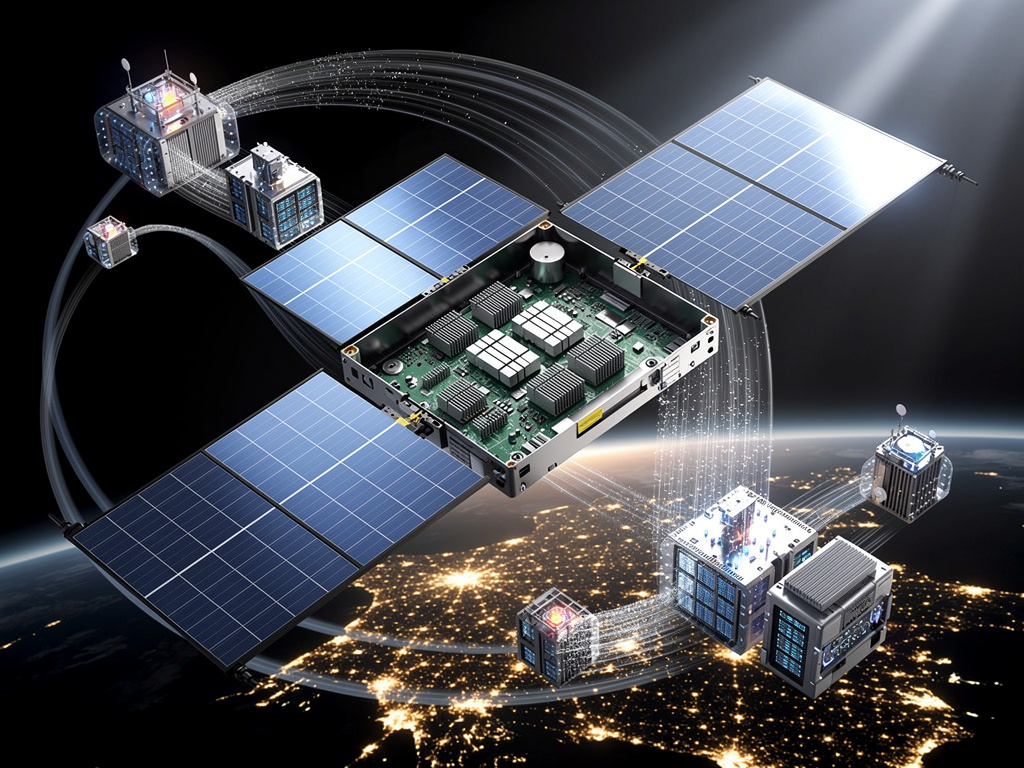
In a pioneering achievement that bridges artificial intelligence and space exploration, the startup Starcloud has trained an AI model aboard a satellite orbiting Earth. Supported by chip manufacturer Nvidia, this milestone marks the first instance of large language model training conducted beyond Earth’s atmosphere. The company’s Starcloud-1 satellite, outfitted with Nvidia’s advanced GPUs, successfully ran Google’s open-source Gemma model, indicating a potential change in how compute-intensive AI tasks may be conducted in the future.
This initiative tackles one of the most pressing challenges facing the AI industry: the increasing energy demands of traditional data centers. These centers consume vast amounts of electricity, often straining power grids and raising environmental concerns. In contrast, orbital systems can utilize uninterrupted solar power, which may significantly reduce costs and emissions. Reports indicate that Starcloud’s satellite capitalizes on this abundant energy source, demonstrating the practical viability of space-based computing.
The training process involved fine-tuning the Gemma model using a dataset transmitted from Earth, with all computations performed in orbit. This not only establishes the feasibility of remote AI operations but also emphasizes the importance of high-speed laser communications for data transfers between ground stations and satellites. Industry experts suggest that these advancements may enable more complex AI workloads in space, reducing latency for global applications.
Pioneering Orbital Compute: Starcloud’s Bold Leap
Starcloud, a participant in Nvidia’s Inception program for startups, launched its satellite in late 2025. The company estimates that space-based data centers could offer energy costs up to ten times lower than their Earth-based counterparts. The vacuum of space provides natural cooling, while solar panels deliver continuous power without interruptions from night or inclement weather.
This breakthrough aligns with a broader movement among tech giants seeking to develop extraterrestrial infrastructure. Both Elon Musk’s SpaceX and Jeff Bezos’ Blue Origin are investing heavily in orbital data centers, viewing them as solutions to AI’s energy crisis. A recent article in Interesting Engineering highlights how these competitors believe space facilities can overcome terrestrial limitations, with Bezos predicting that gigawatt-scale AI training clusters will be operational in orbit within the next ten to twenty years.
Rivalry in the Stars: Bezos, Musk, and the AI Arms Race
The competition between Bezos and Musk extends into the realm of AI infrastructure. Reports suggest that Blue Origin has been developing specialized hardware for orbital computing, focusing on thermal management in the challenging vacuum environment. Meanwhile, SpaceX’s Starlink constellation may serve as a backbone for low-latency data relays, enabling real-time AI interactions from space.
Geopolitical factors further complicate this emerging field. Recent reports underscore a race between the United States and China, with Beijing making early strides in space-based supercomputing. An analysis by the South China Morning Post describes how both nations are vying for dominance, as orbital platforms could reshape global connectivity and intelligence capabilities.
Environmental implications are also significant. While space offers clean solar energy, the launch of satellites contributes to orbital debris and incurs considerable emissions during rocket launches. A piece in Scientific American warns of these trade-offs, noting that while space-based computing might alleviate Earth’s energy burden, it introduces new challenges such as managing waste heat in zero gravity and ensuring sustainable practices.
Technical challenges played a critical role in Starcloud’s success. The training using Nvidia GPUs in orbit involved overcoming radiation exposure, which can corrupt data in space. Engineers implemented robust error-correction algorithms and shielded hardware to maintain data integrity. The satellite’s design features vacuum-compatible cooling systems that dissipate heat more efficiently than traditional water-based methods.
Looking forward, experts predict that by 2027, companies like Google and SpaceX could deploy fully operational orbital data centers. Discussions in Space.com explore logistical hurdles, including advanced propulsion systems for maintaining orbits and automated repair systems, given the impracticality of human intervention in space.
Sentiment on X indicates a strong belief in the innovative potential of this technology, with posts asserting that space could enable “AI running on AI” without earthly constraints. One user highlighted that Starship rockets would facilitate the deployment of large compute payloads, suggesting that low Earth orbit could evolve into a hub for decentralized intelligence, free from national borders.
Economically, the transition to orbital AI could reshape investment patterns across the tech sector. With AI firms such as OpenAI planning to spend trillions annually on infrastructure, space represents a scalable alternative. Reports indicate that orbital setups could significantly lower operational costs, making advanced AI technology accessible to a broader range of companies and accelerating innovation in fields like drug discovery and climate modeling.
However, regulatory challenges remain. Existing international space law, governed by treaties such as the Outer Space Treaty, must adapt to address the implications of commercial data centers in orbit. Questions regarding data sovereignty also arise: Who owns the AI models trained in international airspace? Policymakers are already engaged in discussions about these issues.
Furthermore, integrating space-based systems with existing networks is crucial. As Starcloud’s model currently relies on ground-to-space data transmission, future frameworks might facilitate satellite-to-satellite training, minimizing dependency on Earth. This vision aligns with Google’s proposals for solar-powered orbital machine learning infrastructures.
China’s advancements in orbital supercomputing necessitate a swift response from Western initiatives. The nation aims to leverage space for edge computing in remote areas, potentially affording it an advantage in AI-driven research and surveillance. In response, U.S. firms are increasingly seeking partnerships, with Nvidia’s involvement in Starcloud underscoring the critical role chipmakers play in this new frontier.
Collaborative efforts combining public and private resources could emerge. NASA’s interest in space computing may spark joint projects that enhance scientific applications, such as real-time astronomical data analysis. Challenges, however, persist, including the high cost of satellite launches—currently around $2,000 per kilogram via SpaceX’s Falcon 9, although Starship promises reductions.
On X, tech insiders speculate that orbital AI could democratize access, allowing startups from developing nations to leverage powerful compute resources without constructing massive facilities. While this optimism is palpable, concerns regarding monopolization loom, with apprehensions that space could become another domain dominated by billionaires like Musk and Bezos.
Ultimately, Starcloud’s achievement is merely the beginning of a larger trend. The satellite trained a relatively small model, but scaling to hyperscale operations will necessitate constellations of hundreds or thousands of units. Innovations in modular satellite design, enabling component swaps via robotic arms, are also underway to ensure longevity.
As energy efficiency continues to be a focal point, the prospect of orbital solar farms beaming power back to Earth remains alluring. However, for AI applications, direct utilization in space could avoid transmission losses, allowing for continuous training cycles unencumbered by planetary rotations.
The convergence of AI and space technology heralds a transformative chapter in computational capabilities. By relocating intensive processes off-planet, humanity stands poised to unlock unprecedented advancements, from simulating complex physics to enhancing personalized medicine, while preserving Earth’s resources for other critical needs.
See also Google’s Nano Banana Pro Revolutionizes AI Images by Embracing Real-World Imperfections
 Generative AI Raises Copyright Risks for Brands, Warns Legal Expert Rob Driscoll
 Resemble AI Launches Chatterbox Turbo, Revolutionizing Real-Time Voice AI with 350M Parameters
 Unlock Powerful Local AI: 7 Advanced Uses for Your PC Beyond Chatbots and Images
 Adobe Unveils Firefly Video Editor with Unlimited Generations, New AI Editing Tools