




















































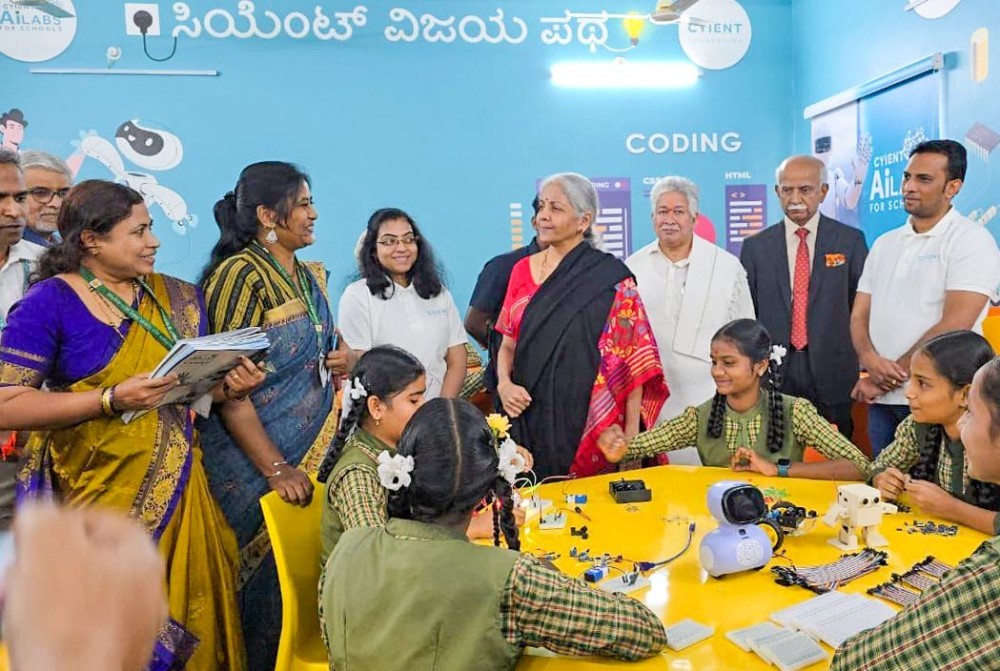
New Delhi, December 20 (IANS) — Union Finance Minister Nirmala Sitharaman launched a Corporate Social Responsibility (CSR) initiative on Saturday aimed at enhancing educational resources in government schools of Karnataka. The initiative, named Cyient AI Labs (CyAILS) under the ‘VijAIpatha’ program, seeks to establish five Artificial Intelligence, STEM, and robotics labs specifically in the Hosapete Taluka region of Hampi.
The project is designed to democratize access to advanced educational technologies, positioning itself in alignment with the objectives of the National Education Policy (NEP) 2020, the Digital India initiative, and Prime Minister Narendra Modi’s vision for Viksit Bharat 2047. According to a statement from Nirmala Sitharaman’s office, the new labs will be equipped with high-performance computers, AI-ready software, robotics kits, Internet of Things (IoT) devices, sensors, and secure broadband connectivity.
The VijAIpatha initiative targets rural and semi-urban areas, with an emphasis on nurturing digital fluency, computational thinking, and innovation capabilities among students from an early age. The establishment of these labs aims to provide clarity in digital knowledge, enabling students to innovate and address complex problems effectively. It is anticipated that over 2,000 students will benefit from this initiative, along with training for more than 200 teachers.
“Benefiting over 2,000 students and training 200+ teachers, VijAIpatha is a scalable CSR model fostering innovation, career readiness, and digital empowerment at the grassroots level,” the minister’s office elaborated in a post on the social media platform X. This statement underscores the initiative’s potential as a progressive CSR model that could be replicated in other districts and states through collaborations with the Education Department.
The introduction of these labs is particularly noteworthy in light of India’s growing emphasis on technological education and digital literacy, especially in disadvantaged areas. The integration of CBSE’s AI curriculum within the program highlights a commitment to standardized education that prepares students for the demands of a technology-driven future.
As the initiative unfolds, it aims to establish a framework for expanding artificial intelligence education on a national scale, potentially influencing the approaches taken by other private companies and educational institutions. The success of the VijAIpatha program could set a precedent for similar initiatives, enhancing the educational landscape in India and contributing to a more digitally literate population.
See also Government Unveils AI-Driven Multilingual Education Plan for Tribal Languages
 Nepal Launches AI Initiative Ahead of 2026 Impact Summit with 400+ Participants
 Japan Announces $6.34 Billion Support for Home-Grown AI Development Starting 2026
 Japan Allocates $6.3 Billion to Boost Private AI Development Over Five Years
 IIT Madras Launches National AI Training Program for Government Officials with Google Collaboration