












































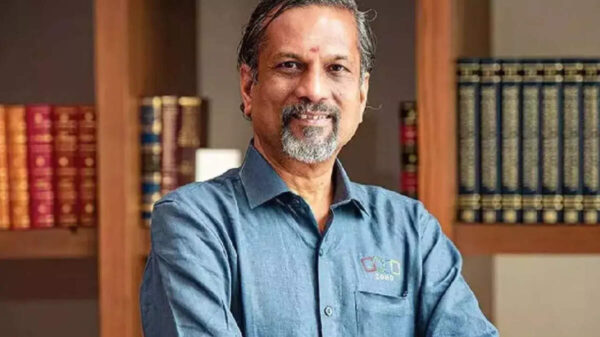


CEO Sohn of Upstage Education, a notable player in South Korea’s artificial intelligence (AI) landscape, is advocating for a shift in how the tech industry perceives talent. Despite a background in liberal arts, Sohn has emerged as a leader in the AI domain, having transitioned from a role at Nvidia to co-founding Upstage in 2020. This startup, the sole participant in the South Korean government’s independent AI foundation model initiative, is gaining traction for its innovative approach to education and skill development.
Sohn’s journey into technology began in 2015 at Nvidia, where he embraced the challenge of understanding complex technical concepts without a traditional technical background. He credited his rapid growth to a willingness to ask questions, stating, “When I first joined Nvidia in 2015, I had the courage to admit that I didn’t know the biggest weapon for me.” By reframing technical jargon into relatable concepts, he was able to carve out a unique niche within the tech industry.
Rather than seeing his liberal arts education as a drawback, Sohn has leveraged it to differentiate his approach to AI. He believes that defining problems clearly and communicating effectively are more crucial than deep technical knowledge. “In the end, it is important to clearly know what problems I want to solve and to pinpoint which parts are most effective to leave to AI,” he explained. This perspective has guided Upstage’s mission to cultivate AI talent across various sectors by emphasizing the importance of problem definition and communication skills.
Under Sohn’s leadership, Upstage has developed a curriculum that categorizes students into stages such as AI users, partners, and innovators. This framework encourages learners to engage with the AI development process rather than merely absorbing theoretical concepts. “We focus on education not only for chefs who make AI themselves, but also for everyone who can use a tool called AI to taste in their workplaces,” Sohn stated, highlighting a broader vision for AI integration across industries.
Sohn’s philosophy extends to the belief that no one should be excluded from using AI tools due to a lack of coding skills. He remarked, “It can no longer be an excuse for liberal arts students not to be good at coding,” indicating a necessity for all students to harness AI’s potential, even if they don’t directly engage in coding themselves.
In a rapidly evolving technological landscape, Sohn emphasizes the importance of adaptability and continuous learning. “The technology industry will continue to develop rapidly in the future, so it is important to try and learn even small things with AI right now,” he noted. His message to students is clear: to thrive in this dynamic environment, they must commit to lifelong learning and exploration of new opportunities.
As Upstage continues to redefine the boundaries of AI education, its approach illustrates a significant shift in how talent is cultivated within the tech industry. By prioritizing problem-solving and communication skills over traditional technical expertise, Upstage aims not only to prepare future leaders in AI but also to democratize the use of technology across diverse professional fields. With leaders like Sohn at the helm, the potential for innovative applications of AI is boundless, paving the way for a more inclusive and versatile tech workforce.
See also AI Technology Enhances Road Safety in U.S. Cities
 China Enforces New Rules Mandating Labeling of AI-Generated Content Starting Next Year
 AI-Generated Video of Indian Army Official Criticizing Modi’s Policies Debunked as Fake
 JobSphere Launches AI Career Assistant, Reducing Costs by 89% with Multilingual Support
 Australia Mandates AI Training for 185,000 Public Servants to Enhance Service Delivery