















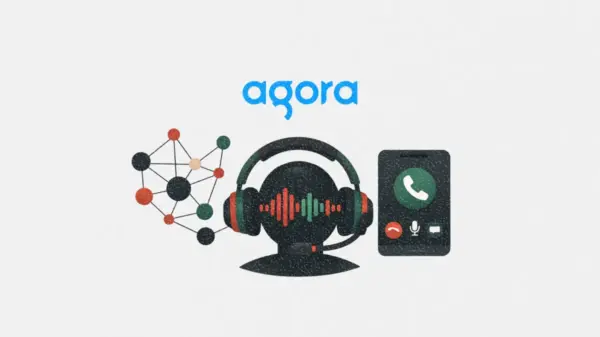






























Real-time engagement platform Agora has launched a new suite of Conversational AI Agent solutions aimed at enhancing customer service and sales and marketing efforts for enterprises. This development indicates a significant shift in how businesses are approaching the automation of customer interactions. As companies transition from experimental implementations to full-scale production environments, there is a growing demand for infrastructure that supports real-time voice conversations with minimal latency and high reliability.
The launch aims to dismantle existing barriers to scalable voice AI, offering potential implications for marketing, sales, and customer experience teams. With rising interaction volumes, companies are increasingly turning to advanced AI solutions to maintain quality while handling customer inquiries efficiently.
According to a report from Gartner, as much as 70% of customer interactions could be automated by conversational AI agents by 2027. Furthermore, by 2028, AI agents are projected to outnumber human sellers by a ratio of 10 to 1. Despite these optimistic predictions, many enterprises have encountered technical challenges when deploying voice AI due to insufficient infrastructure. Long wait times, rigid call routing, and scripted interactions have hindered effective customer engagement. In markets like Singapore, however, adoption is accelerating, with 62.5% of large businesses employing AI technologies, particularly in marketing analytics, sales automation, and customer engagement.
Agora’s new conversational AI platform endeavors to address the challenges associated with voice AI deployment, primarily focusing on latency and orchestration complexity. The platform consists of three core components: an Agent Studio, which is a no-code environment for building and testing voice AI agents; a Conversational AI Engine that integrates technologies such as automatic speech recognition (ASR), large language models (LLMs), and text-to-speech (TTS); and the SDRTN® real-time network, designed for ultra-low latency and high reliability across various regions.
This infrastructure supports natural conversational flows with sub-second response times while maintaining reliable voice communication even in congested networks. Tony Zhao, Agora’s Founder and CEO, emphasized that the infrastructure must be specifically built to facilitate real-time interactions, enabling businesses to deploy conversational agents globally without compromising customer experience quality.
The conversational AI agents are tailored for two significant enterprise use cases: customer service automation and outbound sales engagement. In customer service, AI agents can handle routine inquiries such as appointment reminders, shipping updates, billing questions, and technical troubleshooting. This automation allows customer service teams to focus on more complex issues, enhancing operational efficiency and service quality.
Similarly, in sales and marketing, Agora’s AI agents modernize outbound engagement by facilitating real-time conversational outreach. They are capable of handling tasks such as debt collection, outbound lead qualification, and interactive surveys. Notably, market research company FasesBI reported achieving a conversion rate of 10% using Agora’s voice AI agents to invite participants to surveys, allowing them to scale data collection efforts without increasing headcount.
The launch of Agora’s conversational AI platform highlights critical trends that marketing and customer experience leaders should consider. First, voice AI is transitioning from pilot projects to robust production infrastructures, making real-time networks and orchestration layers essential components. Second, conversational automation is expanding beyond support roles into sales, research, and marketing, fundamentally changing how brands engage with customers. Third, AI agents are poised to transform outbound marketing workflows, enabling continuous operations without the constraints of manual dialing or scripted calls. This necessitates a reevaluation of how brands design voice-first engagement strategies.
As more companies adopt conversational AI, the performance, latency, and conversational quality of these systems will dictate whether they are perceived as helpful assistants or frustrating bots. Platforms that can provide natural conversations at scale will gain a significant competitive edge. Agora’s latest platform reflects a broader industry shift, emphasizing the importance of deploying AI agents in real production environments rather than merely experimenting with them. For teams in marketing, sales, and customer experience, leveraging voice AI agents may unlock new pathways for scaling engagement, automating outreach, and managing increasing interaction volumes without the need to expand human resources.
See also Enhance Your Website”s Clarity for AI Understanding and User Engagement
 FoloToy Halts Sales of AI Teddy Bear After Disturbing Child Interactions Found
 AI Experts Discuss Vertical Markets: Strategies for Targeted Business Growth
 Law Firms Shift to AI-Driven Answer Engine Optimization for Enhanced Marketing Success
 Anthropic Disrupts State-Sponsored Cybercrime Using Claude AI, Reveals Key Insights