












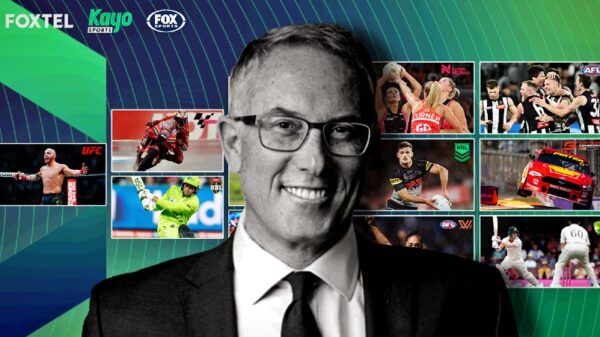































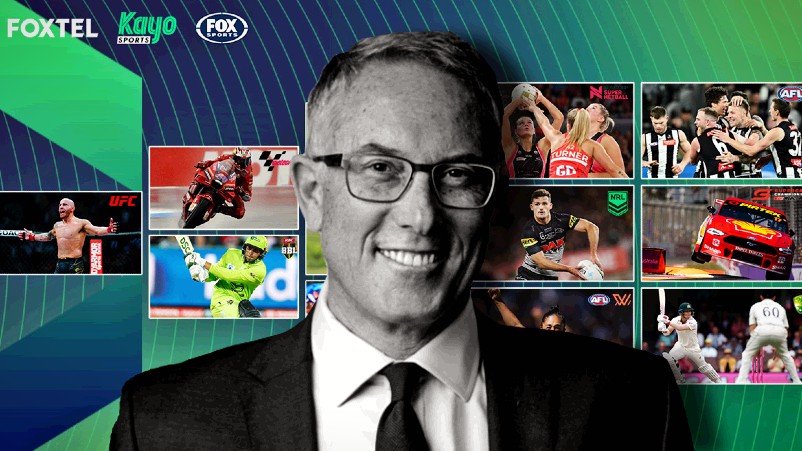
Foxtel Chief Executive Patrick Delany has been making the rounds at various sporting events, including the Winter Olympics and the recent NRL opening round in Las Vegas. Last week, he attended the Supercars opening round and a trip to the MotoGP in Thailand, all while advocating for Foxtel’s billion-dollar investment in Australian sports during a visit to Parliament House in Canberra. His latest announcement came last night in Melbourne, where he revealed that Foxtel’s Kayo has signed a multi-year extension of its broadcasting rights with Formula 1 (F1).
The new partnership will enable Kayo Sports to broadcast every race, qualifying session, and practice in live 4K coverage, as well as live feeds and dedicated Kayo Minis. The platform will also launch a weekly show featuring vertical digital extensions, expanding its award-winning 360 franchise into motor racing, which already includes AFL and NRL.
While Delany and other Foxtel executives remained tight-lipped about the specifics of the extension, citing the competitive nature of F1 rights, he emphasized the importance of maintaining discretion in a landscape where even a single data point can be leveraged by competitors. “In the hyper-optimized world of F1, rights are so competitive,” he explained.
In reflecting on the enduring appeal of live sport to advertisers, Delany stated that brands are increasingly seeking both scale and precision. “As advertisers chase digital addressability and emotionally engaged audiences, live sport has become one of the most powerful environments.” He noted that the ability to target specific personas with digital, addressable advertising is far more efficient than traditional linear advertising.
Delany highlighted that this precision, combined with the emotional intensity of live sports, sets it apart from other advertising environments. “You get consumers and viewers that are emotionally charged at the time,” he noted. As media consumption becomes more fragmented across various platforms and streamers, he argues that live sports offer a unique opportunity to gather large audiences simultaneously.
He pointed out the evolution of media consumption over the past two decades, noting the emergence of various streaming services alongside traditional networks. “General entertainment is spread across multiple platforms, but live sport gathers audiences in one place,” he said.
Moreover, Delany indicated that demand for digitally addressable sports inventory is growing, outpacing supply. “There is a very strong demand for digital addressable sports audiences. Kayo is a key destination for tier-one codes and niche competitions alike,” he stated, observing that while linear advertising continues to decline, demand for Kayo remains robust.
Beyond advertising, Delany emphasized that the sports viewing experience has transformed significantly in the streaming era. He dismissed suggestions that streaming performance issues are systemic, attributing them mostly to individual home Wi-Fi problems. “By and large, issues usually are in your own home,” he asserted, adding that Kayo’s 4K delivery often competes with other household bandwidth demands.
The future, he said, lies in deeper personalisation, with artificial intelligence (AI) playing a crucial role. He envisions a future where viewers can request custom clips focusing on specific players or moments, facilitated by Kayo’s extensive metadata. “We’re loving the opportunity for AI to be used in that interface with all your data points,” Delany remarked.
However, as sports become more shareable and athlete-driven, rights holders face challenges in balancing traditional broadcast environments with the rise of influencer marketing. Delany acknowledged the tension between maintaining exclusive rights and the increasing presence of athlete influencers on platforms like TikTok and Instagram. “The rights are precious,” he warned, cautioning against unchecked fragmentation of premium content.
The structural challenge is evident; athletes now wield global followings and direct distribution channels, while broadcasters invest heavily in securing live rights. With the landscape of sports broadcasting evolving, Delany’s message is clear: live sports remain a premium environment where emotional engagement and data-driven precision converge. As streaming matures, the battleground may shift from the sports field to the control of digital content distribution.
See also Enhance Your Website”s Clarity for AI Understanding and User Engagement
 FoloToy Halts Sales of AI Teddy Bear After Disturbing Child Interactions Found
 AI Experts Discuss Vertical Markets: Strategies for Targeted Business Growth
 Law Firms Shift to AI-Driven Answer Engine Optimization for Enhanced Marketing Success
 Anthropic Disrupts State-Sponsored Cybercrime Using Claude AI, Reveals Key Insights