


















































In a segment aired on December 3, 2025, on MITechTV, Melih Oztalay, CEO of SmartFinds Marketing, spoke with host Mike Brennan about the rapidly evolving landscape of AI marketing. The discussion, available on the MITechTV YouTube Channel, focused on how businesses can prepare for the anticipated shifts in AI marketing practices by 2026.
Oztalay has been at the forefront of an ongoing series on MITechTV aimed at helping executives navigate the complexities of artificial intelligence’s impact on customer acquisition and digital transformation. Brennan opened the conversation by acknowledging a shared sentiment among business leaders: the pace of AI advancement is so swift that even seasoned journalists find it challenging to keep up.
Agreeing with Brennan, Oztalay pointed out that while professionals were experimenting with tools like ChatGPT just a year ago, the speed of AI development has surpassed traditional consumer understanding. “ChatGPT, Gemini, Claude, and Perplexity are no longer new AI,” he remarked. “They are now old AI media.” This observation underscored the core theme of their discussion: the gap between the adoption of AI tools and the construction of AI-first infrastructures is widening.
Oztalay characterized 2025 as the year of AI boom, with an explosion of AI-powered platforms changing the ways customers search, evaluate, and make purchasing decisions. “It’s mind-boggling,” he told Brennan, reflecting on the massive global investments in AI and the uncertainties that lie ahead in 2026. For many business leaders, this reality is both inspiring and daunting, as the traditional mechanics of digital visibility are being redefined by generative systems that curate and summarize content prior to potential buyers visiting a website.
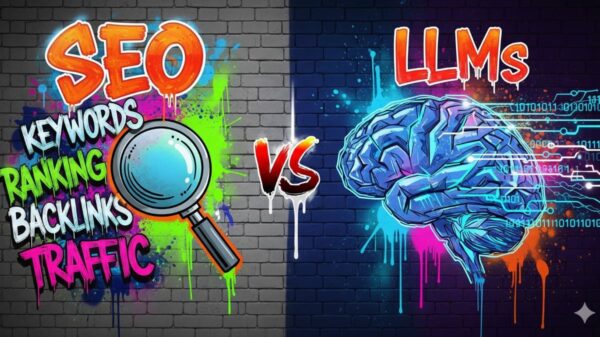
As the conversation progressed, Oztalay outlined the evolution of search engine optimization (SEO) into three concurrent categories: traditional SEO, answer engine optimization (AEO), and generative engine optimization (GEO). He explained that a common misconception among companies is the belief that they can bypass older optimization layers by focusing solely on GEO. “You can’t. All three run simultaneously,” he emphasized, clarifying that generative engines do not eliminate the foundations of digital visibility.
Oztalay introduced what he deemed an essential pivot in digital marketing philosophy: “Ranking is being replaced by being referenced.” In this new paradigm, AI engines prioritize authority signals such as credible mentions, structured content, and expert commentary over mere keyword manipulation or search rankings. This shift indicates that businesses relying exclusively on conventional SEO strategies are at a disadvantage, as AI assesses credibility differently than traditional search engines.
In a practical exercise for executives, Oztalay suggested a straightforward test: ask ChatGPT to list companies in a specific sector and see if one’s own company is included. “You’ll get a long to-do list that tells you exactly what needs to change,” he said, highlighting the importance of adapting to these new standards. SmartFinds Marketing has been focusing on structured content development and AI-readable frameworks through its AI transformation programs.
During the interview, Oztalay noted a downward trend in Google search volumes and click-through rates, emphasizing that while Google’s search engine will not vanish, its role is evolving. AI engines are increasingly becoming the starting point for research. He shared a personal experience of running similar searches on ChatGPT and Google, noting that ChatGPT provided relevant results in seconds, while Google took significantly longer. This illustrates a fundamental change: consumers are seeking clarity and relevance faster than ever, and AI can deliver that efficiently.
As the discussion turned toward the customer journey, Oztalay emphasized that improving visibility is only part of the equation; businesses must also focus on enhancing conversion rates. He outlined four key strategies that can help achieve this: implementing AI systems to monitor visitor behavior, deploying on-site AI chatbots for information collection, utilizing heatmaps to understand user interactions, and conducting A/B testing to identify the most effective page versions. “In 2026, the game is reducing friction and shortening decision time,” he stated, underscoring the compacting sales cycles.
As buyers adjust their expectations—trusting AI for rapid answers and needing content quickly—companies that fail to meet these demands risk losing ground instantly. Oztalay reiterated that businesses must adapt to this accelerated pace to remain competitive. “Leads are hotter sooner, and pipeline velocity can change in weeks rather than quarters,” he warned.
The segment concluded with actionable insights for executives aiming to prepare for AI marketing in 2026. Key recommendations included building AI-ready infrastructure, developing authority signals through expert content and media placements, aligning conversion strategies with AI-driven analytics, and retraining marketing teams to reflect shorter sales cycles. Oztalay cautioned that those delaying adaptation will face significantly higher costs in the long run.
As AI marketing continues to evolve, the competitive edge will belong to those companies that are not only prepared for the technology but also poised to leverage it effectively. “Ranking is being replaced by being referenced,” Oztalay stressed, suggesting that this shift will define the industry far more than any algorithm update.
See also Criteo Unveils AI Strategy, Integrates LLMs to Enhance E-Commerce Revenue Potential
 Langsmith Launches No-Code Agent Builder for Custom Market Research Assistants
 AI Transforms Advertising: Market to Reach $107.5 Billion by 2028 with Enhanced Targeting
 BrandMeOn Launches AI Chatbot for Instant Customer Engagement on Social Media Platforms
 SharpenCX and Ytel Merge to Launch Unified AI CX Platform for Seamless Engagement