














































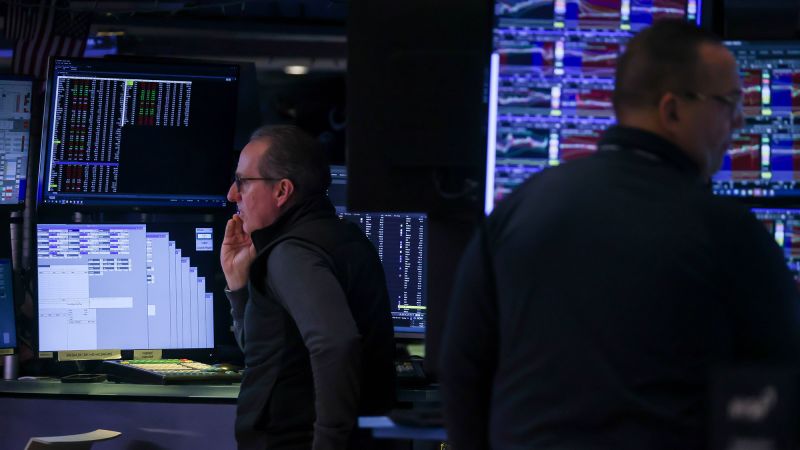
US stocks fell on Thursday, extending a recent trend of volatility as Wall Street reacted to ongoing concerns regarding artificial intelligence and new data indicating a weakening labor market over the past two months. The Dow Jones Industrial Average dropped 420 points, or 0.85%, while the S&P 500 fell by 0.9%, and the tech-heavy Nasdaq Composite saw a decline of 1%.
The Nasdaq is facing its worst three-day decline since April, as investors navigate the potential disruptions AI could bring to the software industry. An exchange-traded fund that tracks the software sector decreased by 2.2% on Thursday, marking its eighth consecutive loss.
According to Mohit Kumar, a strategist at Jefferies, “The near-term trigger was the Anthropic plug-in release, but investors have been grappling with software for the past few months as AI reduces the need for coders and impacts the revenue stream of a number of companies.” He added that the market is currently in a phase of “shoot first and ask questions later,” with heightened concerns surrounding private equity and private credit firms due to their exposure to the sector.
Shares of Blue Owl (OWL), a private credit firm with investments in software companies, declined by 3.6% on Thursday, continuing an 11-session losing streak. While the focus remains on AI’s impact on software, Wall Street is also navigating the corporate earnings season, with lingering apprehensions about the profitability of big tech’s investments in AI.
Microsoft (MSFT) shares fell 2.3%, having traded lower in five out of the past six sessions following its earnings report last week. Alphabet (GOOG) saw a 3% drop after the company reported its earnings and revealed plans to increase spending on data centers and AI-related initiatives. Overall, the Nasdaq is down more than 5.5% from its most recent record high set in October.
The sentiment in the market was further dampened by a broader risk-averse mood impacting cryptocurrencies, with Bitcoin sinking below $67,000, reaching its lowest point in 15 months. Gold, often viewed as a safe haven during uncertain times, fell by 1%, while silver plunged by 10%, continuing a recent trend of extreme volatility.
Stocks further extended their losses Thursday morning after two economic data reports depicted a fragile labor market. US Treasury bonds rallied, leading to lower yields. According to the Bureau of Labor Statistics, the monthly Job Openings and Labor Turnover Survey indicated that job openings in December dropped to their lowest level since 2020.
This disappointing economic data followed reports from Challenger, Gray & Christmas, which revealed that January witnessed the highest number of job cut announcements since 2009. As a result, Wall Street’s fear gauge, the VIX, surged by 11%, surpassing 20 points, a threshold indicating heightened market volatility. CNN’s Fear and Greed Index also remained in the “fear” zone.
As investors await the delayed January jobs report due to the partial government shutdown, uncertainty remains high. “With the jobs report delayed until next week, jitters around the labor backdrop are contributing to today’s cautious tone,” remarked Seana Smith, senior investment strategist at Global X ETFs. As the market grapples with these challenges, the future trajectory remains uncertain, with ongoing scrutiny on the implications of AI and labor market dynamics.
See also Grow and Convert Launches AI SEO Service with Proprietary Tools for Enhanced Visibility
 Mobile Marketing in India Shifts to Authenticity and AI Amid Privacy Concerns
 Adobe’s Rachel Thornton Reveals How AI Can Make Marketers 10x More Effective
 Matt Diamante Joins Edward Show for SEO Insights on AI Marketing Strategies
 Google’s AI Overviews Cut Click-Through Rates by Up to 60%, Reshaping Digital Marketing Strategies