



















































Asian equities opened 2026 with substantial gains, although concerns about a potential artificial intelligence (AI) bubble and varying interest rate strategies across the region could pose challenges. The region’s close ties to the global AI supply chain leave it vulnerable to significant fluctuations in Wall Street performance, despite more attractive valuations for Chinese chipmakers and Beijing’s initiative for technological self-sufficiency, which provide some degree of protection.
In 2025, MSCI’s Asia stock index outperformed global counterparts by nearly five percentage points, marking its best relative performance since 2017. This trend has fueled investor interest in the technology sector, which reached a record high early in January 2026. Nevertheless, while some analysts advocate for increased exposure to AI-driven markets, others caution about the risks associated with a concentration of major technology firms, particularly in Taiwan and South Korea.
Ken Wong, an Asian equity portfolio specialist at Eastspring Investments in Hong Kong, noted the emergence of “AI fatigue,” as opposed to an outright bubble. He cautioned that any downturn in AI capital expenditures or a deterioration in earnings trajectories could introduce significant risks.
Investor sentiment remains cautious regarding Wall Street’s exuberance over AI, while optimism is building around Chinese chipmakers. The Chinese government is considering a substantial incentive package worth up to **US$70 billion** (S$90 billion) to bolster its semiconductor industry, signaling a commitment to achieving tech independence.
The enthusiasm for Chinese tech stocks is further supported by their relatively low valuations, with a key index of Hong Kong-listed shares trading at **19 times** forward earnings, compared to **25 times** for the Nasdaq 100 Index. Recent trading debuts of companies like **MetaX Integrated Circuits Shanghai** and **Moore Threads Technology** illustrate the strong demand, prompting other firms such as Baidu’s AI chip unit and **GigaDevice Semiconductor** to seek funding through public offerings.
The policy landscape in the Asia-Pacific is a critical factor influencing capital flows and investor sentiment. The US Federal Reserve is anticipated to cut rates twice in 2026, potentially creating conditions for central banks in countries like India and Thailand to lower borrowing costs and stimulate economic growth. In contrast, the Bank of Japan faces pressure to raise rates to combat inflation and a weakening yen, while New Zealand and Australia are also shifting towards tighter monetary policies.
Dilin Wu, a research strategist at **Pepperstone Group**, stated, “India’s sustained low rate environment may provide gentle tailwinds for its equity market, while further easing in Thailand, Malaysia, and potentially China could boost stocks.” He emphasized that markets with policy flexibility and strong earnings resilience are likely to outperform, while highly leveraged or rate-sensitive assets may face increased pressure.
As some investors pivot away from US assets and the crowded AI trade, they are focusing on markets that underperformed in 2025. The **NSE Nifty 50 Index** in India finished 2025 with a **10.5 percent** gain, falling short of the MSCI AC Asia Pacific Index by its largest margin since 1998. Expectations for lower consumption tax rates and interest rate cuts are fueling hopes for a turnaround in earnings.
Some analysts see potential in **ASEAN** markets, which, while lagging behind, are viewed as offering value. Ng Xin-Yao, a fund manager at **Aberdeen Investments**, highlighted, “India and ASEAN are interesting for being very non-AI, while some of these markets have underperformed, so there might be value.” He recommends selecting stocks with resilient cash flows that are less reliant on macroeconomic or political factors, particularly those offering high dividend yields.
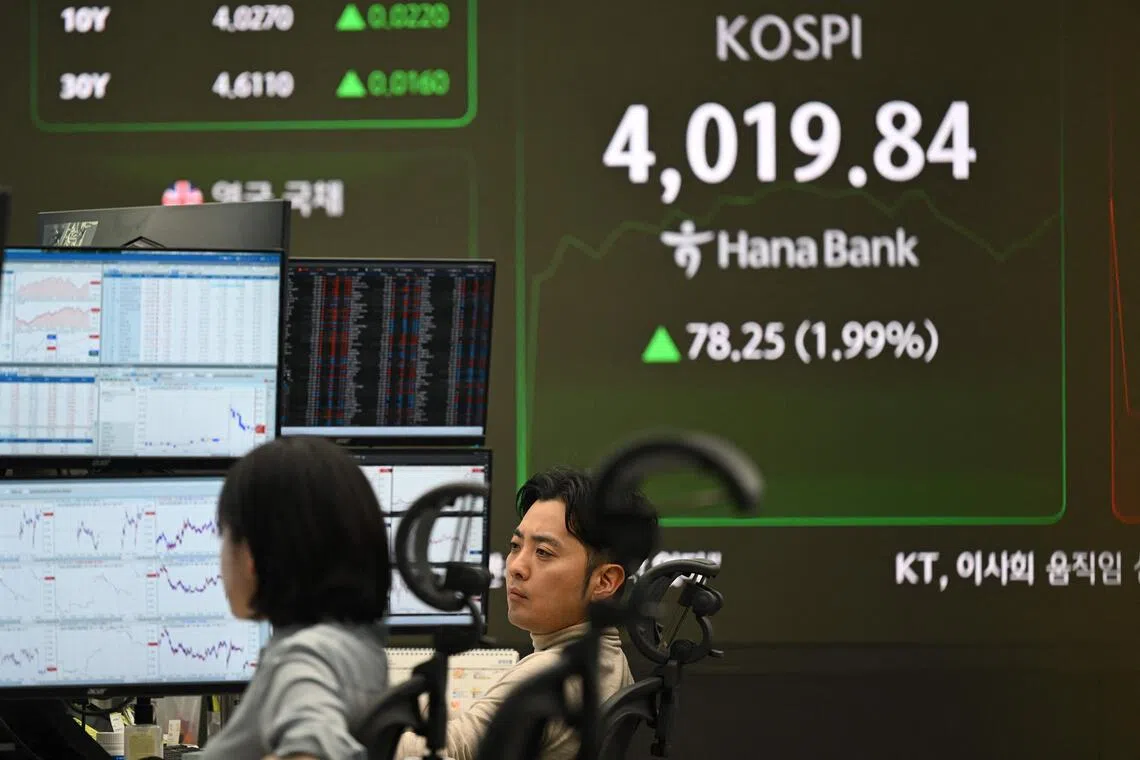
The spotlight remains on South Korea, where stocks achieved a staggering **76 percent** rally in 2025, driven by the AI boom and optimism regarding corporate and market reforms. The **Kospi Index** gained another **2.3 percent** on January 2, reaching above **4,300** and moving toward the **5,000** level targeted by President **Lee Jae Myung**.
AI-related momentum continues to benefit South Korea’s semiconductor giants. **Samsung Electronics** reached new heights on January 2 after its co-CEO reported positive customer feedback, stating, “Samsung is Back.” This momentum is further corroborated by data showing a **43 percent** increase in December 2025 semiconductor exports, highlighting the pivotal role of both Samsung and **SK Hynix** in the global AI landscape. The future trajectory of this market will be influenced by governmental measures aimed at enhancing corporate governance and supporting small-cap stocks.
See also Musk Warns Grok Users: Illegal Content Will Face Legal Consequences Amid Indian Crackdown
 California Law Requires AI Companies to Disclose Disaster Plans and Risk Assessments
 India Orders X to Revise Grok AI Tool Following Obscene Content Complaints
 BRICS Leaders Call for Global Governance Framework to Ensure Safe AI Development
 AI Distrust Soars in 2026: 75% of Americans Fear Job Losses and Ethical Failures