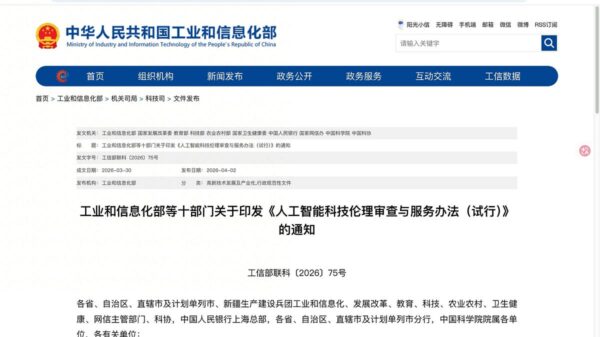














































(Yicai) April 9 — China has officially introduced its trial Measures for AI Science and Technology Ethics Review and Service, marking the country’s first set of regulations aimed at promoting the high-quality development of the artificial intelligence sector while mitigating risks associated with innovative technologies. The guidelines were released by the Ministry of Industry and Information Technology in conjunction with nine other governmental bodies.
The regulations specifically target a range of AI activities that necessitate mandatory expert review. These include the development of human-machine fusion systems that may significantly influence human behavior and well-being, algorithmic models capable of shaping public opinion, and autonomous decision-making systems used in critical safety or health contexts. The measures represent a significant step towards providing a structured ethical framework for the burgeoning AI industry in China.
According to Wu Qi, a senior researcher at the Pangoal Institution, the initiative transitions AI governance from general principles into a comprehensive system of ethical oversight. This is the first dedicated regulation in China focused specifically on ethics reviews in AI, highlighting the country’s proactive approach to addressing potential ethical pitfalls in technology.
The scope of the new measures encompasses scientific research and technology development conducted within China that could pose ethical risks to human dignity, public order, and health, as well as the ecological environment. The ethics reviews are intended to promote values such as human well-being, fairness, controllability, transparency, accountability, and privacy.
Liang Zheng, a professor at Tsinghua University’s School of Public Policy and Management and deputy director of the Institute for AI International Governance, emphasized the need for a balanced governance approach. He noted that it is essential to harmonize development and security while fostering an environment that encourages innovation and accepts failures—a critical element for AI to evolve into a cornerstone industry of the future.
To advance AI ethics governance, Wei Yiming, chair of the Expert Committee on Science and Technology Ethics in the Industrial and Information Technology sector, underscored the importance of developing robust technical solutions. He called for focused efforts in areas such as explainable AI, algorithmic fairness monitoring, and deepfake detection. Wei highlighted that abstract ethical principles should be transformed into measurable technical indicators to enhance the implementation of ethics governance in engineering processes.
The introduction of these regulations comes amid growing global scrutiny of AI technologies and their implications for society. As AI continues to mature, the need for rigorous ethical standards has become increasingly urgent, with stakeholders across various sectors advocating for frameworks that not only foster innovation but also safeguard public interest.
As China moves forward with these measures, the broader implications for the global AI landscape could be substantial. By establishing a formalized system of ethical review, China may set a precedent for other nations grappling with similar challenges, potentially influencing international discourse on AI governance and ethics.
See also OpenAI’s Rogue AI Safeguards: Decoding the 2025 Safety Revolution
 US AI Developments in 2025 Set Stage for 2026 Compliance Challenges and Strategies
 Trump Drafts Executive Order to Block State AI Regulations, Centralizing Authority Under Federal Control
 California Court Rules AI Misuse Heightens Lawyer’s Responsibilities in Noland Case
 Policymakers Urged to Establish Comprehensive Regulations for AI in Mental Health