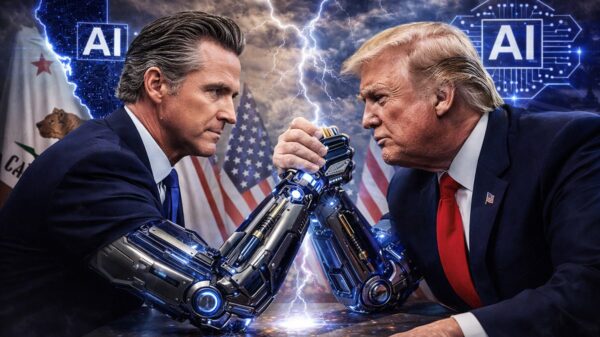
President Donald Trump on Monday renewed calls for federal regulation of artificial intelligence (AI) as Florida lawmakers begin examining the implications of AI within the state. In a post on Truth Social, Trump emphasized the need for a unified regulatory approach, stating, “There must be only One Rulebook if we are going to continue to lead in AI.” He revealed plans to sign an executive order on the topic later this week, arguing that a fragmented system with 50 state approvals would hinder progress in the AI sector.
“You can’t expect a company to get 50 Approvals every time they want to do something. THAT WILL NEVER WORK!” Trump continued, highlighting his belief that the U.S. is currently leading in AI but risks losing its edge without cohesive federal standards.
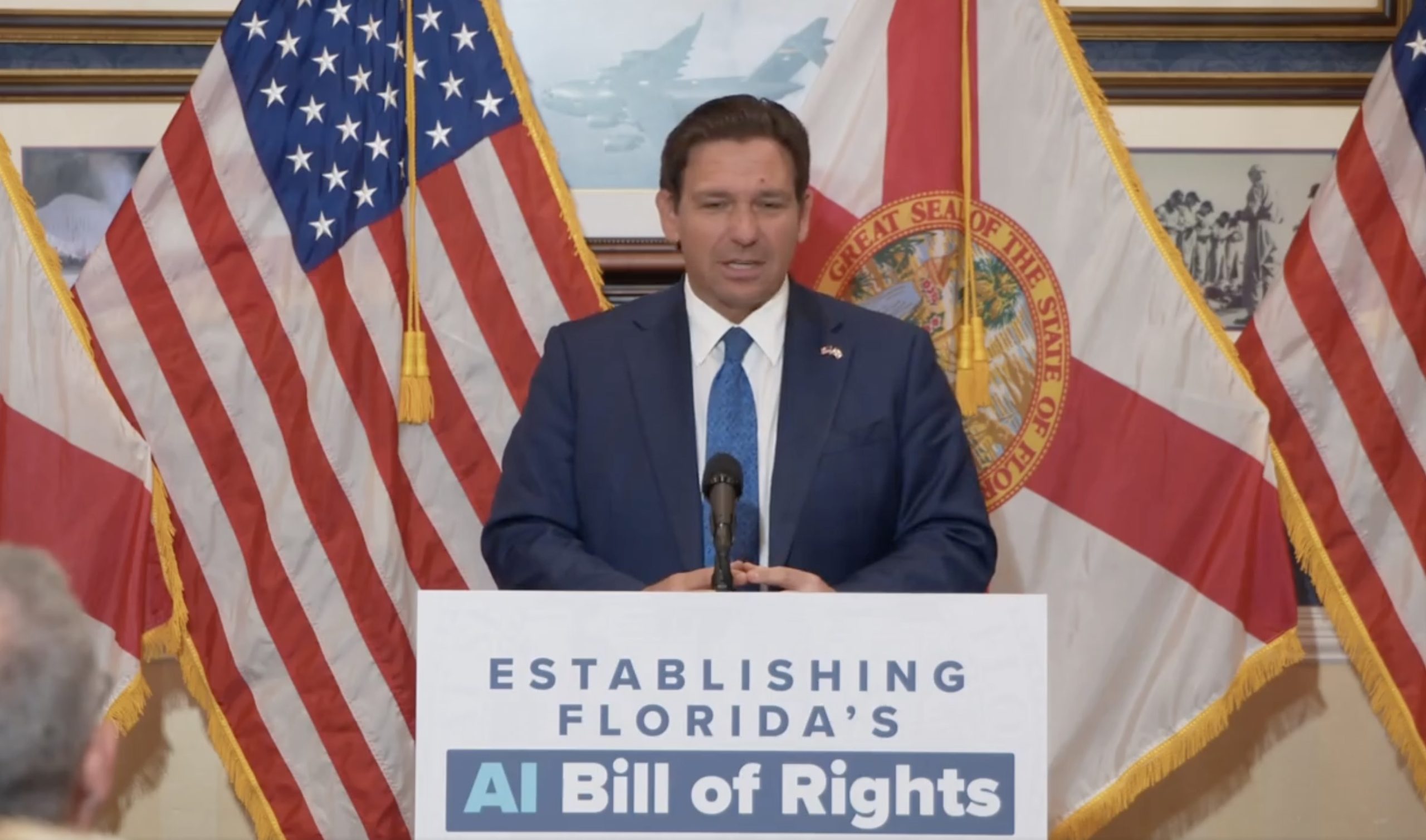
In contrast, Florida Governor Ron DeSantis has voiced strong objections to the prospect of federal preemption over state AI regulations. He took to social media to assert that an executive order could not override state legislative actions. “Congress could, theoretically, preempt states through legislation,” DeSantis noted on X, but criticized Congress for lacking a coherent regulatory scheme, suggesting that their inaction could lead to what he termed an “AI amnesty.” He expressed doubt that Congress could secure the votes necessary for such measures, given their unpopularity with the public.
On Tuesday, several Florida House panels are set to convene discussions addressing various issues related to AI. A spokesperson for House Speaker Daniel Perez, R-Miami, stated that these discussions are not intended as a precursor to sweeping regulatory legislation. “AI is a transformative technology, and like all technology, it can have positive and negative impacts,” said House spokeswoman Amelia Angleton. She reiterated that any comprehensive regulatory framework should be addressed at the federal level.
The Florida House panels will cover diverse topics, including the Economic Infrastructure Subcommittee’s examination of the impacts of data centers on electric utilities, the Careers & Workforce Subcommittee’s focus on AI’s challenges to employment, the Natural Resources & Disasters Subcommittee’s review of AI in emergency management, and the Civil Justice & Claims Subcommittee’s analysis of AI’s influence on legal practices.
Senate President Ben Albritton, R-Wauchula, expressed interest in the content of Trump’s forthcoming executive order on AI regulation. “The president has a view about this which is more global, is very energetic about wanting to see where AI can lead the business community … about the national defense,” he remarked, emphasizing the potential of AI to enhance national security. Albritton also acknowledged DeSantis’ concerns regarding the personal impact of AI on Floridians and the need to protect individual liberties.
This summer, DeSantis opposed a proposal in the federal “One Big Beautiful Bill Act” that would have imposed a decade-long ban on state-level AI regulations, a proposal that ultimately failed. Recently, he reiterated his concerns about a potential 10-year preemption, arguing it would effectively hand control to a few tech companies. “That is basically saying, ‘Let the handful of tech companies drive the train, and we’re just along for the ride,’” he stated during an event in The Villages.
DeSantis has also warned of the risks associated with AI, describing the technology as potentially leading to an “age of darkness and deceit” without proper safeguards. He reiterated his call for a Florida “citizens bill of rights” for AI, asserting that failing to establish meaningful protections could have dire consequences, particularly for children. His proposed legislation aims to address issues including protections against AI created in China and the risks posed by deep fake videos, as well as the environmental impacts of large data centers on water resources and utility costs.
As conversations surrounding AI regulation unfold at both federal and state levels, the ongoing debate reflects broader concerns about balancing innovation with public safety and ethical considerations. The stakes in this regulatory landscape are significant, as lawmakers seek to define the future of AI governance in a rapidly evolving technological environment.
See also India’s AI Governance Guidelines Transform Auto Sector, Shifting Liability to Manufacturers
 Europe’s AI Ethics Platforms Market Forecast to Soar to $45.3 Billion by 2035 Amid Regulatory Shift
 India’s Privacy Law: Calls for Real-Time Accountability as AI Data Demands Shift
 UK Government Launches AI Growth Lab to Accelerate Adoption Amid Regulation Hurdles
 Florida Lawmakers Advance AI Bill of Rights Amid National Regulation Debate