



















































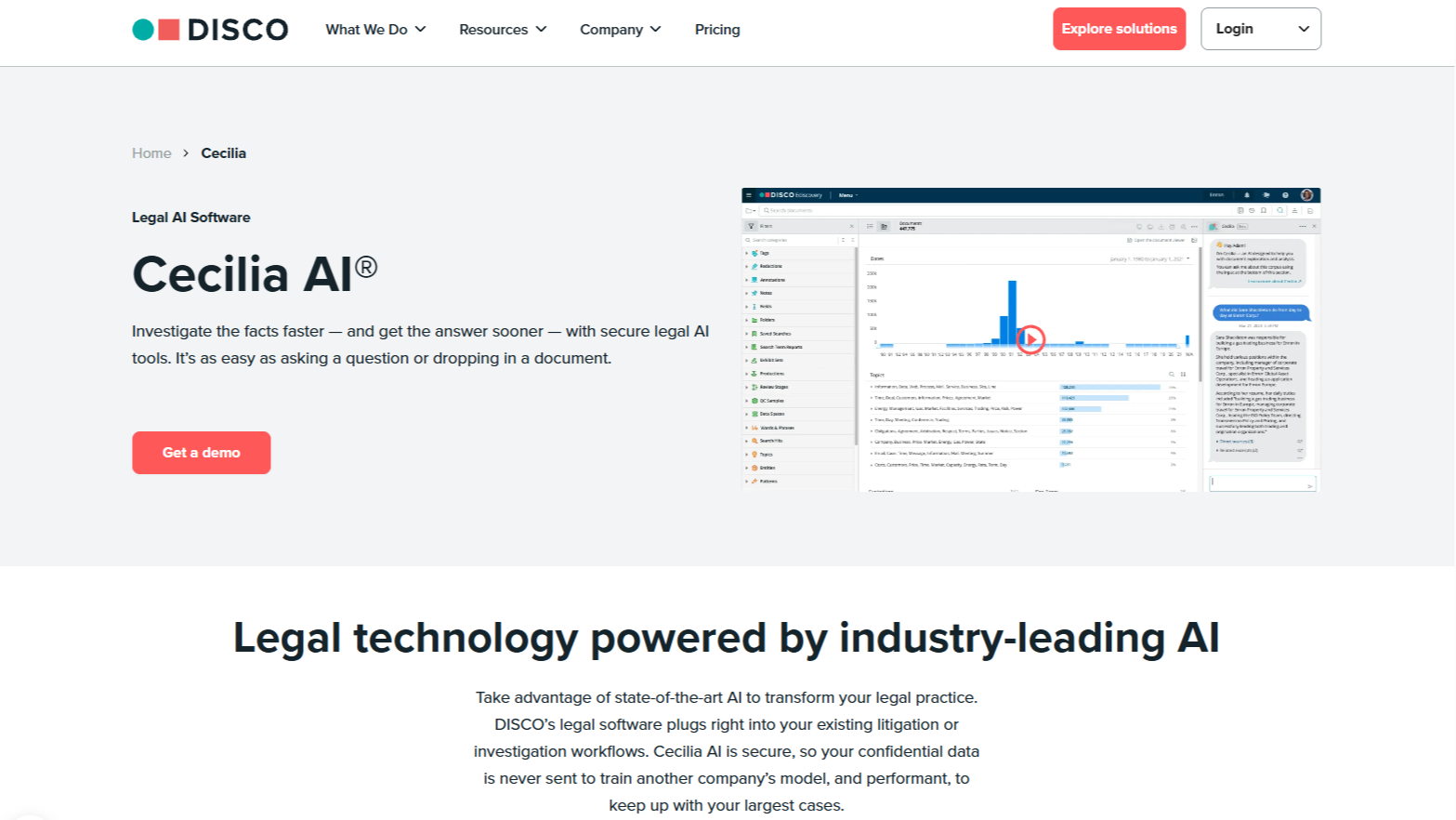
AUSTIN, Texas — DISCO, a legal technology firm, has unveiled what it describes as “the industry’s first scaled agentic AI tool for fact investigation and e-discovery.” The enhancement to its Cecilia Q&A tool is aimed at addressing large-scale e-discovery tasks that involve millions of documents and terabytes of data, with a launch date set for later this year.
The new capabilities introduce an autonomous, multi-step reasoning engine to DISCO’s existing AI platform. CEO Eric Friedrichsen emphasized that this enhancement will allow for more detailed analytical capabilities, enabling the identification of nuanced connections within extensive document sets. Unlike other agentic AI applications that focus on smaller tasks, DISCO’s scaled agentic AI can handle enterprise-level datasets, a crucial differentiator in high-stakes litigation.
Agentic AI, as defined by industry experts, refers to systems capable of autonomously breaking down complex requests into multiple steps, reasoning through problems, and executing tasks without continuous human intervention. While many such applications in legal tech focus on specific tasks—like contract reviews or brief writing—DISCO is targeting the larger, complex workflows typical of major litigation.
Richard Crum, DISCO’s chief product, technology and strategy officer, noted that the company’s approach is tailored for “large, complex workflows,” allowing it to process vast amounts of data while retaining its autonomous reasoning capabilities. This capability positions DISCO to manage entire litigation matters rather than just individual documents.
In the past 18 months, DISCO has introduced several AI-powered tools under its Cecilia AI platform. These include Cecilia Q&A, which is now receiving the agentic capabilities upgrade, and Cecilia Auto Review, designed for automated document reviews at a remarkable speed of up to 32,000 documents per hour. Additionally, the company launched Cecilia Definitions for enhanced text analysis and received recognition as a G2 2025 award winner for “Best Legal Software Products,” based on user reviews.
According to a study released in October 2025 by DISCO and Ari Kaplan Advisors, 72% of legal professionals anticipate adopting generative AI within the next year, with 35% already utilizing it. However, the research indicated that security concerns remain the primary barrier to broader adoption.
On the partnership front, DISCO announced an expansion of its strategic e-discovery and technology partnership with Mourant, a professional services firm focused on financial services clients. This collaboration further enhances DISCO’s position in the legal technology landscape.
Since its founding in 2012, DISCO has established itself as a cloud-native platform provider, integrating technology with professional services to cater to the evolving needs of legal practitioners. The firm went public in 2021 and is traded on the NYSE under the ticker symbol LAW. Under the leadership of CEO Eric Friedrichsen, who took the helm in April 2024, DISCO has shifted its focus toward “customer-centric” development aimed at high-value, complex litigation matters, distancing itself from being a generalist provider.
In its recent quarterly report for Q3 2025, DISCO posted total revenue of $40.9 million, representing a year-over-year increase of 13%. The software revenue climbed to $35.2 million, up 17%. Customer adoption of the Cecilia AI platform surged by over 300% since September 30, 2024, signaling robust interest and engagement from legal professionals.
DISCO’s enhanced Cecilia Q&A tool, featuring agentic capabilities, is expected to be available at no additional cost to customers later in 2026. Built on DISCO’s cloud-native platform, the tool operates within the company’s established security and privacy framework, ensuring that users can leverage its advanced features confidently.
DISCO plans to showcase the new tool at Legalweek and will continue to provide updates on its website, further solidifying its commitment to innovation in legal technology.
See also European Commission Charges Meta with Antitrust Violations for Blocking Third-Party AI on WhatsApp
 Veriff Reveals Key Findings on AI-Driven Identity Fraud Trends for 2026
 UMich’s Construction Cameras Raise Privacy Concerns Amid AI Surveillance Policy Gaps
 Regulators Shift Focus to Real-World AI Testing, Elevating QA’s Role in Compliance
 Global Key Solutions Launches KeyPedia™, AI Platform for Real-Time Regulatory Compliance Tracking