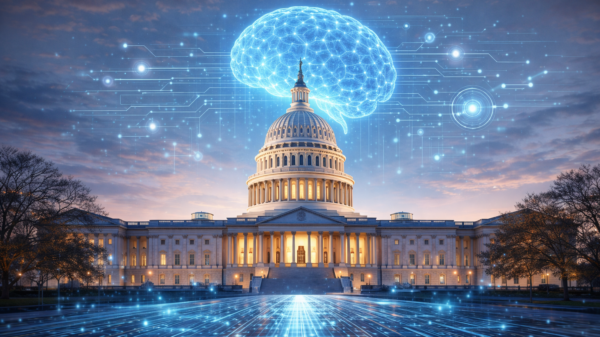























































An Executive Order (EO) titled “Ensuring a National Policy Framework for Artificial Intelligence (AI)” has been issued, mandating federal agencies to identify and mitigate barriers to a cohesive national standard for AI. The EO emphasizes the necessity for U.S. AI companies to “innovate without cumbersome regulation,” arguing that “excessive state regulation” undermines this goal. This directive aims to create a unified framework that prevents state laws from conflicting with federal policy.
The EO specifically outlines that protections must be implemented to safeguard children, prevent censorship, respect copyrights, and ensure community safety. In a letter addressed to the Department of Justice in September, America’s Credit Unions pointed to state fair lending and algorithmic bias laws as examples of regulations that impose undue burdens on credit unions using AI technologies.
To facilitate this initiative, the EO includes several key actions. Within 30 days, an AI litigation task force will be established to challenge any state laws that contradict the EO’s policy framework. Furthermore, the Department of Commerce is tasked with producing a report within 90 days identifying state laws that conflict with the objectives outlined in the EO. Following this report, the Federal Communications Commission (FCC) must assess whether to adopt a federal reporting and disclosure standard for AI models that would preempt conflicting state legislation.
In addition, the Federal Trade Commission (FTC) is required to release a policy statement clarifying how its prohibitions on unfair and deceptive practices apply to AI models, as well as the extent to which these standards may override state laws that mandate changes to the outputs of such models. The EO also directs executive branch agencies to evaluate whether discretionary federal funding to states could be decreased if those states enact conflicting AI regulations.
Notably, certain state laws are excluded from the potential for preemption. These include regulations related to child safety, AI compute and data center infrastructure, state government procurement of AI, and other unspecified topics. The EO reflects a growing concern among policymakers about the fragmented regulatory landscape for AI across the United States, which may hinder the innovation and deployment of AI technologies.
This move aligns with broader efforts from the federal government to establish a clear and consistent regulatory environment for AI. As artificial intelligence continues to evolve rapidly, the need for a national framework becomes increasingly pressing, allowing for innovation while simultaneously addressing ethical, legal, and safety concerns. The outcomes of these initiatives could significantly shape the trajectory of AI development in the U.S., balancing the interests of innovation against the imperative for responsible use.
See also AI Transformation in India: 80% of Routine Tech Jobs to Be Automated by 2026
 Over 150 Parents Urge NY Governor to Sign AI Safety Bill Without Amendments
 NCOIL Opposes Trump’s AI Regulation Order, Citing Threats to State Authority
 Australia’s AI Plan Lacks Dedicated Regulation, Experts Warn of Growing Risks
 OMB Issues New Guidelines for AI Procurement: Agencies Must Ensure LLMs Are Unbiased by March 11