






































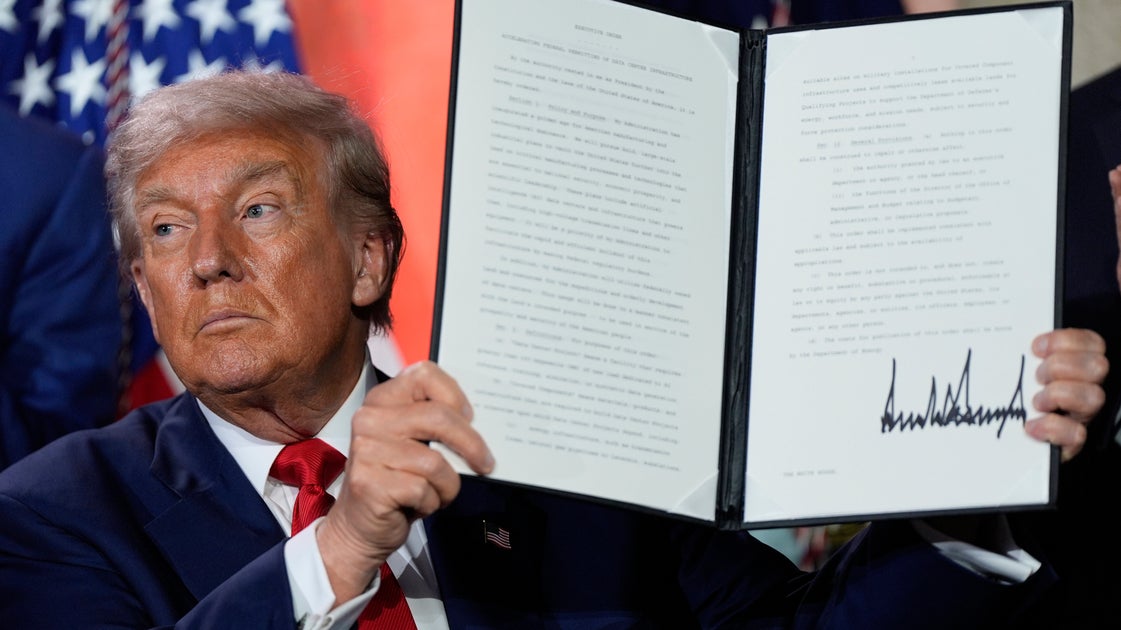
WASHINGTON ― The populist faction of the Republican Party is increasingly concerned that its support for artificial intelligence (AI) and efforts to minimize regulation of the tech industry may have unintended consequences, potentially leading to significant job losses and greater wealth concentration among billionaires at the expense of the working class. This apprehension comes as President Donald Trump pushes for aggressive expansion of the AI sector as part of a broader initiative to remove regulatory obstacles, particularly in the context of competition with China.
This week, Trump directed the nation’s science agencies to integrate AI into government functions, while his administration is reportedly contemplating an executive order that would prohibit individual states from imposing their own regulations on the technology. Such a move aims to alleviate frustration among states eager for action from Congress, but it has drawn criticism from within the party.
“I don’t think we are doing enough to protect workers,” said Senator Josh Hawley (R-Mo.) in an interview with HuffPost, reflecting a sentiment among some MAGA Republicans who oppose a moratorium on state regulation. “We need to do more because I’m confident Silicon Valley will get rich from this… But what about blue-collar workers in my state?”
Steve Bannon, a key figure in Trump’s inner circle, has also raised alarms, labeling AI as potentially “the most dangerous technology in the history of mankind.” On his show, “The War Room,” Bannon stated, “This is not capitalism. This is corporatism and crony capitalism,” warning that without proper safeguards, AI could precipitate a “jobs apocalypse” that would adversely affect many of Trump’s supporters.
Concerns extend beyond job loss; some MAGA Republicans are also uneasy about the rapid expansion of data centers essential for powering AI technology. Representative Marjorie Taylor Greene (R-Ga.) criticized the prospect of a ten-year ban on state regulation, calling it “a gift to Big Tech and a disaster for American workers and states’ rights.” Her remarks followed the removal of such a moratorium from Trump’s legislative agenda earlier this year.
Interestingly, the hesitations voiced by MAGA populists resonate with progressive critics of AI. Senator Bernie Sanders (I-Vt.) has been vocal about the risks associated with AI, stressing that the wealthiest individuals, including tech magnates like Elon Musk and Jeff Bezos, stand to gain disproportionately from automation, often at the expense of working-class jobs. “It will mean even more wealth and even more political power for these guys at the top,” Sanders said in an interview, cautioning that without intervention, living standards for workers could decline significantly.
Recent layoffs in the tech sector have fueled fears of an impending recession, while simultaneously raising questions about the role of AI in eliminating jobs. While Dean Baker, a senior economist at the progressive Center for Economic and Policy Research, acknowledged that mass unemployment fears may seem exaggerated given the natural churn of the job market, he noted that high levels of layoffs could indicate a weakening labor environment. “If AI increased worker productivity so much that it caused mass unemployment, it would also substantially boost broader economic growth,” he added.
Despite these varying perspectives, there is a consensus among experts that the labor market is facing challenges, exacerbated by a tech-inflated stock bubble that might lead to a recession. David Sacks, a prominent Trump ally in Silicon Valley, has urged investors to remain optimistic about AI investments, suggesting that stagnation could threaten economic growth. “According to today’s WSJ, AI-related investment accounts for half of GDP growth,” he asserted in a social media post.
Concerns surrounding AI are not limited to job displacement; they also encompass broader societal implications. Geoffrey Hinton, known as the “Godfather of AI,” voiced apprehension about the potentially devastating impact of AI on employment. “If AI gets as smart as people, or smarter, any job they might do can be done by AI,” he cautioned at a recent event.
Moreover, the ramifications of AI extend into sectors traditionally seen as secure. Senators Brian Schatz (D-Hawaii) and Mark Warner (D-Va.) highlighted that unemployment rates among recent graduates and entry-level knowledge workers could experience significant spikes due to AI advancements. “We have to be clear-eyed about their primary selling proposition and how disruptive it is,” Schatz noted.
As Congress grapples with AI regulation, there remains a significant gap between the urgent need for policy and the current legislative landscape. While bipartisan efforts under the Biden administration aimed to develop a regulatory framework, momentum has stalled under Trump’s administration, which has generally prioritized industry expansion over regulatory caution. “Any new technology is going to be disruptive,” said Senator Bill Hagerty (R-Tenn.) in a recent interview, emphasizing optimism about potential productivity gains.
However, the recent cyber-attack by a Chinese state-sponsored group utilizing AI has intensified calls for immediate government action. “Guys wake the f up. This is going to destroy us—sooner than we think—if we don’t make AI regulation a national priority tomorrow,” warned Senator Chris Murphy (D-Conn.). As the debate over AI continues, it remains clear that both economic and security concerns will shape the future discourse surrounding this transformative technology.
See also Google CEO Sundar Pichai Urges U.S. to Balance AI Regulation Amid Global Competition
 Tier-II Cities Drive Real Estate Boom in India: Ayodhya, Lucknow, and More See Surge in Demand
 Australia Unveils First National AI Plan, Emphasizing Voluntary Business Compliance
 OSTP Faces Backlash for Deregulating AI Amidst Growing Public Safety Concerns
 SAI360 Acquires Plural Policy to Enhance AI-Driven Regulatory Compliance Solutions