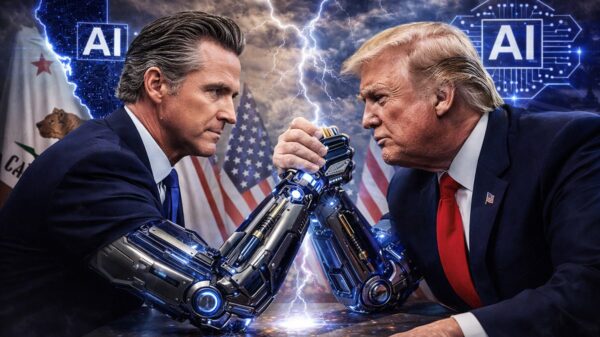



















































Reports from early December suggest that President Donald J. Trump is poised to sign an executive order aimed at establishing a federal framework for regulating artificial intelligence (AI), effectively overriding state-level laws. This action would prevent states from enforcing their own regulations concerning safety, transparency, data use, and algorithmic accountability, in an effort to create a unified national standard.
The Trump administration argues that a disjointed array of state laws on AI could hinder interstate commerce and compromise the nation’s competitiveness in technological advancement. The rationale presented is not unfamiliar: with states unable to reach consensus, and as new technologies cross borders, only a cohesive national standard can ensure stability in this rapidly evolving sector.
While the rationale has its merits—many states such as California, Colorado, Texas, and New York have enacted conflicting regulatory approaches—the proposed federal takeover raises concerns. Critics argue that such a move could stifle innovation and centralize control over a domain that is inherently dynamic. The fundamental question surrounding the action pertains to the balance of governmental power: what is necessary to protect individual freedoms, and what might infringe upon them?
As the author of an upcoming book titled “A Serious Chat with Artificial Intelligence,” I have come to appreciate a paradox emerging in our current technological landscape: while AI may extend our capabilities, there is a risk that we may inadvertently curtail our freedoms. The push for centralized regulation, however well-intentioned, has historically led to stagnation rather than progress.
State-level regulation of AI, though not without its challenges, has allowed for diverse approaches. Various states are tackling different concerns—from algorithmic bias to data privacy—with many experimenting with rules on disclosure and transparency. This variety exemplifies federalism in action, showcasing states as “laboratories of democracy” rather than mere extensions of federal authority.
The administration’s approach—federal preemption followed by uniform regulation—could, paradoxically, create greater problems. The assumption that a central authority can better manage the risks associated with emerging technologies than the collective knowledge of millions of actors in a free market is philosophically flawed. This has proven true across numerous industries from railroads to nuclear power, and it is highly likely to hold true for AI as well.
Government regulation may be warranted in specific contexts, such as when AI is utilized as a weapon or for unlawful purposes. Historical precedents indicate that overregulation can stifle industry growth—consider the nuclear power sector, which faced stagnation due to excessive regulations spurred by fear. Had growth continued unimpeded, we might have better addressed climate-related challenges.
Economic Implications of Uniform Regulation
Economist Robert Higgs coined the term “regime uncertainty” to describe the phenomenon where unpredictable regulatory environments deter private investment. This principle applies aptly to today’s AI landscape, where innovators are confronted with a barrage of conflicting regulations worldwide, including the European Union’s AI Act and various state laws in the U.S. As Higgs noted, when government seeks to be the co-author of every technological development, innovation tends to freeze in anticipation of regulatory interventions.
Friedrich Hayek, another influential economist, argued that the intricacies of a complex market cannot be understood by a single governing body. Instead, they emerge from spontaneous order—the self-adjusting system of free participants responding to incentives and information. In the realm of AI, this principle is particularly relevant. With the technology evolving rapidly and user feedback shaping its trajectory, the market reacts quickly to failures, compelling companies to adapt or risk losing customers.
In recent months, leaders in the AI industry have expressed the need for regulation, but concerns about the potential entrenchment of existing players have also been voiced. Smaller companies fear that federal licensing requirements could stifle innovation, echoing Hayek’s warning that regulation often benefits established players at the expense of newcomers.
The notion that regulation is essential to mitigate real risks assumes a false dichotomy: that centralized control is necessary for order, while freedom leads to chaos. In reality, it is the balance between government oversight and the spontaneous order of a free market that fosters meaningful progress. The current dialogue around AI regulation reflects deep-seated anxieties rather than an informed understanding of how innovation thrives.
Demanding comprehensive regulation at this stage may lead to premature constraints, stifling the potential benefits that AI could offer. Historical examples abound where fears of new technologies resulted in missed opportunities for improvement and safety. The challenge lies in navigating the unknown without resorting to restrictive measures that could hinder growth and discovery.
The administration’s proposal for a single federal standard may ultimately do more harm than good. Rather than centralizing authority, federal policy should focus on preventing states from imposing restrictive regulations that could hinder AI innovation. By embracing a framework that protects the freedom to innovate, we can foster an environment where the benefits of AI can be fully realized while mitigating its inherent risks.
Trusting in the spontaneous order of a free society, coupled with existing legal frameworks to address grievances, may provide a more effective approach to the challenges posed by AI. This perspective underscores the importance of balancing the need for oversight with the recognition of how innovation unfolds through experience. In the end, maintaining the courage to embrace technological advancements, rather than constraining them out of fear, may be the key to unlocking the potential that AI holds for the future.
See also Trump’s Health Agencies Accelerate AI Adoption, Reducing Patient Protections
 AI Transforms US Immigration Compliance: Departments Enhance Workflows with Continuous Vetting
 HHS Unveils AI Rules for Healthcare: Key Insights for Leaders by February 2026
 Trump’s AI Executive Order Advances Federal Preemption of State Regulations
 Federal AI Strategy Introduces Compliance Challenges for Banks and Tech Firms