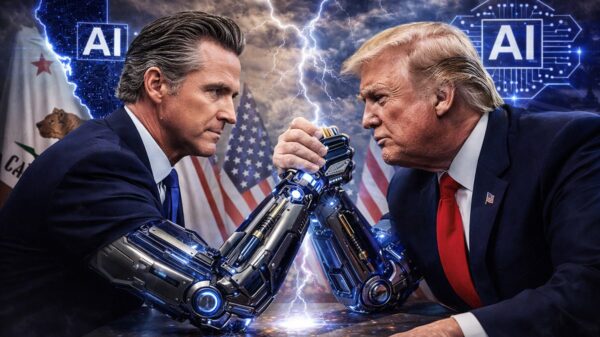
















































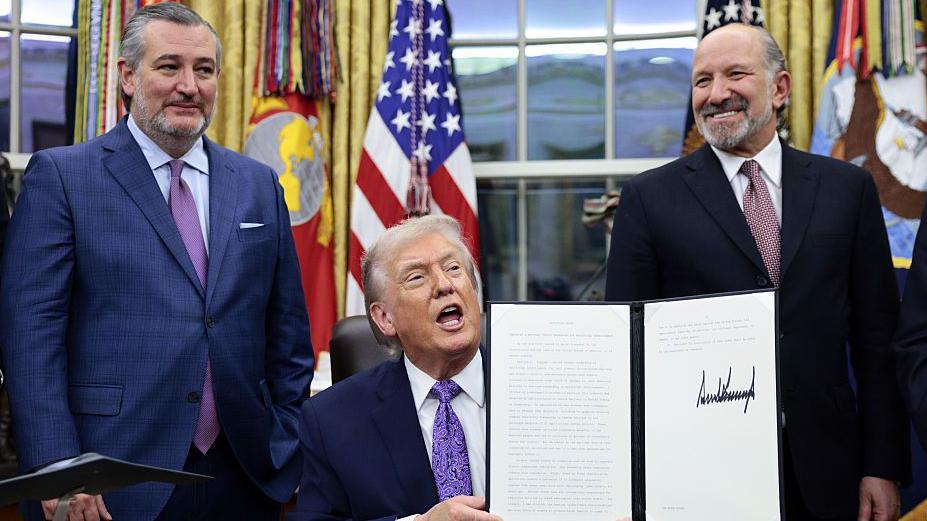
US President Donald Trump has signed an executive order designed to prevent states from implementing their own artificial intelligence (AI) regulations, a move that aims to establish federal oversight in a rapidly evolving sector. “We want to have one central source of approval,” Trump stated during a press briefing in the Oval Office on Thursday.
The order equips the Trump administration with the necessary tools to counter what White House AI adviser David Sacks characterized as “onerous” state regulations. However, Sacks clarified that the federal government would not interfere with AI regulations concerning children’s safety, highlighting the administration’s intent to maintain some level of oversight.
This decision marks a significant victory for large technology companies, which have long advocated for uniform AI legislation across the United States. Industry leaders argue that varying state-level regulations could stifle innovation and impede the US’s competitive edge against countries like China, as firms invest heavily in AI technology.
Despite the potential advantages, the executive order has faced criticism. At present, there are no national laws governing AI in the US, yet over 1,000 separate bills have been proposed in various states, according to the White House. This year alone, 38 states, including California—home to many leading technology firms—have enacted nearly 100 AI regulations, as reported by the National Conference of State Legislatures.
The regulations introduced vary considerably. For example, California has mandated that platforms remind users when they are engaging with a chatbot, a measure aimed at protecting younger audiences from potential risks. Additionally, the state has passed a bill requiring major AI developers to detail their strategies for mitigating catastrophic risks associated with their technologies.
In North Dakota, a newly enacted law prohibits the use of AI-powered robots for stalking or harassment. Arkansas has introduced measures to ensure AI-generated content respects intellectual property rights, while Oregon has ruled that AI systems cannot utilize licensed medical titles, such as “registered nurse.”
Critics contend that Trump’s executive order undermines the essential role of state regulations in the absence of robust federal guidelines. Julie Scelfo, representing the advocacy group Mothers Against Media Addiction, remarked, “Stripping states from enacting their own AI safeguards undermines states’ basic rights to establish sufficient guardrails to protect their residents.”
California’s Governor Gavin Newsom, a Democrat and vocal opponent of the president, accused Trump of prioritizing the interests of tech allies with this executive order. “Today, President Trump continued his ongoing grift in the White House, attempting to enrich himself and his associates, with a new executive order seeking to preempt state laws protecting Americans from unregulated AI technology,” he stated.
While major AI firms such as OpenAI, Google, Meta, and Anthropic did not provide immediate comments regarding the order, the move garnered support from tech advocacy group NetChoice. Its director of policy, Patrick Hedger, expressed optimism about collaborating with the White House and Congress to establish nationwide standards and a clear regulatory framework for innovators.
Michael Goodyear, an associate professor at New York Law School, emphasized the concerns within the AI industry regarding compliance with a fragmented set of state rules, which may conflict with one another. “It would be better to have one federal law than a bunch of conflicting state laws,” he noted, while also cautioning that this assumes a quality federal law is forthcoming.
The introduction of this executive order highlights the ongoing tension between state and federal authority in the realm of technology regulation. As AI continues to evolve rapidly, the balance between fostering innovation and ensuring public safety remains a critical issue for lawmakers, industry stakeholders, and advocacy groups alike.
See also Trump Launches AI Task Force to Challenge State Regulations on Technology Oversight
 Trump Signs Executive Order Halting State AI Regulations, Calls for Federal Oversight
 Parents Urge NY Governor Hochul to Sign RAISE Act for AI Safety Amid Big Tech Opposition
 Veeam Acquires Securiti AI to Enhance Data Resilience and Governance for Safe AI Adoption