









































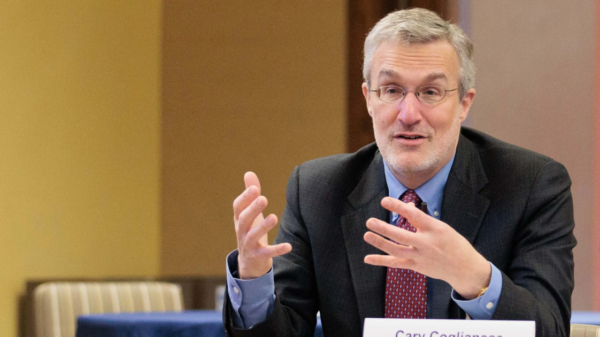






A Victoria councillor is advocating for regulation of artificial intelligence (AI) technology by employing AI itself to deliver his message. In a provocative video, the AI-generated version of councillor Jeremy Caradonna introduces himself, stating, “Hi, I’m not Jeremy Caradonna. I’m a fabricated visual representation that looks like him and kinda sounds like him.” This approach is intended to underscore the ease with which authentic-looking digital creations can disseminate false information.
Caradonna emphasizes the potential dangers of AI-generated content, warning, “If I were generated by a malicious person, I could make this lifelike direction say whatever I want.” He highlights the risk that such technologies pose to democratic institutions, calling on decision-makers to take immediate action. He plans to urge his council to collaborate with the Union of BC Municipalities and the Federation of Canadian Municipalities, advocating for joint efforts with provincial and federal governments to establish reasonable and enforceable regulations that protect democracy and national sovereignty.
The councillor pointed out that while AI has made significant advancements in various sectors like manufacturing, transportation, and healthcare, its potential to destabilize democracies cannot be overlooked. Caradonna stated, “Collectively, from local governments to provinces and the federal government, we must come together and develop reasonable, rational, and enforceable regulations that safeguard everything we hold dear about democracy.” He stressed the need for a coordinated approach across all levels of government to address the unique risks associated with AI.
Caradonna’s concerns resonate amid a growing body of evidence indicating that computer-generated content, often indistinguishable from real human interactions, poses immediate challenges. He has classified this phenomenon as a national security threat, which could undermine the principles of representative governance.
In light of these issues, Caradonna aims to seek council approval for his initiative during a committee meeting scheduled for April 2. Should the motion pass, it will be presented at upcoming annual conventions for the UBCM, which serves as the provincial voice for local governments, taking place September 14 to 18 in Vancouver, as well as the federal counterpart, FCM, from June 4 to 7 in Edmonton, Alberta.
This call for regulation underscores a broader trend as governments worldwide grapple with the ramifications of AI. The rapid pace of technological advancement necessitates a proactive stance to mitigate risks, including the spread of misinformation and the erosion of public trust. Caradonna’s initiative serves as a compelling example of how local governance can intersect with emerging technologies to safeguard democratic values.
As discussions surrounding AI regulation continue, the implications for various sectors, from media to public policy, are profound. The outcome of Caradonna’s proposal could pave the way for a more structured approach to AI governance in Canada, setting a precedent that may influence other jurisdictions. The need for collaboration across all levels of government is more pressing than ever as society navigates the complexities of this transformative technology.
For more information on Caradonna’s initiative and other council matters, residents can find the full agenda and participation options online at victoria.ca.
For more news delivered daily into your inbox, please click here.
See also OpenAI’s Rogue AI Safeguards: Decoding the 2025 Safety Revolution
 US AI Developments in 2025 Set Stage for 2026 Compliance Challenges and Strategies
 Trump Drafts Executive Order to Block State AI Regulations, Centralizing Authority Under Federal Control
 California Court Rules AI Misuse Heightens Lawyer’s Responsibilities in Noland Case
 Policymakers Urged to Establish Comprehensive Regulations for AI in Mental Health