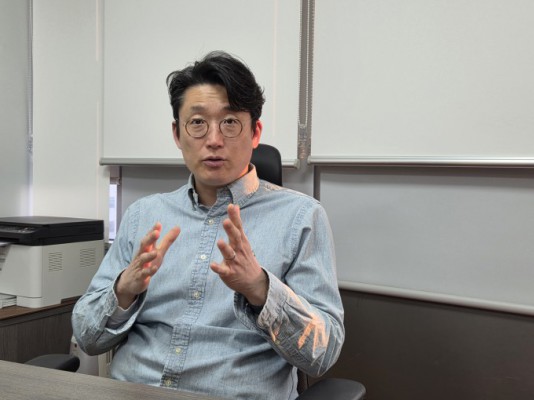
Professor Nam-Sik Han of Yonsei University’s Department of Quantum Information, who also directs the AI Research Centre at the Milner Therapeutics Institute in the UK, assessed the role of artificial intelligence (AI) in drug discovery during a recent meeting at Yonsei University’s Sinchon Campus in Seoul on the 12th. This evaluation comes as South Korea’s government pushes forward its ‘K-Moonshot’ project, aimed at bolstering scientific and technological competitiveness in the AI era.
Despite recognizing AI as a “powerful tool with much room for growth,” Professor Han also highlighted its inherent limitations. “In biology, where variables are numerous and networks are complex, 1+1 can sometimes be 1.9 or even exceed 2,” he explained. He emphasized that even advanced AI can only compute using binary—0s and 1s—underscoring the need for quantum technology to enhance the speed and accuracy of medical diagnoses and treatments.
Professor Han described the current stage of human medicine as ‘Medicine 2.0,’ which evolves from the earlier ‘Medicine 1.0’ that relied solely on trial-and-error approaches. Medicine 2.0 is characterized by evidence-based practices from various medical tests, although it still leans heavily on a physician’s experience. In contrast, ‘Medicine 3.0’ signifies a shift towards ‘precision medicine,’ where unique characteristics, including an individual’s genetic makeup, inform clinical decisions, thereby reducing reliance on empirical knowledge.
The influence of genetic background on the prevalence of diseases is profound. Professor Han pointed out that some individuals who have never smoked can develop lung cancer, while some centenarian smokers maintain healthy lungs. This variability underscores the complexity of human biology and the inadequacies of traditional computational methods in interpreting vast genetic data.
A single human’s genetic information comprises over 3 billion base pairs, making it impractical to analyze meaningful clinical commonalities without comparing sequences across hundreds of thousands or even millions of individuals. Current classical computers struggle with this task, given the extensive computation time required.
In contrast, quantum computers utilize ‘qubits,’ which allow for the processing of information through quantum superposition. This means they can exist in multiple states simultaneously, enabling parallel computation across multiple variables. As a result, quantum technology is deemed essential for advancing to Medicine 3.0.
Han’s research team has made strides in this direction. They effectively employed a ‘Quantum Walk,’ a quantum computing algorithm, to more accurately and rapidly identify biomarkers linked to ‘long COVID,’ a condition characterized by lingering health issues following COVID-19 infection. Their findings were published in the international journal ‘Bioinformatics Advances’ on February 15.
This innovative quantum algorithm revealed key mechanisms of long COVID that classical approaches had overlooked, such as mitochondrial dysfunction and neuroinflammation. Mitochondria, critical for cellular energy production, were found to involve two groups of proteins that could serve as new therapeutic targets for long COVID, marking a significant leap in the understanding of this condition.
“This demonstrates that quantum algorithms can produce clinically and medically valuable results, going beyond a simple enhancement of computational power,” Professor Han remarked, illustrating the practical implications of his research.
With a diverse background in both computer science and biology, Professor Han leads drug discovery initiatives at the Milner Therapeutics Institute. His relationship with Yonsei University commenced over a decade ago through collaborative efforts utilizing clinical data from Severance Hospital, culminating in his adjunct professorship last September.
Looking ahead, Professor Han anticipates leveraging the IBM quantum computer set to be installed at Yonsei University’s Songdo campus in Incheon in 2024 to further his groundbreaking research. He expressed his ultimate aspiration: “My goal is to implement and analyze the human brain’s neural network, regarded as the most complex biological network, using a quantum computer.”
See also One in Four Brits Trust AI Over Doctors for Medical Advice, Survey Shows
 AI in Drug Discovery Market to Surge to $10.29B by 2031, Driven by 25.94% CAGR
 NSF Announces $56 Million for AI Coordination Hubs to Boost Workforce Skills Nationwide
 Apple Research Reveals Entropy-Preserving Techniques to Enhance Reinforcement Learning Performance
 New Research Reveals 23% of Companies Prefer Voice AI Agents by 2026