























































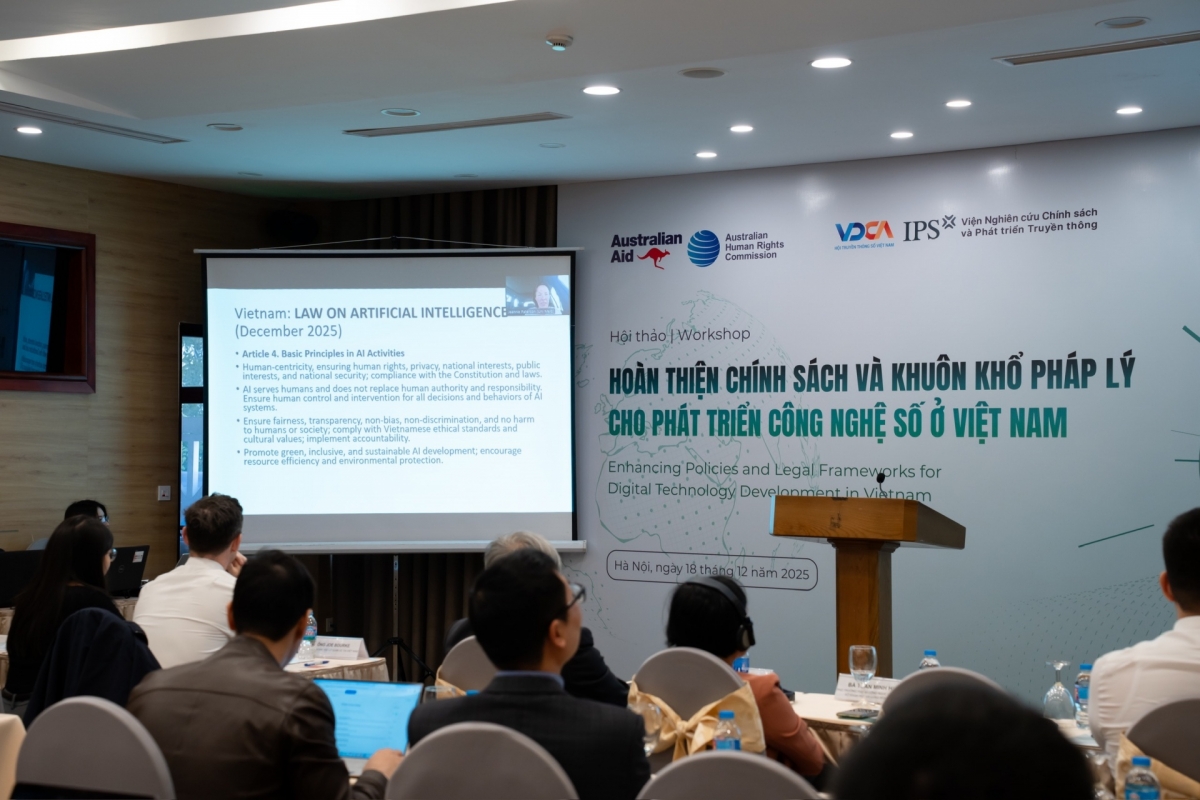
On December 18 in Hanoi, the Vietnam Digital Communications Association (VDCA), in collaboration with the Institute for Policy and Media Development Studies, convened a workshop to explore policies and legal frameworks essential for advancing digital technology in Vietnam. This event came shortly after significant legislative progress, including the National Assembly’s approval of the Artificial Intelligence Law and associated legal documents governing data and electronic transactions on December 10.
The workshop is part of the Vietnam-Australia Responsible Technology Technical Cooperation Programme for 2023-2026, aimed at developing an appropriate AI governance framework while safeguarding human rights in the digital sphere. This initiative seeks to enhance policies, create a safe and transparent digital ecosystem, and establish a foundation for sustainable innovation in Vietnam.
Nguyen Minh Hong, chairman of VDCA, shared insights from the Southeast Asia Digital Economy Report, highlighting that Vietnam’s digital economy is projected to reach $40 billion, positioning it third in Southeast Asia, with a growth rate of 17% compared to 2024. “Vietnam is witnessing a rapid expansion and maturation of its digital ecosystem and digital economy,” Hong remarked. He cautioned, however, that the development of digital technologies presents challenges regarding ethical use and ensuring inclusivity for all citizens, especially vulnerable groups.
The workshop aimed to review recent policy introductions and discuss pressing matters such as the protection of human rights in the digital landscape, international best practices for AI governance, and key features of the newly enacted AI law. From an international perspective, Joe Bourke, second secretary at the Australian Embassy in Vietnam, noted Australia’s recent establishment of its National AI Plan and the creation of an AI Safety Institute. These initiatives seek to ensure that technological advancements are developed inclusively and safely.
“The Australian government is committed to partnering with Vietnam through bilateral cooperation schemes with organizations such as IPS, the Vietnam Chamber of Commerce and Industry, and the Ho Chi Minh National Academy of Politics,” Bourke stated, emphasizing the importance of a digital transformation roadmap grounded in human rights and aligned with international standards.
Joanna Mansfield, head of International Engagement at the Australian Human Rights Commission, underscored the necessity of balancing innovation with human rights protection. “Emerging technologies, including AI, carry risks of misuse if not properly governed. AI therefore must be developed for people, rather than to infringe upon or undermine fundamental rights,” she said. Mansfield highlighted the urgency of embedding human rights from the design stage and focusing on accountability, transparency, and the protection of vulnerable communities.
Ho Duc Thang, director of the National Institute for Digital Technology and Digital Transformation under the Ministry of Science and Technology, observed that Vietnam is emerging as the fourth market globally, following the EU, South Korea, and Japan, to make significant strides in AI governance. He noted that the recently passed Artificial Intelligence Law is among the quickest in Vietnam’s legislative history, with core principles centered on balancing development and safety through measures like AI vouchers and free computing resources for small and medium enterprises.
Thang highlighted the development of an AI ethics assessment framework, described as a specialized certification process ensuring human-centricity and transparency in line with Vietnamese values prior to the large-scale deployment of AI systems. Complementing this insight, Prof. Jeannie Marie Paterson, director of the Centre for Artificial Intelligence and Digital Ethics at the University of Melbourne, shared comparative insights on the regulatory frameworks of Australia and Vietnam.
Paterson proposed six principles for the responsible use of AI, which include identifying accountable entities, understanding impacts and planning accordingly, measuring and managing risks, ensuring transparency, conducting testing and monitoring, and maintaining meaningful human oversight. “While Australia tends to rely more on flexible, guidance-based mechanisms, or soft law, Vietnam demonstrates a strong commitment through concrete legal obligations on safety and sustainable development,” she remarked.
The discussions at this workshop reflect Vietnam’s ambitious digital transformation agenda, which seeks to leverage technology across various sectors—from digital payments and e-government services to AI-driven manufacturing and smart city initiatives. As the country navigates the complexities of digital governance, the emphasis on human rights and ethical AI development remains paramount for its future digital landscape.
See also AI Compliance Challenges Rise as Misuse Cases Surge: Key Tactics for Advertisers
 Senator Marsha Blackburn Reveals TRUMP AMERICA AI Act to Establish Federal AI Standards
 Europe’s AI Sector Faces $500B Investment Gap as Omnibus Proposal Falls Short
 Windsor Launches AI Chatbot Pilot to Streamline 30% of Provincial Offences Calls
 Texas Legislators Defend AI Regulation Amid Trump’s Threat to Federal Funding