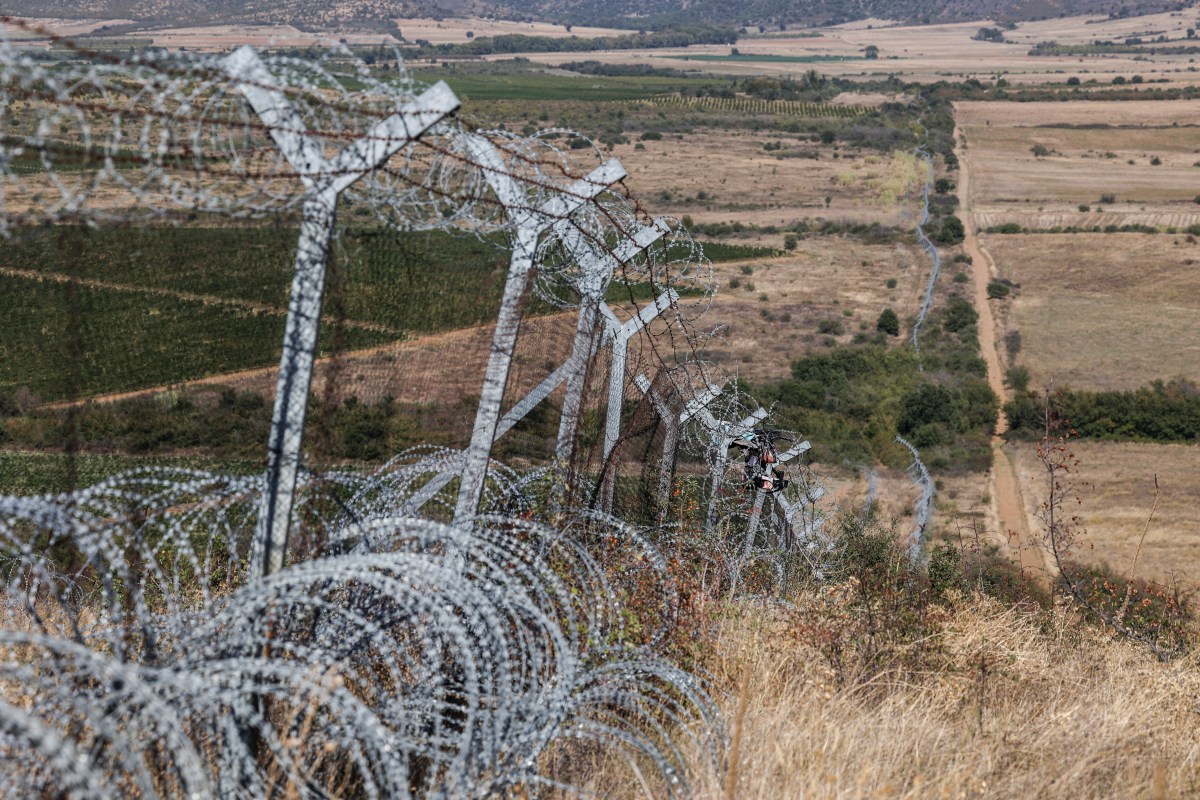
A new high-tech border wall is set to be constructed along the Greek-North Macedonian border as part of a broader trend across Europe toward increased militarisation of migration policies. This shift is driving significant opportunities for defence firms and research institutes, particularly in Switzerland, as governments allocate substantial funding for advanced surveillance technologies.
Historically, Greek border guards have relied on the sudden flight of storks as an early-warning system to detect movements along the Axios River, where migrants frequently attempt to cross into northern Europe. However, this reliance on nature will soon be replaced by an array of cameras, radar systems, and drones as Greece implements the “Evros model,” a high-tech, AI-supported initiative aimed at controlling its borders, particularly those with Turkey. This technology is being expanded further to Albania, with financial backing from the European Union, which has allocated €35.4 million (approximately $41.2 million) for the “E-Surveillance” programme.
As migration is increasingly framed as a security issue across Europe, the oversight mechanisms governing these technologies are waning. Bram Vranken, a representative from the Corporate Europe Observatory, warns that border policies are becoming insulated from public scrutiny and democratic accountability.
The ongoing investigation into this trend was conducted by a cross-border team of journalists from Greece, Germany, the UK, and Switzerland. Their research encompassed developments in eight countries, including interviews with officials and border guards, as well as a review of hundreds of public documents and internal files. This investigation received support from the Investigative Journalism for Europe Fund and the Pulitzer Center.
The growing tendency to treat migration as a military and defence issue has opened lucrative business avenues for lobbyists and contractors in Brussels. Defence firms are not the only beneficiaries; research institutes like Idiap in Switzerland are also tapping into this new AI ecosystem. Idiap, known for its foundational research in artificial intelligence, recently secured funding from Frontex, the European border and coast guard agency, to develop a dataset focused on biometric identification at borders.
Under the guidance of Sébastien Marcel, Idiap’s biometrics research group aims to create a collection of simulated images and videos that reflect challenging scenarios at border crossings. This project includes generating over 10,000 artificial identities and aims to facilitate the development of a multispectral dataset for gait and facial recognition. The data will be tested for accuracy and efficacy, with full control retained by Idiap throughout the project.
The pathway from foundational AI research to practical applications in migration control is increasingly murky. Systems originally designed for military use are now being redeployed to manage migration flows. For example, a drone surveillance network tested by the US defence firm Shield AI demonstrated its capabilities along the Bulgarian-Turkish border, streaming real-time footage to a command centre, where an AI system could alert authorities to potential border crossings. Frontex noted a reduction in criminal activity during the pilot, but concerns remain about the treatment of migrants and the ethical implications of such surveillance measures.
The blurred lines between testing and operational deployment raise significant legal and ethical questions. Niovi Vavoula, a professor at the University of Luxembourg, argues that once systems are tested on real individuals in uncontrolled environments, they can no longer be classified merely as research projects. This sentiment is echoed by the European Union’s recent AI regulations, which designate strict classifications for AI systems, with national security applications often exempt from oversight.
Frontex has publicly stated that it does not operate high-risk AI systems, yet the deployment of EU-supplied technologies with AI components indicates a complex relationship with these regulations. Authorities often use vague terminology, describing their initiatives as algorithms or automation, which allows them to sidestep scrutiny.
Switzerland, while not yet bound by the EU’s AI Act, is expected to align its regulations with EU standards in the coming years. The Swiss government has recently increased its budget allocation for border management and visa policy by €1 billion, which will enhance the national contribution to the Schengen area and provide additional resources for addressing migration and security challenges.
This evolving landscape of high-tech border control raises critical questions regarding the balance between national security and the rights of individuals seeking asylum. As migration increasingly intersects with technologies traditionally associated with defence, the ethical implications and governance of these systems will require urgent attention to ensure that human rights are upheld in an era of rising surveillance.
See also AI Prescribing Legislation Sparks Debate Over Error Tolerance in Health Care Systems
 UH Researchers Unveil AI Tool to Accurately Map Sun’s Magnetic Field in 3D
 Lomonosov Team Achieves Multi-State Accuracy in Ultrafast Photodynamics with ML Potentials
 Google Integrates Gemini AI into Search and Assistant, Enhancing User Experience with Smart Summaries
 Kenya Achieves Historic UN Resolution on AI’s Environmental Sustainability at UNEA-7