

















































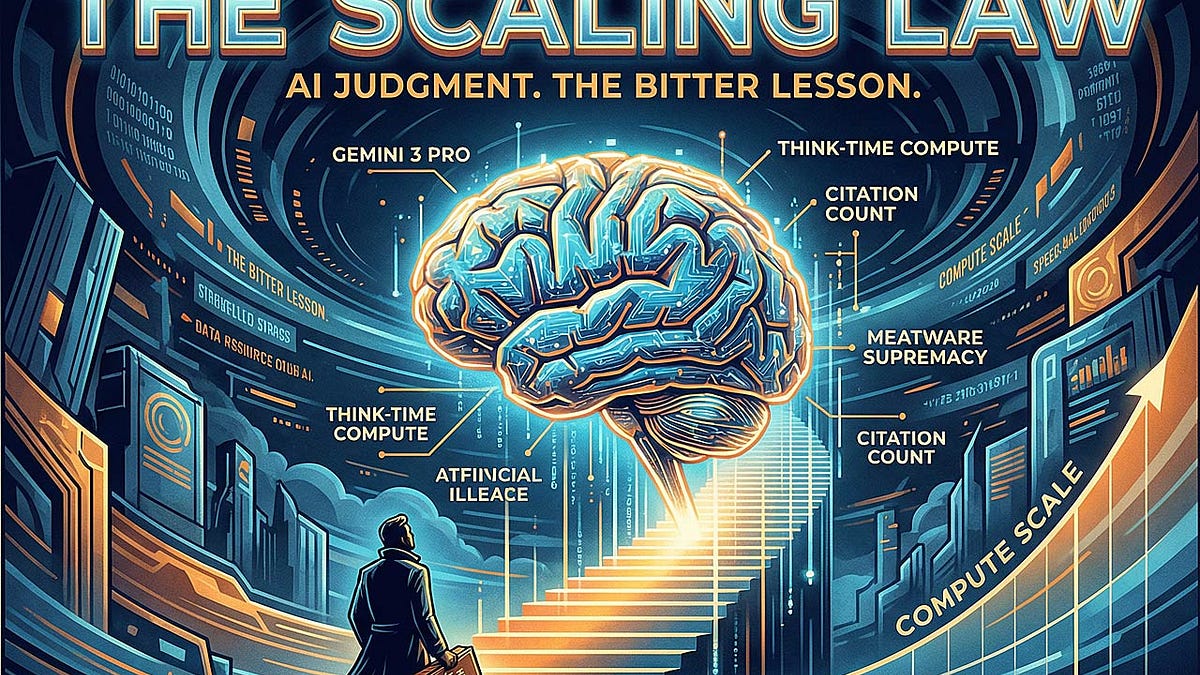
AI systems are showing signs that they may soon surpass human judgment, according to a recent study by Harvard researcher Bingyang Ye and colleagues. Their research indicates that the effectiveness of AI’s judgment scales with increased computational power, raising questions about the future of human expertise in evaluating complex tasks. The study, focusing on AI’s ability to predict which scientific papers will gain prominence, suggests that as AI models grow larger and are given more processing time, their predictive performance improves.
The concept of the “bitter lesson” in AI research highlights that simply applying more computational resources often outperforms traditional methods built around human expertise. This principle, previously observed in fields like chess and Go, suggests a shift in how AI could reshape the landscape of decision-making in various domains. Currently, the study’s findings are not enough to declare a definitive scaling law for AI judgment, as the research was confined to one domain—predicting citations of academic papers.
The study analyzed the performance of three prominent AI model families: those from Google, OpenAI, and Anthropic. Among them, Gemini 3 Pro emerged as the most effective, outperforming its predecessors significantly. Furthermore, the researchers discovered that models given more “think-time” or computational budget typically produced better judgments, indicating a direct correlation between computation and decision-making quality.
In another development, the Baymard Institute recently launched an AI service capable of conducting heuristic evaluations based on 154 usability guidelines for e-commerce sites, achieving an impressive accuracy of 95%. This marks a notable increase from the previous version of their tool, which only managed 39 guidelines. Over just eight months, the AI’s evaluation capabilities nearly quadrupled, suggesting a doubling effect every four months in its usability improvements. While these findings are promising, they also highlight the need for ongoing research in usability and AI.
As AI technology evolves, the implications for user experience design are profound. The ability of AI to conduct effective heuristic evaluations could redefine how businesses approach usability testing and design optimization. However, there remains a gap; the AI is currently only able to match human experts in a fraction of the usability guidelines it needs to master, indicating that further advancements are still required.
In the realm of creative design, AI tools are becoming more adept at generating brand-consistent visual assets. Luke Wroblewski’s recent launch of the LukeW Character Maker demonstrates this evolution. By allowing users to request illustrations that align with specific brand styles, the tool showcases AI’s growing capabilities in adhering to branding guidelines. This process not only involves language models to refine asset requests but also a verification step that assesses whether the generated images align with established brand standards.
As AI continues to evolve, the effectiveness of its design judgment will likely improve, potentially enabling the technology to meet diverse quality standards across various customer segments. However, the creative sector faces its own challenges. A new AI music creation tool, Mureka, has sparked interest for its enhanced sound quality. Influencers have praised its capabilities, but the author of this piece found inconsistencies in its output compared to the more established Suno platform. Mureka’s music sometimes lacked cohesion, with noticeable variations in vocal stability and unexpected interruptions in song structure.
As competition among AI-driven music services heats up, the need for features that empower individual creators remains essential. While innovations like Mureka represent exciting advancements, the author expresses a preference for Suno due to its user-friendly interface and editing tools. However, the ongoing evolution of AI in music and design raises intriguing questions about the future of creative work, especially as these technologies become increasingly mainstream.
As AI continues to scale its capabilities, the implications for both professional fields like research and creative industries are significant. The potential for AI to redefine how we understand judgment and usability could lead to a future where human expertise is complemented, or even surpassed, by machine intelligence. The next few years will be critical in determining the trajectory of AI’s role in both judgment and creativity, shaping how industries approach complex challenges.
See also Generative AI Drug Discovery Market Surges as First AI-Generated Molecules Enter Phase II Trials
 CURE-ND Event Unites AI Experts to Enhance Collaboration in Disease Research
 ISG Launches Study on Microsoft AI Services to Enhance Enterprise Business Processes