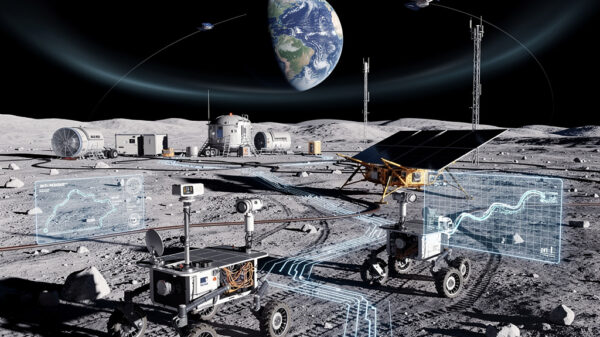




















































Researchers from the Technische Universität Berlin and the German Aerospace Center have made significant strides in lunar topography reconstruction using a novel deep learning approach. Led by Hao Chen, Philipp Gläser, and Konrad Willner, the team has developed a method that enhances existing frameworks to provide detailed, meter-scale data of the lunar surface, particularly in the challenging polar regions where low solar illumination has traditionally hindered accurate mapping.
This breakthrough comes at a time when understanding planetary surfaces and the geological processes shaping them is crucial for future lunar missions. Although extensive high-resolution imagery of the Moon is available, researchers have struggled with fine-scale topographic data. The new deep learning framework, which improves scale recovery and extends its capabilities to the less explored lunar poles, addresses these limitations effectively. Experiments indicate that this new method outperforms traditional shape-from-shading techniques in both accuracy and adaptability across various terrains and lighting conditions.
The team’s approach builds on a previously established deep learning framework, enhancing its scale recovery mechanism and successfully applying it to regions known for their extreme illumination challenges. This includes the Moon’s southern polar areas, characterized by permanently shadowed regions. The researchers demonstrated that their model could reliably reconstruct lunar topography across a broad spectrum of geological features and ages, marking a significant advancement in topographic modeling.
Specifically, the researchers reported root mean square errors (RMSE) of 0.65 meters in the lunar south polar region, a remarkable improvement over the 0.92 meters previously achieved with conventional mapping techniques. The study’s findings suggest that deep learning can significantly improve the resolution of lunar topography, providing essential insights into the Moon’s geological history and supporting advanced exploration missions.
In their experiments, the research team utilized data from various lunar terrains to validate their method. They found that the deep learning approach yielded consistent and robust results, showing greater resilience to varying illumination conditions compared to traditional methods. The team utilized high-quality stereo photogrammetry-derived digital terrain models as a baseline, necessitating extensive computational training to allow the framework to adapt to the unique characteristics of lunar topography.
This innovative methodology opens new possibilities in planetary science, enabling detailed investigations into the Moon’s surface features and geological processes that were previously unattainable due to data limitations. With the ability to analyze diverse terrain types, the framework could be crucial for future missions aiming to explore lunar resources or understand the Moon’s evolution.
The research team is optimistic that their deep learning-centric approach could extend beyond lunar applications. While the current focus is on the Moon, they acknowledge challenges in applying similar methodologies to other planetary bodies such as Mercury, primarily due to the scarcity of high-resolution optical imagery. However, they see potential in adapting their techniques to accommodate the unique conditions of different celestial environments.
The study not only enhances lunar topographic modeling but also represents a significant leap in applying artificial intelligence to planetary science. By leveraging existing datasets more effectively, researchers can extract substantial geological insights while facilitating faster and more efficient mapping processes across the lunar surface. The implications for future lunar exploration are profound, as enhanced topographic data can inform mission planning and improve understanding of the Moon’s geological history.
As lunar missions ramp up in the coming years, this research could serve as a pivotal tool, offering a comprehensive understanding of the Moon’s diverse features and their historical context. With the capability to achieve unprecedented levels of topographic resolution, the implications extend well beyond the Moon, potentially reshaping methodologies for planetary exploration.
👉 More information
🗞High-fidelity lunar topographic reconstruction across diverse terrain and illumination environments using deep learning
🧠 ArXiv: https://arxiv.org/abs/2601.09468
 Global Deep Learning Chips Market Expected to Reach $63.2 Billion by 2033, Driven by AI Growth
 Grok AI Generates 3M Sexualized Images in 11 Days, Including 23K of Minors, Study Finds
 OpenAI Reveals New AI Model with 95% Accuracy in Natural Language Processing
 Deep Learning Barcelona Symposium 2025 Showcases 99 Research Posters and Industry Insights
 AI Transforms Global Healthcare Post-COVID, Yet Funding Declines, Warns Davos 2026 Panel