






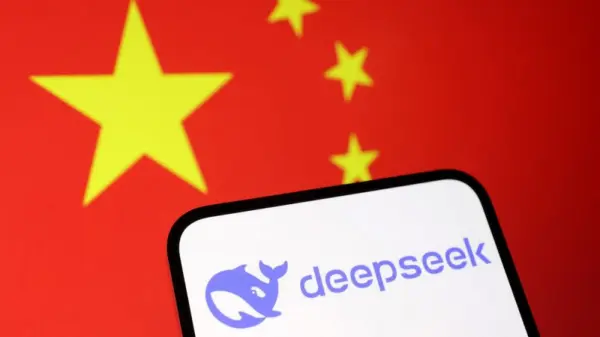



































DeepSeek, a Chinese artificial intelligence company, is poised for a significant release that industry watchers believe will indicate the country’s advancements in AI technology. Anticipation has been mounting for weeks as the company prepares to unveil its next-generation model, V4, following its earlier success with a low-cost chatbot that rivaled leading US competitors in early 2025.
Despite the buzz surrounding the imminent launch, details regarding the V4 model remain scarce. Reports have emerged questioning the geopolitical implications of the hardware used in its development, specifically whether it will utilize advanced chips from US firms or rely on domestically produced alternatives that China is actively working to develop.
“It’s important to know because at one level, it is a signal of China’s AI self-sufficiency trajectory,” said Wei Sun, a principal AI analyst at Counterpoint Research, in comments to AFP. The tech publication The Information reported last week that the V4 model may operate on sophisticated chips developed by Huawei, marking a pivotal moment for China in navigating US restrictions on high-end AI chip exports from Nvidia.
According to five unnamed sources, major Chinese tech firms—including Alibaba, ByteDance, and Tencent—have reportedly placed large orders for Huawei chips in preparation for DeepSeek’s upcoming launch. Founded in 2023 as a side project of a hedge fund with access to advanced Nvidia processors, DeepSeek gained prominence in January 2025 with its R1 deep-reasoning chatbot, which had a notable impact on US technology stocks. Former President Donald Trump labeled its release a “wake-up call” for American firms.
The R1 chatbot built upon DeepSeek’s previous major AI model, V3, which was released in December 2024. Since then, the company has seen its cost-effective and customizable AI tools widely adopted across China and emerging markets, including Southeast Asia and the Middle East.
Looking ahead, Stephen Wu, founder of Carthage Capital, told AFP that the V4 model is expected to be multimodal, capable of generating text, images, and video. “I expect the upcoming DeepSeek V4 release will not just be a software update; it will be a highly capable, open-source model that handles massive context windows at a fraction of the cost,” he stated. However, the stakes are high for DeepSeek as its status as a leader in advanced AI development could be challenged.
The company’s earlier models relied heavily on Nvidia chips, and a potential shift toward domestic alternatives would necessitate significant re-engineering. Wei Sun emphasized that “that transition can slow development cycles and introduce performance trade-offs, especially for V4, a model expected to be state-of-the-art.” As the technology sector watches closely, the implications of DeepSeek’s launch extend beyond corporate competition, highlighting the broader narrative of AI development amid geopolitical tensions.
See also AI Study Reveals Generated Faces Indistinguishable from Real Photos, Erodes Trust in Visual Media
 Gen AI Revolutionizes Market Research, Transforming $140B Industry Dynamics
 Researchers Unlock Light-Based AI Operations for Significant Energy Efficiency Gains
 Tempus AI Reports $334M Earnings Surge, Unveils Lymphoma Research Partnership
 Iaroslav Argunov Reveals Big Data Methodology Boosting Construction Profits by Billions