








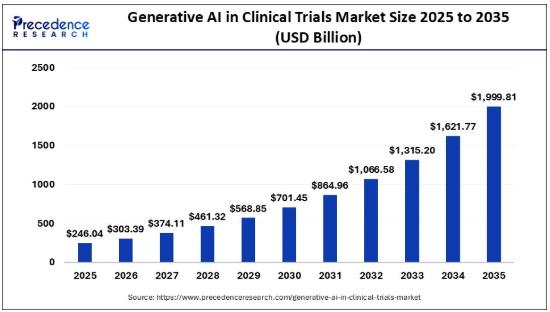











































The generative AI in clinical trials market is poised for remarkable growth, expanding from USD 246.04 billion in 2025 to an estimated USD 1,999.81 billion by 2035, according to Precedence Research. This surge represents a robust compound annual growth rate (CAGR) of 23.31%, driven by a fundamental shift towards faster drug development, cost efficiency, and the increasing role of AI in enhancing trial processes. The applications of generative AI range from patient recruitment to real-time data analysis, fundamentally transforming the clinical trial landscape by improving efficiency, accuracy, and reducing human error.
AI’s influence in this sector is significant. By automating vital stages of clinical trials, including patient recruitment, trial design, and data analysis, AI greatly reduces the time and costs associated with these processes. AI-powered algorithms allow for the prediction of trial outcomes, optimization of trial designs, and real-time monitoring, thereby enhancing operational efficiency. Furthermore, generative AI models can simulate patient responses, offering insights that help researchers anticipate risks and enhance trial effectiveness. This technology also accelerates regulatory procedures by ensuring structured and precise data collection, facilitating quicker approvals.
Several factors are driving the growth of the generative AI market in clinical trials. The demand for faster drug development is paramount, as traditional methods can be slow and expensive. Generative AI enables a more rapid and efficient approach to patient recruitment and trial management, addressing this pressing need. Additionally, the optimization of trial efficiency—through real-time data tracking, outcome prediction, and error reduction—is propelling market expansion. The increasing emphasis on personalized medicine further amplifies the role of AI in developing tailored treatments, which improves both the accuracy and success of clinical trials.
The Asia-Pacific region is set to experience the highest growth in this market. Factors contributing to this include a rising number of clinical trials, a substantial patient population, and the growing integration of AI technologies. Countries like China are emerging as significant hubs for clinical trials, bolstered by advances in biotechnology and domestic drug development efforts. In contrast, North America currently holds the largest market share, attributed to its advanced healthcare infrastructure and strong presence of pharmaceutical and AI companies. Government support and a high volume of clinical trials in the U.S. further bolster this region’s dominance.
Generative AI facilitates wider adoption of AI platforms in the pharmaceutical and biotech sectors, where companies are increasingly automating complex trial processes. This technology streamlines trial protocol development, enhances data processing, and accelerates document generation, thereby expediting the market introduction of new drugs. Moreover, generative AI is enhancing patient recruitment by utilizing extensive datasets from electronic health records and genetic information, enabling more accurate and timely matches between patients and trials. This not only increases success rates but also diversifies trial populations.
As decentralized trials gain traction, AI plays a crucial role in enabling remote patient monitoring and participation. This model broadens access to clinical trials, particularly for patients in remote or underserved regions, thus improving engagement and reducing dropout rates. Additionally, generative AI enhances predictive analytics capabilities, allowing researchers to foresee outcomes and adjust trial strategies in real-time, ultimately minimizing trial failures and optimizing research efficiency.
By 2025, the patient recruitment segment is expected to hold the largest share of the market, with generative AI identifying eligible patients swiftly through data analysis. Innovations in monitoring and reporting are anticipated to grow rapidly, as AI facilitates the real-time tracking of patient health, reducing the need for physical visits to trial sites. In terms of deployment, cloud-based solutions are leading due to their flexibility and cost-effectiveness, while on-premises systems are projected to grow the fastest in response to increasing demand for data security and regulatory compliance.
The competitive landscape includes major players like IBM, Microsoft, and Google Health, all of whom are leveraging generative AI to enhance clinical trial processes. For instance, IBM utilizes AI to model clinical trials by creating simulated patient cohorts, while Microsoft enhances trial screening and decision-making through its multimodal generative AI. Oracle’s recent launch of its Life Sciences AI Data Platform is designed to streamline clinical trials and regulatory processes, showcasing the ongoing evolution in this field.
As healthcare continues to innovate, the integration of generative AI in clinical trials represents a significant advancement. The promise of enhanced efficiency, reduced costs, and the ability to personalize medicine underscores the transformative potential of this technology. As the market evolves, stakeholders across the pharmaceutical and healthcare sectors are likely to see substantial benefits from adopting generative AI solutions, setting the stage for a new era in clinical research.
See also AI Study Reveals Generated Faces Indistinguishable from Real Photos, Erodes Trust in Visual Media
 Gen AI Revolutionizes Market Research, Transforming $140B Industry Dynamics
 Researchers Unlock Light-Based AI Operations for Significant Energy Efficiency Gains
 Tempus AI Reports $334M Earnings Surge, Unveils Lymphoma Research Partnership
 Iaroslav Argunov Reveals Big Data Methodology Boosting Construction Profits by Billions