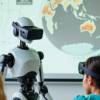





















On May 27, 2025, researchers at Harvard Business School were not questioning the implementation of artificial intelligence (AI) in the workplace; instead, they were assessing the nuanced roles of AI and human labor in driving productivity. As AI adoption surges across U.S. industries, particularly in white-collar jobs, the focus has shifted to understanding where AI excels and where human capabilities remain irreplaceable. Their findings, emerging from the Digital Data Design Institute, are reshaping how American companies view work and collaboration.
Data from Anthropic indicates that AI utilization in workplaces has reached unprecedented levels, particularly benefitting tasks traditionally assigned to teams. Research conducted by D³ (Data-Driven Decision-Making) in collaboration with Procter & Gamble revealed that individuals equipped with AI tools can perform at levels comparable to entire teams operating without such technology. This trend poses a compelling challenge for companies under pressure to reduce costs and enhance output, as the logic supporting traditional team structures becomes increasingly tenuous.
However, the researchers cautioned against a complete shift to AI-driven workforces. While AI has demonstrated efficiency, the most innovative solutions were produced by strategically designed teams that integrated AI tools. The D³–P&G study highlighted that even with AI assistance, teams can yield higher-quality outcomes than isolated individuals. Notably, the AI systems employed in this research were not specifically optimized for collaboration, suggesting that purpose-built AI for teamwork could lead to even greater improvements.
Scholars at Harvard have underscored that increased productivity does not automatically translate into enhanced value creation. Although AI can streamline execution, it is not a substitute for the insights generated through human collaboration. The research suggests that AI is most effective when it augments teams rather than replacing them entirely.
Another crucial insight from the D³ study is the way AI integration can diminish performance disparities among departments and roles within large U.S. corporations. With AI-driven knowledge bases, teams outside of specialized fields such as research and development can generate valuable outputs more efficiently. This democratization of information has the potential to break down silos within organizations, making expertise more accessible across different levels. However, this leveling effect comes with its own set of challenges.
A separate D³ experiment conducted with Boston Consulting Group revealed a significant imbalance in the benefits of AI, particularly among skill levels. Lower-skilled and early-career workers experienced a 43 percent increase in performance when utilizing AI, while top performers only saw gains of 17 percent. Although both figures imply substantial improvements, the disparity raises concerns about the long-term implications for talent development within organizations. If AI can perform junior-level tasks more efficiently, senior employees may become less inclined to delegate foundational responsibilities, which could undermine the mentorship model essential for leadership growth.
The evidence gathered from Harvard, Procter & Gamble, and Boston Consulting Group converges on a critical conclusion: AI should not be viewed as a replacement for human involvement but as a transformative force that alters workplace dynamics. U.S. employers are now faced with the more complex challenge of determining what tasks to automate, which roles to preserve, and where human struggle and creativity must continue to thrive.
As discussions unfold within the hallowed halls of Baker Library, the future of work is not solely dependent on the extent of AI adoption. It hinges on the deliberate decisions organizations make regarding its use. The most resilient companies may be those that recognize AI as an asset to enhance human collaboration rather than diminish it, ensuring that teamwork remains a cornerstone of their operational strategy.
See also Machine Learning Study Reveals Electrolyte Imbalances Significantly Predict Mortality Risks
 China Advances EUV Lithography, Threatening ASML and NVIDIA with Lower-Cost Chips
 NASA’s OSIRIS-REx Reveals Life’s Building Blocks in Asteroid Sample, Challenges Biology Detection
 UCSD’s Hao AI Lab Acquires NVIDIA DGX B200, Boosts Low-Latency LLM Performance
 Google Research Advances AI to Amplify Human Ingenuity and Drive Real-World Impact