


















































Recent research highlights significant advancements in breast cancer detection and prevention, addressing various challenges faced globally. In Romania, Mihai (2024) discusses the intricate landscape of breast cancer screening, outlining both challenges and opportunities for early detection. This study emphasizes the need for improved healthcare strategies to enhance screening rates in the country.
Meanwhile, in Saudi Arabia, a comprehensive analysis by AL Zomia et al. (2024) has tracked epidemiological trends of female breast cancer since 1990. This study leverages global burden of disease data to forecast future statistics, presenting essential information that can inform public health policies and resource allocation.
In Japan, Uematsu (2023) proposes a shift in the traditional approach to screening mammography. By advocating for “breast awareness” and the incorporation of supplemental ultrasonography, Uematsu suggests a more personalized and effective screening method that could potentially improve early detection rates among women.
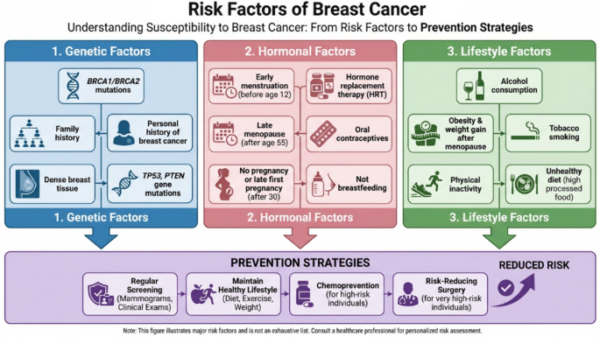
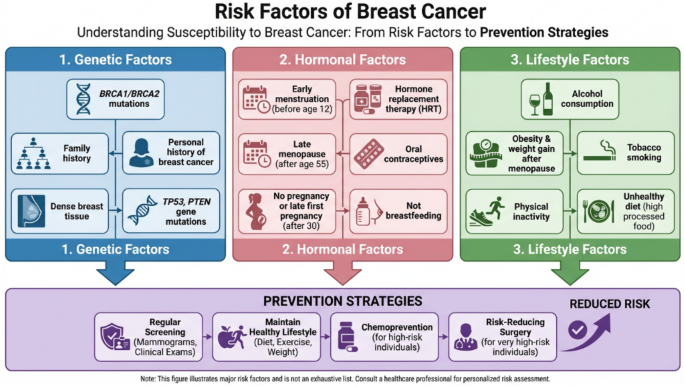
Understanding the genetic component of breast cancer is crucial for preventative strategies. A study by Pal, Das, and Pandey (2024) delves into genetic variations associated with familial breast cancer, reinforcing the significance of genetic counseling and testing in at-risk populations. This work complements García-Sancha et al. (2025), who explore various risk factors and prevention strategies in their review of susceptibility to breast cancer.
As research progresses, novel diagnostic methodologies are emerging. Dyachenko and Bel’skaya (2025) investigate the heterogeneity of breast cancer and its impact on tumor marker levels in saliva, proposing a non-invasive detection method that could revolutionize early diagnosis. This approach taps into the potential of liquid biopsies, which are less invasive than traditional methods.
Another significant development is the genomic and transcriptomic analysis conducted by Aftimos et al. (2021) as part of the AURORA initiative. This extensive project analyzes breast cancer primaries and matched metastases, offering insights that could lead to more targeted therapies and better patient outcomes.
Artificial intelligence (AI) is playing an increasingly pivotal role in breast cancer research. Abiodun (2024) provides a systematic review of deep learning techniques for subtype classification and prognosis in breast cancer genomics. This meta-analysis highlights the potential of AI in improving diagnostic accuracy and personalizing treatment options.
The integration of AI with histopathological image analysis is also gaining traction. Al-Jabbar et al. (2023) introduce a multi-method diagnosis approach using hybrid and deep learning techniques to enhance early detection rates. Their research underscores the importance of technological advancements in improving diagnostic procedures.
As the field continues to evolve, the application of AI-driven strategies raises questions about their implications for clinical practice. Research by Raza et al. (2024) emphasizes the efficiency of deep learning techniques in diagnosing breast cancer, suggesting a future where AI could significantly reduce time and resources spent on diagnosis.
Looking ahead, the convergence of genetic, technological, and epidemiological research presents a multifaceted approach to tackling breast cancer. The ongoing studies not only aim to improve detection and treatment but also seek to enhance patient quality of life through personalized medicine. As the landscape of breast cancer research continues to develop, the integration of various disciplines will be vital in shaping future interventions and policies aimed at combatting this pervasive disease.
See also AI Study Reveals Generated Faces Indistinguishable from Real Photos, Erodes Trust in Visual Media
 Gen AI Revolutionizes Market Research, Transforming $140B Industry Dynamics
 Researchers Unlock Light-Based AI Operations for Significant Energy Efficiency Gains
 Tempus AI Reports $334M Earnings Surge, Unveils Lymphoma Research Partnership
 Iaroslav Argunov Reveals Big Data Methodology Boosting Construction Profits by Billions