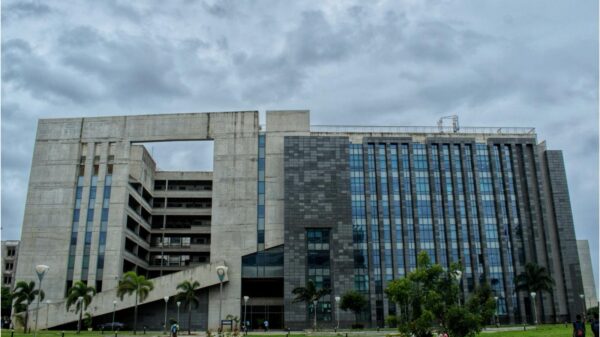
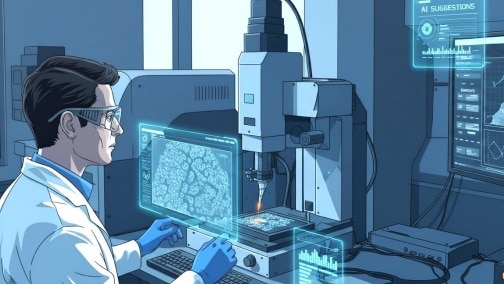
Researchers at the Indian Institute of Technology, IIT Delhi, have unveiled an innovative artificial intelligence system named AILA—the Artificially Intelligent Lab Assistant. This groundbreaking development utilizes an AI Agentic Framework that allows it to conduct actual scientific experiments akin to a human scientist. AILA features an intuitive chat interface, resembling a chatbot, through which users can issue commands in English. The AI then translates these instructions into code to execute experiments autonomously.
During a recent demonstration, research scholar Indrajeet Mandal highlighted the system’s capabilities, particularly its application with the Atomic Force Microscope (AFM), a complex instrument vital for material research. Mandal explained that AILA not only controls the AFM but also makes real-time decisions throughout experiments, analyzing results independently.
Speaking to the media, Professor Anoop Krishnan emphasized the transformative potential of this technology within India’s scientific landscape. He noted that systems like AILA could significantly enhance efficiency, allowing experiments to be completed in minutes rather than hours, thereby reducing the demand for human labor in the lab.
The development of AILA comes at a time when the scientific community is increasingly looking towards automation and artificial intelligence to streamline research processes. By combining advanced AI with sophisticated equipment such as AFMs, researchers are not only pushing the boundaries of scientific inquiry but also addressing challenges like time and labor constraints that often hinder research productivity.
In a broader context, AI technologies are making rapid inroads in various fields, with applications that range from healthcare to engineering. The advent of tools like AILA reflects a growing trend in which machine learning and artificial intelligence are set to augment human capabilities, particularly in data-intensive disciplines.
As AILA continues to evolve, its impact could extend beyond just laboratory settings. The potential for integrating AI-driven assistants into educational institutions and research facilities globally raises interesting questions about the future of scientific research. With AILA, IIT Delhi is not only contributing to India’s technological advancement but also positioning itself at the forefront of AI-driven innovation in science.
In conclusion, the successful development of AILA at IIT Delhi marks a significant milestone in the intersection of artificial intelligence and scientific research. As the scientific community embraces such technologies, the implications for research efficiency and productivity could be profound, ultimately fostering a more innovative and agile scientific ecosystem.
See also AI Researchers Dalvi and Gawas Unveil Machine Learning Advances for Anemia Detection
 DP Technology Raises $114 Million in Series C to Expand AI Tools for Scientific Research
 AI Integration in Nursing Care: New Study Analyzes Ethical Implications and Patient Outcomes
 Deep Learning Models Predict Gastric Cancer Prognosis, Boost Immunotherapy Outcomes
 Study Reveals Over 20% of YouTube’s New User Recommendations Are Low-Quality AI Content