




















































Researchers at CEMES, CNRS, and Université de Toulouse, in collaboration with their colleagues from CNRS, Sorbonne Université, and Université Lille, have unveiled new insights into the formation of zinc oxide (ZnO) nanoparticles. This study, led by Quentin Gromoff, Magali Benoit, Jacek Goniakowski, and Carlos R. Salazar, focuses on the complex growth mechanisms of these nanoparticles and the surprising phase transitions they undergo during their development. The findings, published in a recent paper, could significantly enhance the design of materials with specific structural characteristics.
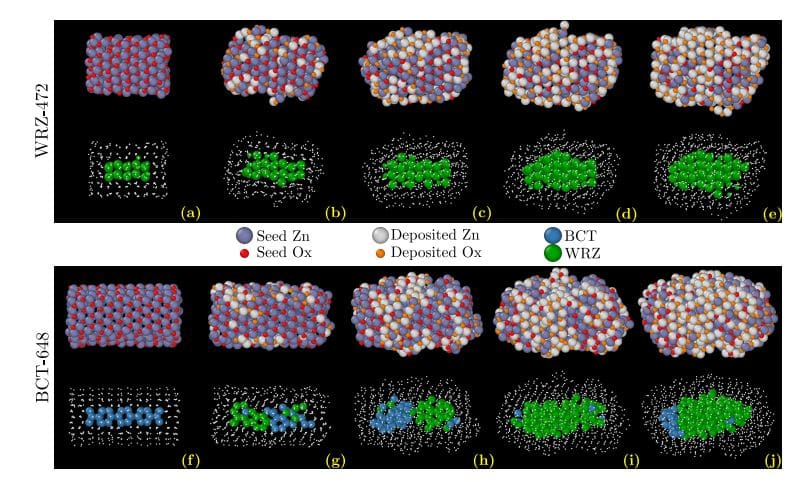
The research reveals that while a body-centered tetragonal structure is thermodynamically stable for small ZnO particles, the growth process drives a phase transition to a more stable wurtzite structure. This transformation is influenced by specific ion redistributions within the nanoparticle, which effectively compensate for polar facets that emerge as the structure evolves. Such insights advance our understanding of how nanoparticle structures form during synthesis, potentially transforming applications in fields such as catalysis, sensing, and optoelectronics.
Combining advanced computational simulations with machine learning techniques, the research team employed coarse-grained molecular dynamics simulations to predict and analyze these transitions. This method allows for the investigation of nanoparticle growth under various conditions, revealing pathways to different structural phases and identifying key parameters that influence morphology. The application of machine learning enables a more accurate prediction of structural evolution, providing a valuable tool for materials design.
The study emphasizes the critical role of surface polarity and long-range electrostatic interactions in determining the growth direction and final morphology of ZnO nanoparticles. Researchers closely examined how polar surfaces tend to stabilize through the formation of reduced-polarity facets, which is pivotal in developing more efficient materials. By integrating long-range electrostatic interactions into their machine learning potentials, the team was able to model interatomic forces with higher precision, facilitating large-scale simulations that unveiled the relative stability of various ZnO crystal structures under different conditions.
According to the researchers, capturing long-range electrostatic interactions is essential for understanding the stability and morphology of polar surfaces. The research highlights not only the interplay between surface polarity and electrostatic forces but also the implications for crystal structure formation, which are crucial for controlling the synthesis of ZnO nanoparticles. This understanding lays the groundwork for innovations in creating more sensitive sensors and improving optoelectronic devices.
As the study progresses, researchers recognize the potential applicability of these findings to the formation of other metallic oxides, such as those based on titanium, iron, and copper. They acknowledge that the modeling approach utilized represents a simplification of complex interactions, suggesting that future work could leverage more sophisticated methodologies to capture the nuances of both polar and non-polar surfaces effectively.
This research not only advances fundamental knowledge about ZnO nanoparticles but also presents practical implications for the materials science community. By providing insights into growth-driven phase transitions, the study paves the way for controlled nanoparticle synthesis and the optimization of materials for various technological applications. The ability to manipulate nanoparticle characteristics opens new avenues for research and development, underscoring the importance of understanding the fundamental processes that govern material formation.
👉 More information
🗞Growth driven phase transitions in Zinc Oxide nanoparticles through machine-learning assisted simulations
🧠 ArXiv: https://arxiv.org/abs/2511.19025
 AI Research Shifts Focus from Scaling to Human-Like Learning for Improved Generalization
 Amazon Awards 63 Research Grants to 41 Universities Across 8 Countries for AI Innovation
 DeepSeek and Alibaba Endorse China’s AI Regulatory Framework, Call for National Law
 Aston University Launches AI Research Platform to Enhance Business Intelligence at AlixPartners
 Cornell Tech Secures $7M from NASA and Schmidt Sciences to Modernize arXiv Platform






