
















































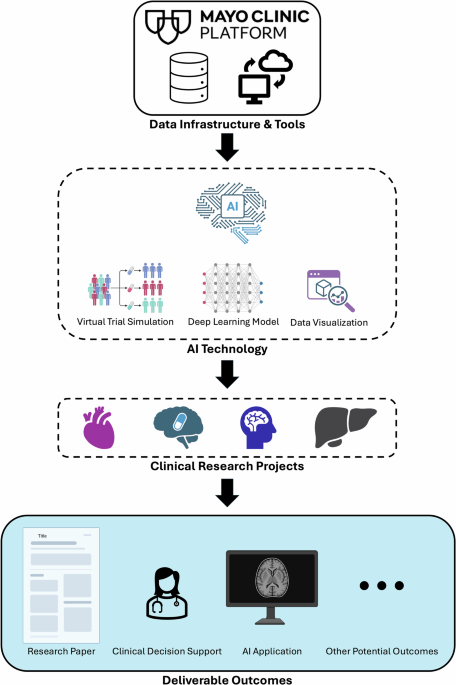
The Mayo Clinic Platform (MCP) has emerged as a secure, cloud-based environment that is transforming the landscape of clinical research by providing expansive access to de-identified and standardized data from over 15.1 million patients. Designed to foster innovation and accelerate research, MCP offers integrated analytical tools that facilitate collaboration among researchers across various disciplines while ensuring compliance with privacy and security standards.
The platform employs a sophisticated multilayered de-identification process that combines rules-based heuristics and deep learning models to protect personally identifiable information. This approach guarantees adherence to HIPAA regulations and institutional governance policies, making it a reliable resource for researchers looking to leverage clinical data for real-world applications. By standardizing electronic health record (EHR) data to common medical terminologies and data models, MCP enhances the quality and utility of its datasets, which can support diverse research initiatives ranging from AI model training to generating insights for clinical practices.
MCP’s comprehensive suite of integrated research tools simplifies the data-to-discovery workflow, enabling both technical and non-technical users to efficiently access and analyze data within a unified platform. The system is specifically designed for scalability, promoting reproducible research that adheres to stringent privacy and governance standards. Furthermore, researchers benefit from a dedicated data science environment that seamlessly integrates various open-source analytical frameworks, such as Python and TensorFlow, allowing for high-performance computing and model evaluation in a compliant setting.
Among the notable tools available through MCP, the Cohort Visualizer stands out for its user-friendly interface, enabling researchers to create and analyze patient cohorts without requiring advanced coding skills. This tool streamlines the hypothesis testing process by allowing users to visualize cohort characteristics through graphical summaries. Additionally, the Schema Visualizer offers an interactive interface for exploring the data dictionary and schema, providing essential information on tables and their relationships within the dataset. Together, these tools facilitate a more efficient approach to clinical research by allowing for rapid data retrieval and analysis.
MCP’s capabilities have been put to the test in a series of innovative research projects aimed at addressing pressing clinical questions. One such project focuses on simulating randomized controlled trials (RCTs) for heart failure patients using observational data to evaluate drug efficacy without the ethical and financial burdens typically associated with traditional trials. Another project investigates the relationship between antihypertensive medications and the risk of Alzheimer’s Disease in patients with mild cognitive impairment, utilizing survival analysis to explore potential drug interactions.
In a further demonstration of MCP’s potential, researchers are developing a deep learning model to predict the progression from mild cognitive impairment to Alzheimer’s disease using longitudinal EHR data. This model aims to validate its findings across various datasets and healthcare systems, ensuring its applicability in real-world clinical settings. A fourth project calls for leveraging advanced deep learning techniques to predict major adverse cardiovascular events following liver transplantation, highlighting the platform’s ability to inform clinical strategies and enhance patient outcomes.
The tools within MCP have greatly facilitated these projects, allowing for unified cohort development and data extraction. Researchers utilized Jupyter Notebooks to execute SparkSQL queries for data extraction, followed by comprehensive analysis using either R or Python. By providing a cloud-hosted and subscription-based environment, MCP is accessible to external researchers, healthcare organizations, and industry partners, fostering collaboration and ensuring that users have access to standardized data and analytical tools.
Looking ahead, MCP’s hybrid model of incorporating both open-source and proprietary components promises to enhance its scalability and the replicability of research outcomes. As the platform continues to evolve, it is set to play a pivotal role in bridging the gap between real-world clinical data and actionable insights, ultimately pushing the boundaries of medical research and improving patient care.
See also Chinese Team Launches DeepRare AI System, Achieves 57.18% Accuracy in Rare Disease Diagnosis
 ByteDance Launches Seedance 2.0, Generating High-Quality Videos with Minimal Input
 AI Enhances Qualitative Research: Human and LLM Analyses Yield Similar Insights
 Agentic AI Enhances Deep Learning Workflows, Automates Hyperparameter Tuning
 AI Scientists Surge: Autoscience Institute’s Carl Achieves 75% Conference Acceptance Rate