

































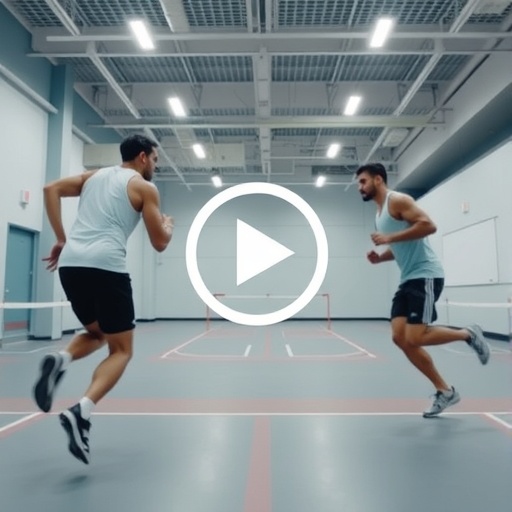
In a significant development for sports analytics, researchers Giovanini and Moura have introduced a novel method for the automatic tracking of indoor sports players. This groundbreaking study, set to transform how coaches and teams analyze player performance, employs advanced video-based deep learning techniques to enhance tracking capabilities in dynamic indoor environments. The implications of this research promise to extend beyond mere statistics, influencing coaching techniques and game strategies across various indoor sports, including basketball, volleyball, and badminton.
The challenge of accurately tracking player movements in cluttered and fast-paced indoor settings has long plagued sports technology. Traditional tracking methods, often reliant on manual observation or rudimentary automation, struggle to keep pace with the rapid action typical of indoor games. The innovative approach proposed by Giovanini and Moura leverages sophisticated deep learning algorithms capable of processing and analyzing real-time data with unprecedented speed and accuracy. In sports where rapid reflexes and swift decision-making are vital, precise tracking becomes essential.
Central to their methodology is a deep learning architecture designed to identify and track players within video footage. By utilizing extensive datasets of labeled player movements, the researchers trained their model to differentiate between individual athletes, even in visually complex scenarios. This capability meets the growing demand for data-driven performance analysis, providing coaches with invaluable insights into player efficiency and interaction during games.
A critical aspect of the research is its focus on the concurrent validity of the tracking system. By comparing automated tracking performance against established methodologies, Giovanini and Moura aim to demonstrate that their system is not only reliable but superior to existing technologies. This validation process ensures that their findings are robust, paving the way for practical applications in sports engineering. The empirical studies conducted aim for a seamless transition from research to real-world implementation.
The potential deployment of this technology could drastically alter how coaches prepare for competitions. Beyond insights into player positioning and movement patterns, the system allows for an in-depth analysis of gameplay dynamics. Coaches will be able to dissect strategies with precision, understanding how spatial arrangements can impact game outcomes. Such detailed analysis encourages a culture of continuous improvement, as teams embrace a more scientific approach to both training and gameplay.
Moreover, this research addresses pressing concerns regarding player health and safety. The data generated from the tracking system can yield critical insights into player fatigue and potential injury risks. By monitoring movement patterns over time, trainers can identify athletes at risk and implement preventative measures, thereby revolutionizing how teams manage athlete workloads and recovery protocols.
The researchers emphasize the adaptability of their deep learning tracking system to various indoor sporting environments, aiming for minimal adjustments. This flexibility means that schools, athletic trainers, and professional teams can benefit from the technology without requiring extensive infrastructure changes.
The growing public interest in sports technology underscores the demand for innovative solutions among fans and stakeholders. Spectators are increasingly eager for enhanced live coverage that integrates real-time player tracking data. With automated systems like this, sports venues can provide fans with immediate access to analytics on player performance, significantly enriching the viewing experience. This technology holds potential applications not only in professional leagues but also in amateur competitions and youth sports programs, making it universally relevant.
Published in the journal “Sports Engineering,” the study by Giovanini and Moura opens avenues for further exploration of deep learning capabilities in sports analytics. Their commitment to developing reliable, efficient, and scalable tracking solutions marks a potential shift in the sports industry’s approach to player movement analysis. The results may inspire increased focus on artificial intelligence applications within sports engineering.
Additionally, the research sets the stage for future endeavors in deep learning technologies. As demand for data-driven insights in sports escalates, the framework established by these researchers serves as a foundational example. Future studies may adapt and extend these principles to areas such as crowd management, referee assistance, and fan engagement strategies.
The concept of engaging with a broader data ecosystem emerges from this research. By utilizing open datasets and fostering collaboration among various sports institutions, developers can enhance model accuracy through diverse movement pattern training across multiple sports disciplines. This collaborative spirit could catalyze innovation, leading to further breakthroughs in automated analysis.
In conclusion, the significance of this research lies not only in its technical achievements but also in its embodiment of the intersection between sports, technology, and data analytics. The groundwork laid by Giovanini and Moura heralds a new era of innovations, positioning this nascent field for exploration. As the sports world increasingly turns to technology for enhancing performance, ensuring athlete safety, and maintaining fan interest, studies like this will form the backbone of that evolution.
As research progresses, the insights gained are expected to have a lasting impact on the foundations of sports technology. The anticipation surrounding the comprehensive findings of this study is palpable, as players, coaches, and fans alike await tangible results from this groundbreaking exploration.
See also AI Tool Accelerates Seal Population Studies, Cutting Data Processing Time from Hours to Seconds
 Yann LeCun Reveals Reasons for Leaving Meta and Critiques LLM Focus Amid AI Shift
 Chonnam National University Launches AI Campus Initiative, Offering 8 Tools to 30,000 Users
 Korean Study Reveals 94% of AI Chatbots Provide Unsafe Medical Advice Amid Vulnerabilities
 NextNRG Validates AI-Driven Grid Intelligence with Peer-Reviewed Research Expansion